3.14 - Electromagnetism
The magnetic field around a current-carrying wire
- Whenever an electric current flows through a wire, a magnetic field is created around it.
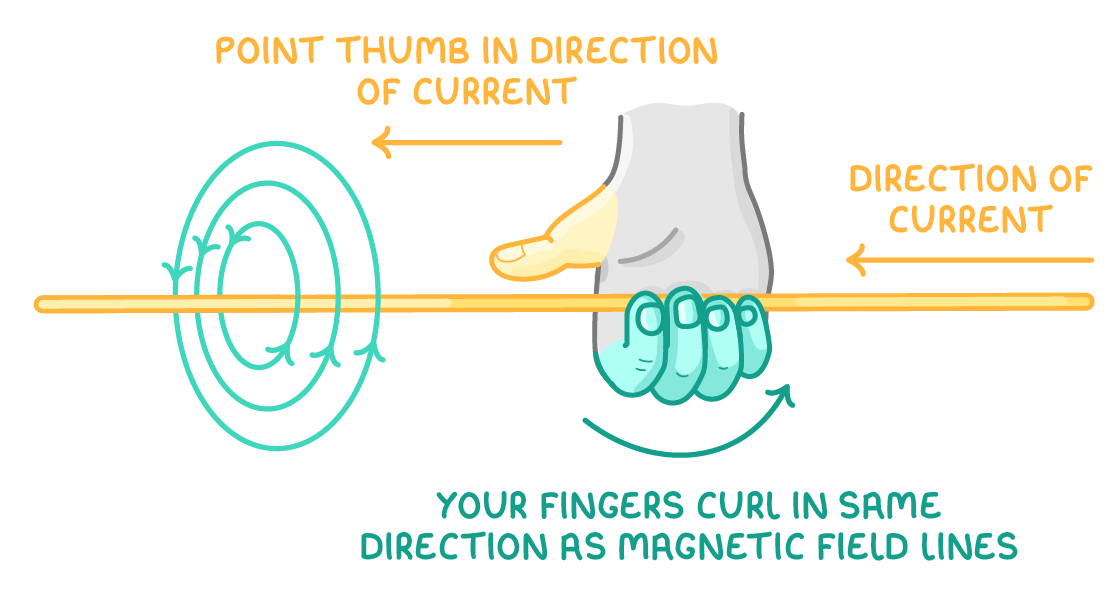
- Around a long, straight current-carrying wire the field is made up of concentric circles, lying in planes perpendicular to the wire, with the wire at their centre.
- This pattern can be shown with small plotting compasses placed around the wire: as current flows, each compass lines up along a circle, tracing the field direction.
The right-hand thumb rule
- Point the thumb of the right hand in the direction of the current and curl the fingers around the wire.
- The fingers then point in the direction of the magnetic field.
- Reversing the current reverses the field.
Field strength
The field strength depends on two things:
- Size of the current - A larger current produces a stronger field.
- Distance from the wire - The field is stronger closer to the wire and weaker further away.
Solenoids and electromagnets
Coiling the wire strengthens the field
- The magnetic field of a single current-carrying wire is fairly weak. It can be made much stronger by wrapping the wire into a coil.
- A coil of wire is called a solenoid.
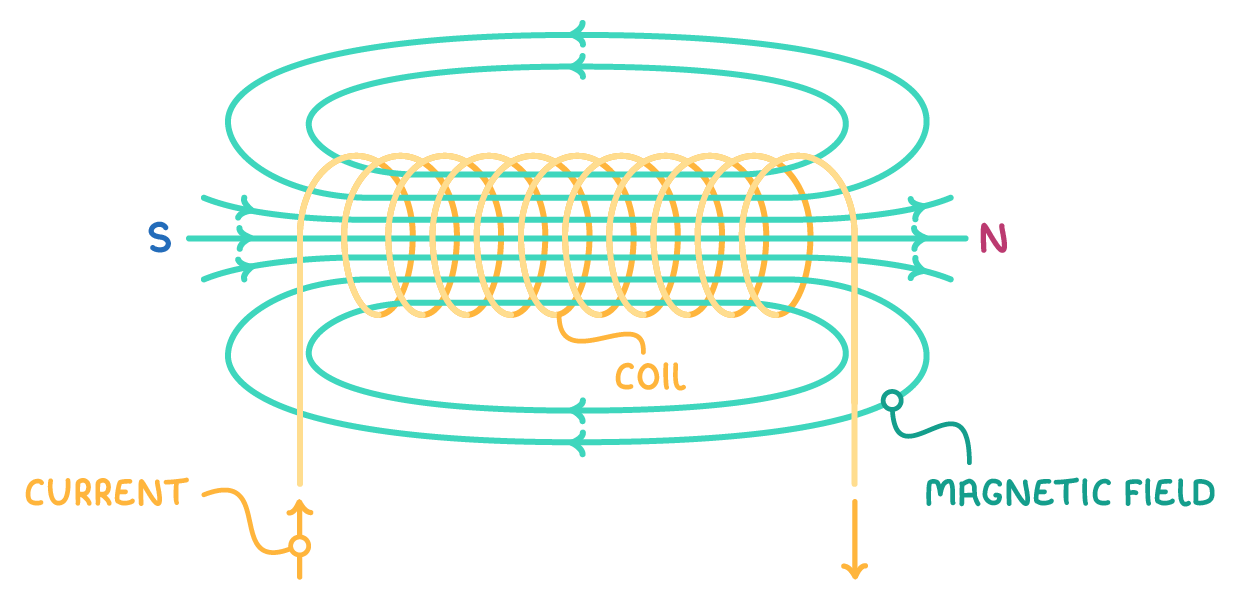
- The field lines around each turn line up and add together, giving:
- A strong, uniform field inside the solenoid, where the field lines are parallel and evenly spaced.
- A field outside the coil that has the same shape as a bar magnet's.
- One end of the solenoid behaves as a north pole and the other as a south pole. Reversing the current reverses the poles.
- To find the north pole, curl the fingers of the right hand around the coil in the direction of the current. The thumb then points to the north pole (the right-hand grip rule).
Increasing the field strength
- Increasing the current through the coil.
- Increasing the number of turns of wire.
- Adding an iron core inside the coil.
The electromagnet
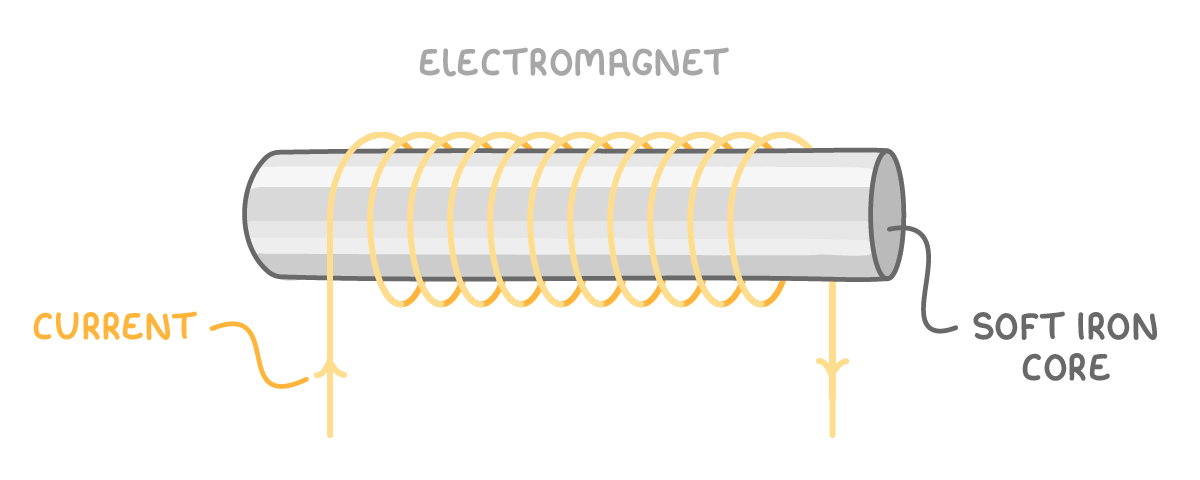
- Placing a soft iron core inside the solenoid greatly increases the magnetic field.
- The soft iron is easily magnetised to become an induced magnet while the current flows, and quickly loses its magnetism when the current is switched off.
- An electromagnet is a solenoid with an iron core: a magnet whose field can be switched on and off, and varied in strength by changing the current.
Plotting the field of a solenoid
- Place a piece of card across the middle of the solenoid.
- With a current flowing, sprinkle iron filings or use a plotting compass on the card to trace the magnetic field lines.
Uses of electromagnets
- Electromagnets can be switched on and off and their strength can be varied, making them useful in many devices.
- A permanent magnet produces a magnetic field all the time and needs no power supply, which is better when a continuous field is needed without an electrical circuit.
Cranes
- Used in scrap yards to pick up, move and drop magnetic materials like iron and steel.
- Turning the current on picks the metal up; switching it off drops it.
Relays
A relay uses a small current in one circuit to safely switch on a much larger current in a separate circuit:
- A switch closes in the low-current circuit, turning on the electromagnet.
- The electromagnet attracts an iron armature on a pivot (the rocker).
- The rocker pivots and pushes the contacts together in the high-current circuit, turning it on.
Examples:
- Relays are used in car ignition circuits to protect the driver from the high currents needed by the starter motor.
- Electromagnets are also used in electric bells and security door locks.
TermDefinition
SolenoidA coil of wire that produces a magnetic field when an electric current flows through it.
ElectromagnetA coil of wire (a solenoid), usually with an iron core, whose magnetic field can be switched on and off by changing the current.
RelayAn electrically operated switch that lets a small current in one circuit switch on a much larger current in a separate circuit.
Key points to remember
How were these notes?