1.19 - Seismic Waves
Earthquakes produce seismic waves - P, S and surface waves
- An earthquake produces seismic waves that travel out through the Earth.
- At a boundary between layers of different properties (such as density), part of the wave is absorbed and part is refracted.
- Where properties change gradually, the wave changes speed gradually and follows a curved path.
- Where properties change suddenly, the speed changes abruptly and the path takes a sharp kink.
The three types of seismic wave
| P-waves | S-waves | Surface waves | |
|---|---|---|---|
| Type | Longitudinal | Transverse | Travel along the Earth's surface |
| Travels through | Solids and liquids | Solids only | Along the surface, moving the ground up and down |
| Speed | Faster than S-waves | Slower than P-waves | Slowest of the three; cause the most damage |
Because P-waves and S-waves travel differently through different materials, comparing where each type is and isn't detected reveals what the inside of the Earth is made of.
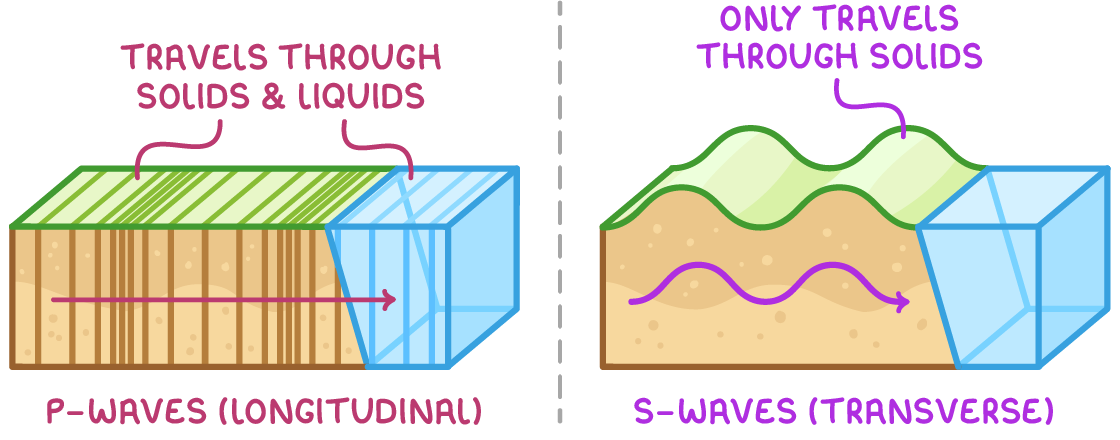
Surface waves are not shown: they travel along the surface, not through the Earth.
Seismometers and the Earth's internal structure
- Seismometers detect seismic waves at the Earth's surface.
- When an earthquake happens, scientists record:
- The time the waves take to reach each seismometer.
- Which parts of the surface receive no waves at all.
- By studying how the waves are absorbed and refracted, they work out where the Earth's properties change sharply to identify the boundaries between its layers.
The current model of the Earth
- A thin crust at the surface.
- An almost-solid mantle beneath it that flows very slowly.
- A liquid outer core.
- A solid inner core.
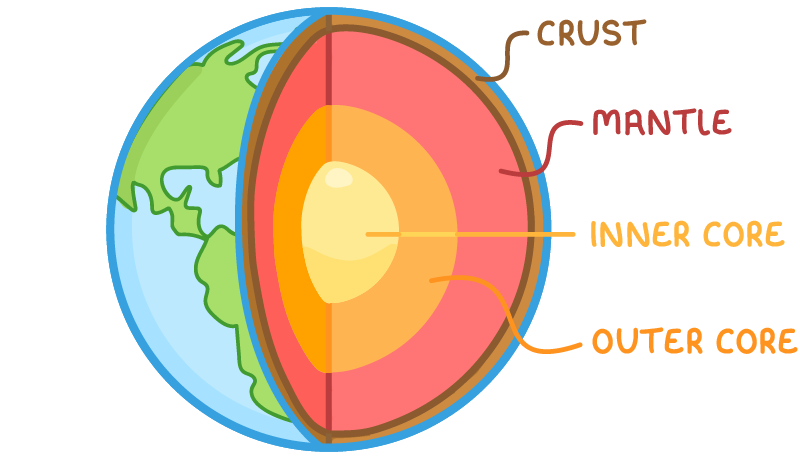
P-wave and S-wave shadow zones reveal the core
P-waves
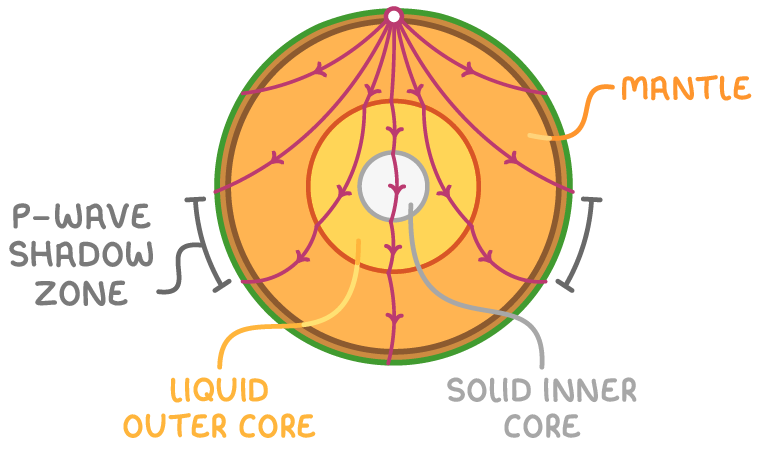
- P-waves travel through both solids and liquids, so they pass right through the core.
- As they cross the mantle and the core, refraction bends their paths.
- At the curved boundaries this leaves a ring-shaped P-wave shadow zone where no P-waves arrive, seen in cross-section as a band on each side of the Earth.
- Measuring its size and position reveals the structure of the core.
S-waves
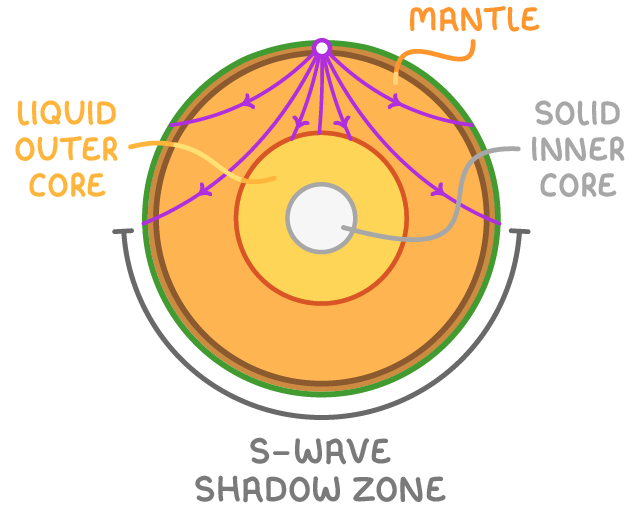
- S-waves are transverse and cannot travel through a liquid, so they can't pass through the liquid outer core at all.
- This leaves a large S-wave shadow zone on the far side of the Earth, where no S-waves are detected.
- The disappearance of S-waves is the key evidence that the outer core is liquid, and the size of the shadow zone reveals the size of the core.
TermDefinition
Seismic waveA wave produced by an earthquake that travels out through the Earth.
P-waveA longitudinal seismic wave that travels through both solids and liquids.
S-waveA transverse seismic wave that travels only through solids.
Surface waveA slow seismic wave that travels along the Earth's surface.
SeismometerAn instrument used to detect and record seismic waves at the Earth's surface.
Shadow zoneAn area on the Earth's surface where a certain type of seismic wave is not detected.
Key points to remember
How were these notes?