3.18 - Alternators & Dynamos
Alternators generate alternating current
- A generator uses movement to induce a current, doing the reverse of a motor.
- An alternator is a generator that produces an alternating current.
How an alternator works
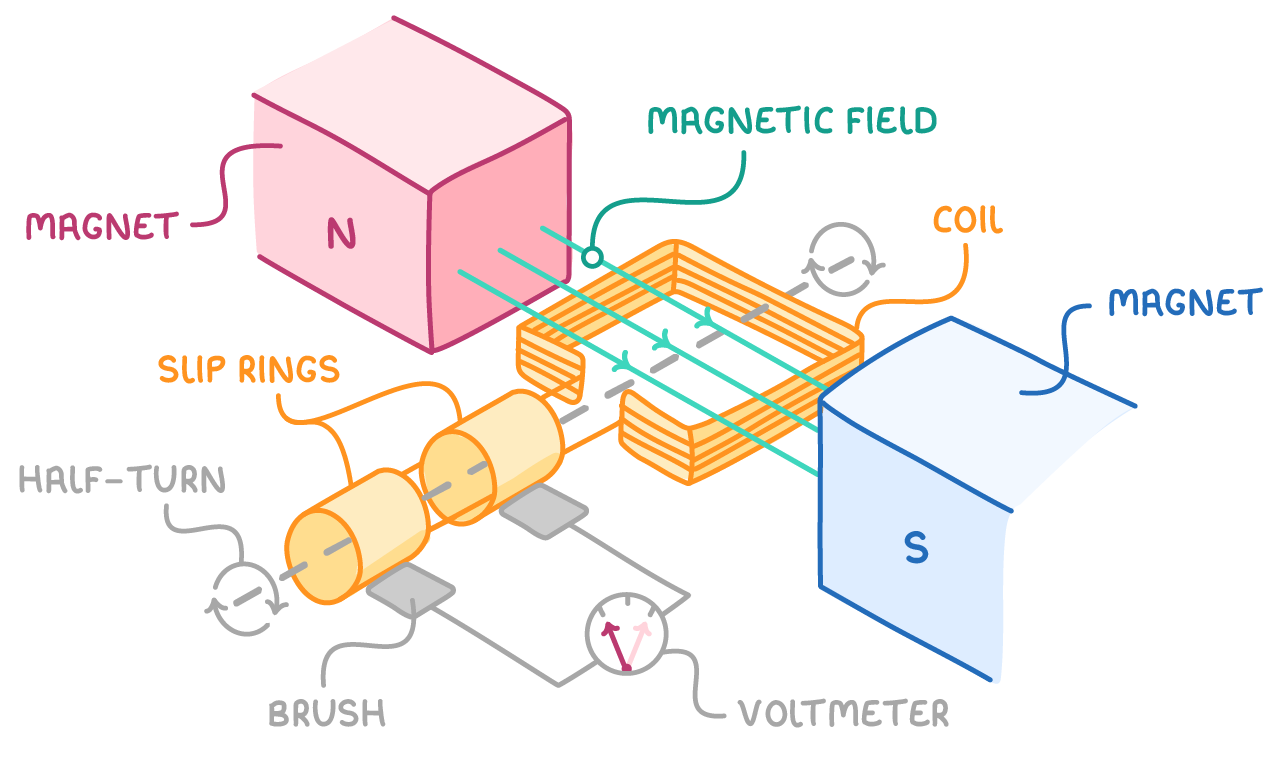
- A coil of wire rotates in a magnetic field, or a magnet rotates inside a coil of wire.
- As the coil (or magnet) turns, it cuts through the magnetic field lines, inducing a potential difference across the ends of the coil.
- If the coil is part of a complete circuit, this drives a current.
- The induced potential difference changes direction every half turn, because each side of the coil reverses the direction it moves through the field.
- The output is an alternating potential difference, which drives an alternating current.
Slip rings and brushes
- An alternator uses slip rings and brushes to keep the output alternating.
- A slip ring is fixed to each end of the coil and rotates with it.
- Each slip ring stays in continuous contact with a brush, which doesn't rotate and connects to the rest of the circuit.
- The brushes stay in contact with the same end of the coil throughout, so the connection is never swapped over.
Factors that increase the generator output
The size of the induced potential difference (and current) can be increased by:
- Spinning the coil or magnet faster, so the field lines are cut at a greater rate
- Using more turns of wire on the coil
- Using a stronger magnetic field
- Increasing the area of the coil
- Adding a soft iron core inside the coil
Reversing the direction of rotation reverses the direction of the induced potential difference, but doesn't change its size.
Dynamos generate direct current
- A dynamo is a generator that produces a direct current.
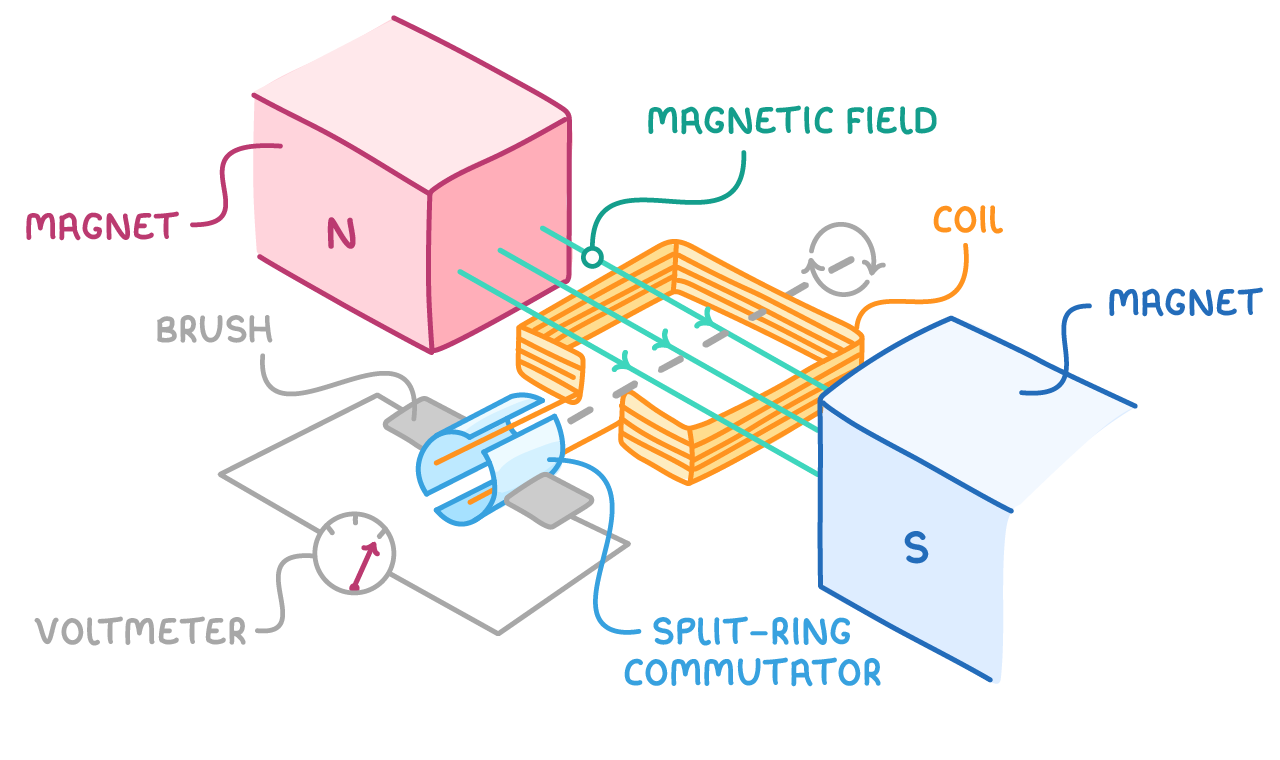
- It works the same way as an alternator, but uses a split-ring commutator instead of slip rings.
How the commutator gives direct current
- As the coil rotates, the induced potential difference reverses direction every half turn.
- The split-ring commutator swaps the connections to the circuit every half turn.
- Because the swap happens in step with the reversal, current always flows the same way through the circuit, producing a direct current.
The generator output on an oscilloscope
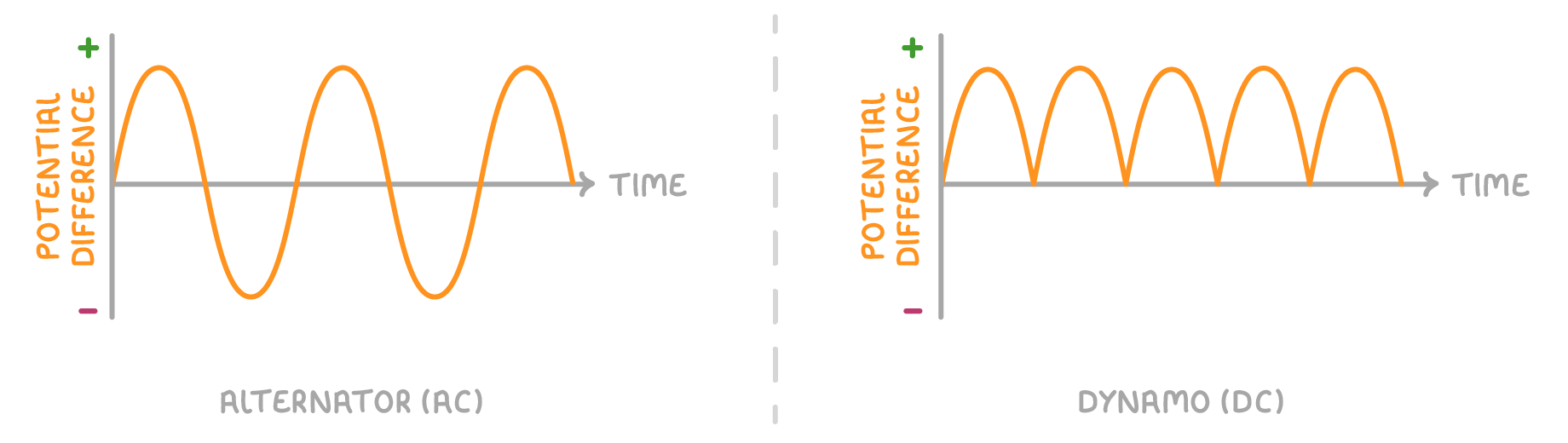
An oscilloscope plots the potential difference produced by a generator against time.
Alternator vs dynamo traces
- Alternator - The trace is a wave that crosses the time axis, swinging between positive and negative peaks.
- Dynamo - The trace stays on one side of the axis, rising and falling in pulses because the output is always in the same direction.
Why the output rises and falls
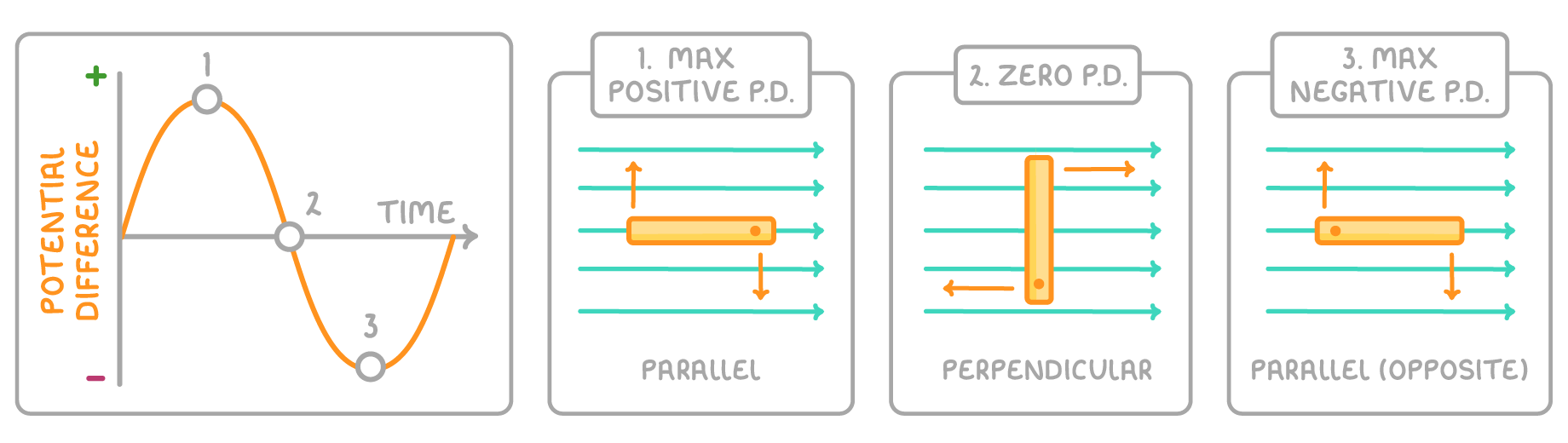
- The induced potential difference is greatest when the plane of the coil is parallel to the field lines - its sides cut the lines at the fastest rate, producing the peaks on the trace.
- The induced potential difference is zero when the plane of the coil is perpendicular to the field lines - its sides move along the lines rather than cutting them.
Effect of spinning faster
- Taller peaks - The field lines are cut faster, inducing a larger potential difference.
- More peaks per second - The coil completes more rotations each second, increasing the frequency.
TermDefinition
GeneratorA device that uses movement to induce a current.
AlternatorA generator that produces an alternating current.
Slip ringA continuous ring fixed to the end of a rotating coil that stays in contact with a brush.
DynamoA generator that produces a direct current.
Split-ring commutatorA split ring that reverses the connections between a rotating coil and the circuit every half turn, which keeps a motor turning one way or makes a dynamo give direct current.
OscilloscopeAn instrument that displays how a potential difference changes with time, as a graph of potential difference against time. It is also called a cathode ray oscilloscope.
Key points to remember
How were these notes?