6.13 - The Solar System
The Solar System and the objects in it
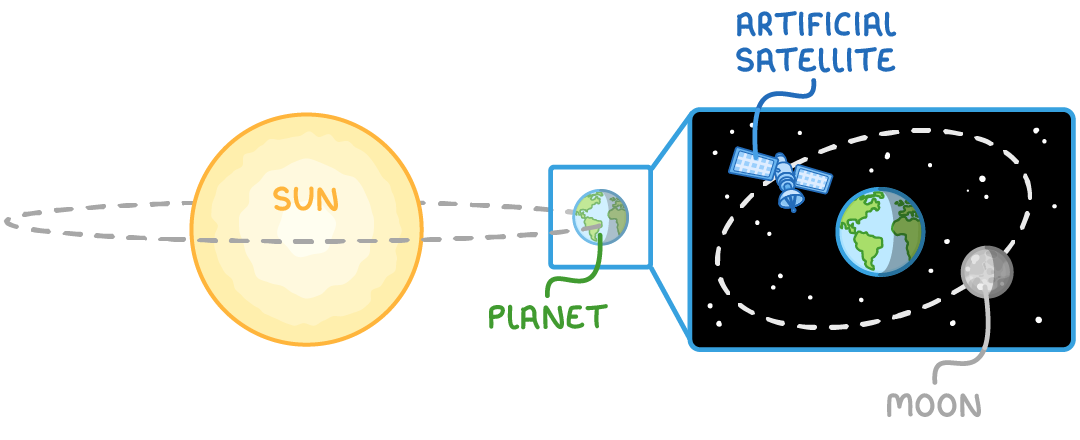
- The Solar System is the Sun together with everything that orbits it.
- At its centre is the Sun, our nearest star: a hot sphere of gas.
Objects that orbit the Sun
- Planets - Large bodies that orbit the Sun; they differ in size, in distance from the Sun and in what they're made of.
- Moons - Natural satellites: bodies that orbit a planet, the way planets orbit the Sun.
- Artificial satellites - Objects humans have built and put into orbit, most of which orbit the Earth.
A satellite is any object that orbits a larger one, so both moons (natural satellites) and artificial satellites are types of satellite.
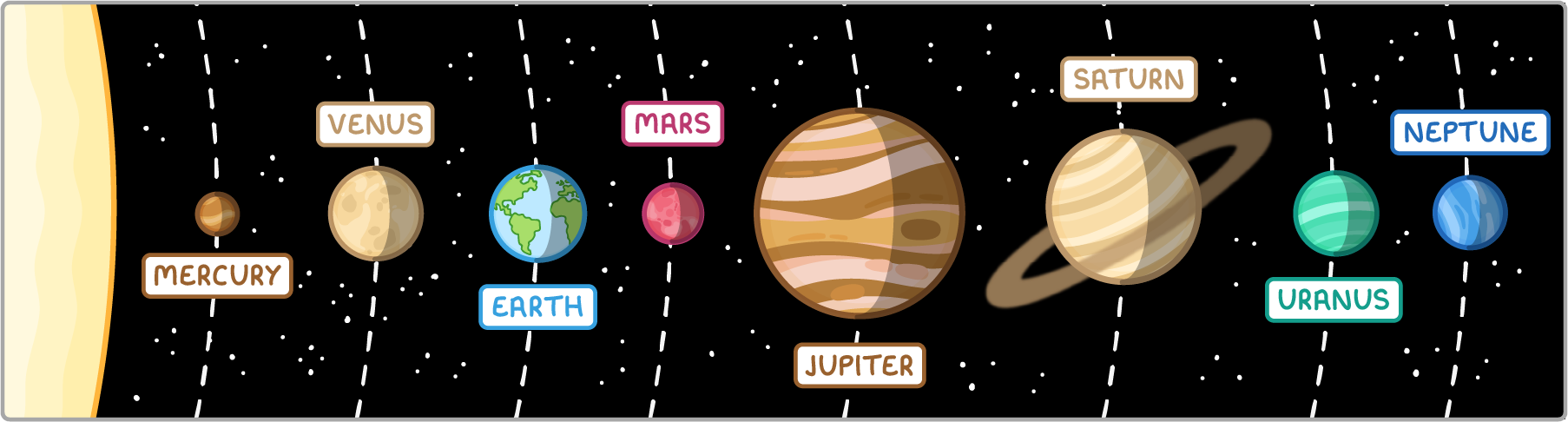
The eight planets in order from the Sun
- There are eight planets in the Solar System.
- In order of distance from the Sun, moving outwards: Mercury, Venus, Earth, Mars, Jupiter, Saturn, Uranus and Neptune.
- The four inner planets (Mercury, Venus, Earth, Mars) orbit closest to the Sun.
- The four outer planets (Jupiter, Saturn, Uranus, Neptune) lie beyond the asteroid belt.
- All eight orbit the Sun in roughly the same plane.
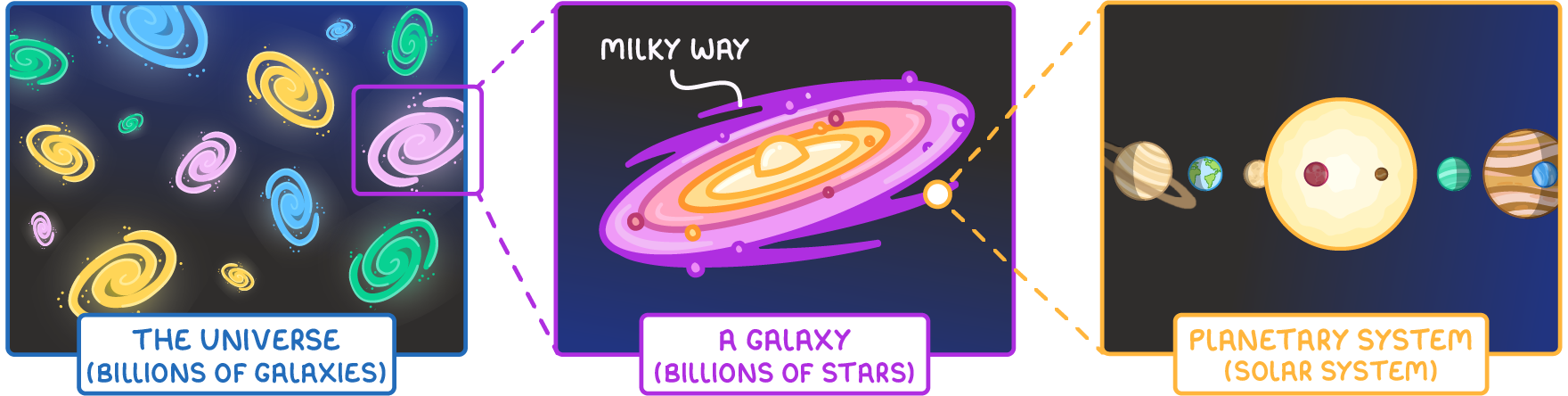
Galaxies and the scale of the Universe
- A galaxy is a huge collection of billions of stars, held together by gravity.
- Our galaxy is the Milky Way. The Sun is just one of its many billions of stars, lying about halfway along one of its spiral arms.
- Other stars in the Milky Way are vastly further from Earth than the Sun is, which is why they appear as tiny points of light while the Sun looks large and bright.
- Distances between neighbouring stars are typically hundreds of thousands of times greater than the distance from the Earth to the Sun.
The Universe
- The Milky Way is just one of billions of galaxies. Together, all of these galaxies make up the Universe.
- Galaxies are separated by even larger distances than the stars within them, so the Universe is mostly empty space.
- The ladder of scale:
- The Universe contains billions of galaxies.
- Each galaxy contains billions of stars.
- Around a star like the Sun lies a planetary system.
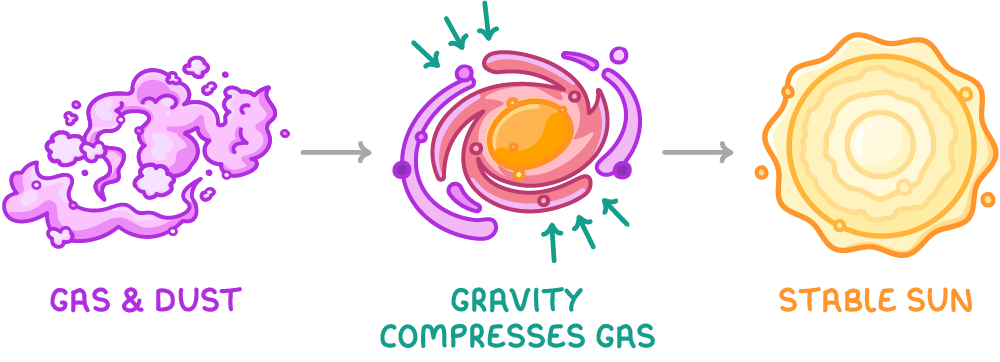
Formation of the Solar System
- The Solar System formed from a vast cloud of dust and gas spread through space.
- Gravity pulled this material together:
- Most of it collected at the centre to form the Sun.
- The rest settled into the planets and smaller bodies that orbit it today.
Doing work on a gas raises its temperature
Doing mechanical work on a gas raises its internal energy and temperature.
Compressing a gas in a pump
- Compressing a gas requires doing work against the outward pressure of the gas.
- This work transfers energy to the kinetic energy stores of the gas particles, so they move faster on average.
- Faster particles mean a higher temperature, which is why a pump feels warm after use.
How this helped form the Solar System
- The Solar System began as a vast cloud of dust and gas.
- As gravity squeezed the gas at the centre into a smaller volume, work was done compressing it.
- This compression raised the temperature of the gas until the centre was hot enough for the Sun to form.
The Sun's stable size
- Once the core became hot enough, hydrogen nuclei began to fuse.
- The energy released by fusion creates an outward radiation pressure.
- This outward push is balanced by the inward pull of gravity, keeping the Sun at a stable size.
TermDefinition
Solar SystemThe Sun together with everything that orbits it.
PlanetA large body that orbits a star.
MoonA natural satellite that orbits a planet.
Artificial satelliteA satellite that humans have built and put into orbit.
GalaxyA huge collection of billions of stars, held together by gravity.
Key points to remember
How were these notes?