2.12 - AC & DC Current
Alternating and direct current
There are two types of electric current: alternating current (a.c.) and direct current (d.c.).
Direct current
- In direct current, the charges move in one direction only, so the current always flows the same way around the circuit.
- It's produced by a direct potential difference - a p.d. that stays positive, or stays negative, rather than switching between the two.
- Cells and batteries supply direct current.
Alternating current
- In alternating current, the current is constantly changing direction, flowing back and forth around the circuit.
- It's produced by an alternating potential difference, in which the positive and negative ends keep swapping over.
- The mains electricity supplied to homes is an alternating current.
UK mains supply
- The UK mains supply is an alternating current supply at about 230 V.
- Its frequency is 50 Hz (50 cycles per second).
Showing a.c. and d.c. on an oscilloscope trace
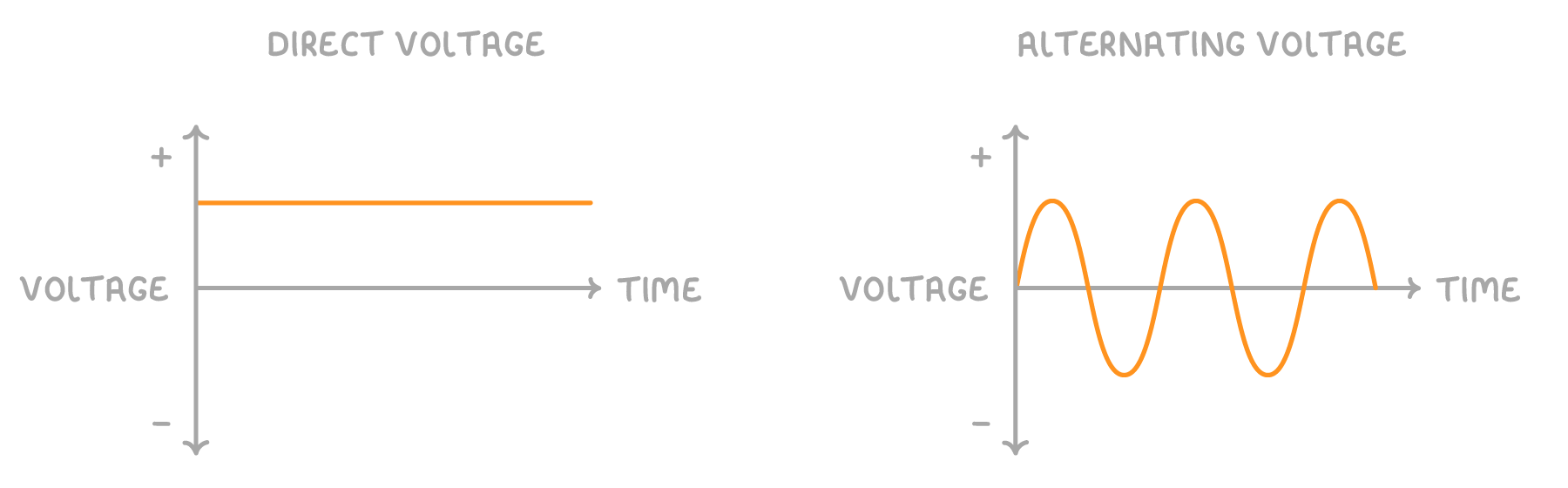
A cathode ray oscilloscope (CRO) displays how potential difference changes with time, so the trace it draws is a graph of voltage against time.
Reading the traces
- Direct voltage - Gives a horizontal straight line, because the p.d. doesn't change with time. The height of the line above the centre line shows the size of the d.c. p.d.
- Alternating voltage - Gives a wave that rises and falls in a regular, repeating pattern, going positive for part of the time and negative for the rest.
- Graphs of current against time have the same shape as the corresponding voltage-against-time traces.
TermDefinition
Direct currentA current where the charges move in one direction only, flowing the same way around the circuit.
Alternating currentA current that is constantly changing direction, flowing back and forth around the circuit.
Direct potential differenceA potential difference that stays positive or stays negative, rather than switching between the two.
Alternating potential differenceA potential difference in which the positive and negative ends keep swapping over.
OscilloscopeAn instrument that displays how a potential difference changes with time, as a graph of potential difference against time. It is also called a cathode ray oscilloscope.
Key points to remember
How were these notes?