3.1 - Static Electricity - Charging
Charging an insulator by friction
- Atoms are built from positive protons and negative electrons. Most objects have equal numbers of each, so they have zero net charge - they're neutral.
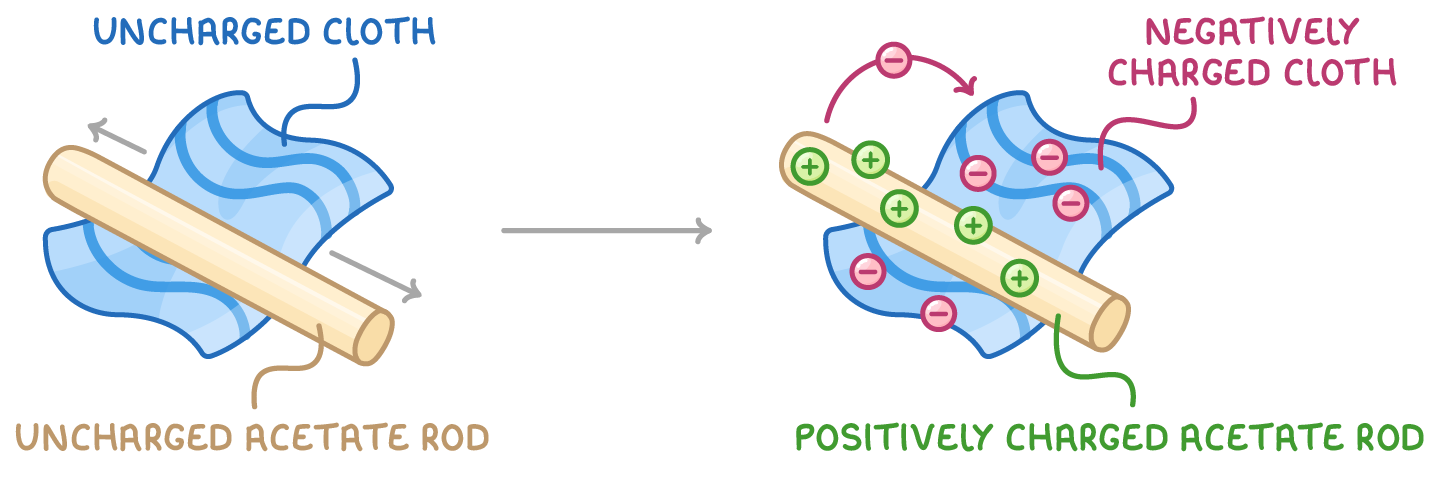
- When two insulating materials are rubbed together, negatively charged electrons are transferred from one to the other.
- Insulators don't let charge flow, so transferred electrons stay trapped where they land. This trapped charge is static electricity.
Which material gains which charge
- The material that gains electrons is left with a negative static charge.
- The material that loses electrons is left with an equal positive static charge.
- Only negative electrons move - positive charges don't. An object becomes positively charged only because electrons have moved away from it.
Polythene and acetate rods
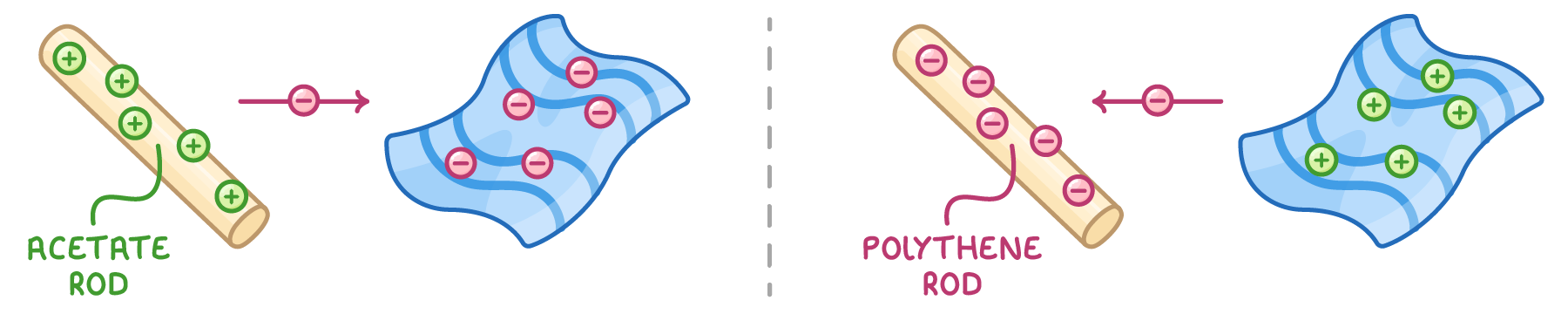
- Polythene rod - Rubbing transfers electrons from the cloth onto the rod, leaving the rod negatively charged.
- Acetate rod - Rubbing transfers electrons from the rod onto the cloth, leaving the rod positively charged.
Like charges repel, opposite charges attract
- When two charged objects are brought close, they exert a non-contact electrostatic force on each other.
- Opposite charges (one positive, one negative) attract each other.
- Like charges (both positive or both negative) repel each other.
- The force gets weaker the further apart the objects are.

Testing charge with a suspended rod
- Suspend a rod of known charge from a thread so it can swing freely.
- Bringing up an object with the same charge repels the rod (pushes it away).
- Bringing up an object with the opposite charge attracts the rod (pulls it towards it).
Too much static causes a spark
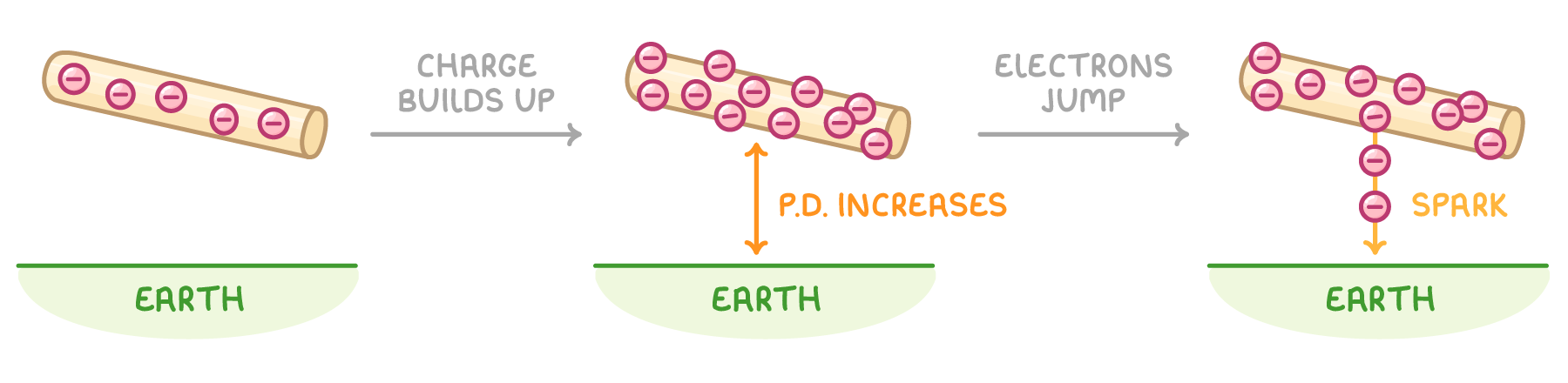
- As charge builds up on an isolated object, the potential difference between the object and the earth (at 0 V) gets larger.
- If the potential difference becomes large enough, electrons can jump across the gap to the earth or a nearby earthed conductor as a spark.
- Lightning is a very large spark between a charged cloud and the ground.
Discharging safely to earth
- A charged conductor can be discharged safely (earthed) by connecting it to earth with a metal strap or wire.
- If negatively charged, electrons flow down the strap to the ground.
- If positively charged, electrons flow up the strap from the ground to neutralise it.
TermDefinition
Static electricityElectric charge that builds up on an object and stays there because it cannot flow away, usually on an insulator.
Electrical insulatorA material that does not allow electric charge to flow through it easily.
Key points to remember
How were these notes?