1.10 - The Greenhouse Effect
The greenhouse effect keeps the Earth warm
- Some gases in the atmosphere are greenhouse gases - the main ones are carbon dioxide (CO2), methane, and water vapour.
- These gases trap radiation in the atmosphere, keeping the Earth warm enough to support life.
- The warming they cause is called the greenhouse effect.
How the greenhouse effect works
- Radiation from the Sun reaches the Earth and warms its surface.
- The Earth emits radiation of its own back towards space.
- Greenhouse gases absorb some of this outgoing radiation and re-emit part of it back down towards the surface, rather than letting it all escape.
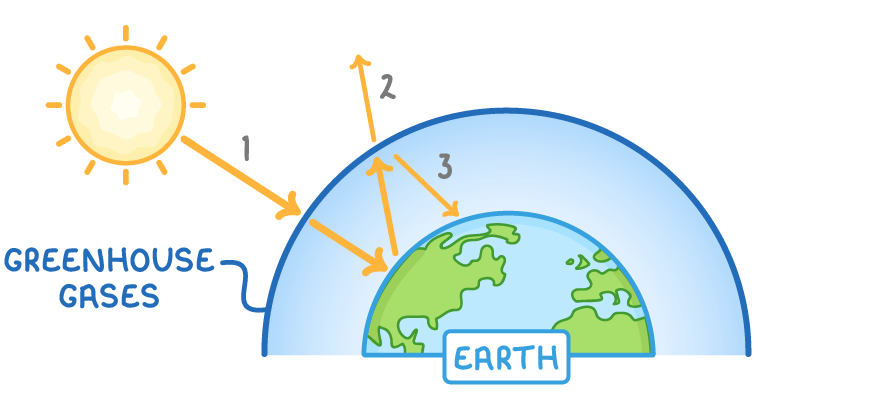
How greenhouse gases trap heat
The Sun and the Earth emit radiation at different frequencies, and greenhouse gases absorb one but not the other.
The Earth emits lower-frequency radiation than the Sun
- The frequency of radiation an object emits depends on how hot it is.
- The Earth is much cooler than the Sun, so the radiation it emits is mostly at a lower frequency than the radiation arriving from the Sun.
Greenhouse gases absorb the Earth's radiation, not the Sun's
Greenhouse gases such as CO2 and methane absorb lower-frequency radiation:
- They absorb very little of the incoming radiation from the Sun, so it mostly passes straight through to warm the surface.
- They absorb a large amount of the lower-frequency radiation the Earth emits on its way back out.
The absorbed radiation is re-emitted in all directions
- Once greenhouse gases absorb radiation, they re-emit it in all directions - including back down towards the Earth's surface.
- Energy that would otherwise have escaped into space is sent back, so the surface stays warmer.
Human activities increase greenhouse gases
- Deforestation - Clearing forests leaves fewer trees to remove CO2 from the atmosphere.
- Burning fossil fuels - Releases locked-away carbon as CO2.
- Agriculture - Farm animals release methane during digestion.
- Creating waste - Waste decaying in landfill sites and on farms releases both CO2 and methane.
Rising carbon dioxide and climate change
- Over the last 200 years, the proportion of CO2 in the atmosphere has risen, mainly from burning fossil fuels and deforestation.
- Most scientists agree this extra CO2 is causing average global temperatures to rise (global warming).
- This warming leads to climate change - long-term shifts in weather patterns around the world.
Why climate change is hard to predict
- The Earth's climate is extremely complex with many variables, so it's difficult to build a model that isn't oversimplified.
- As more data is gathered, computer models are refined to make better predictions.
TermDefinition
Greenhouse gasA gas in the atmosphere, such as carbon dioxide or methane, that absorbs radiation emitted by the Earth.
Greenhouse effectThe warming of the Earth caused by greenhouse gases absorbing and re-emitting radiation back towards the surface.
Global warmingThe ongoing rise in average global temperatures, largely driven by an increase in greenhouse gases.
Climate changeLong-term shifts in weather patterns around the world.
Key points to remember
How were these notes?