3.20 - How Transformers Work
What a transformer is made of
- A transformer is a device used to change the size of an alternating voltage.
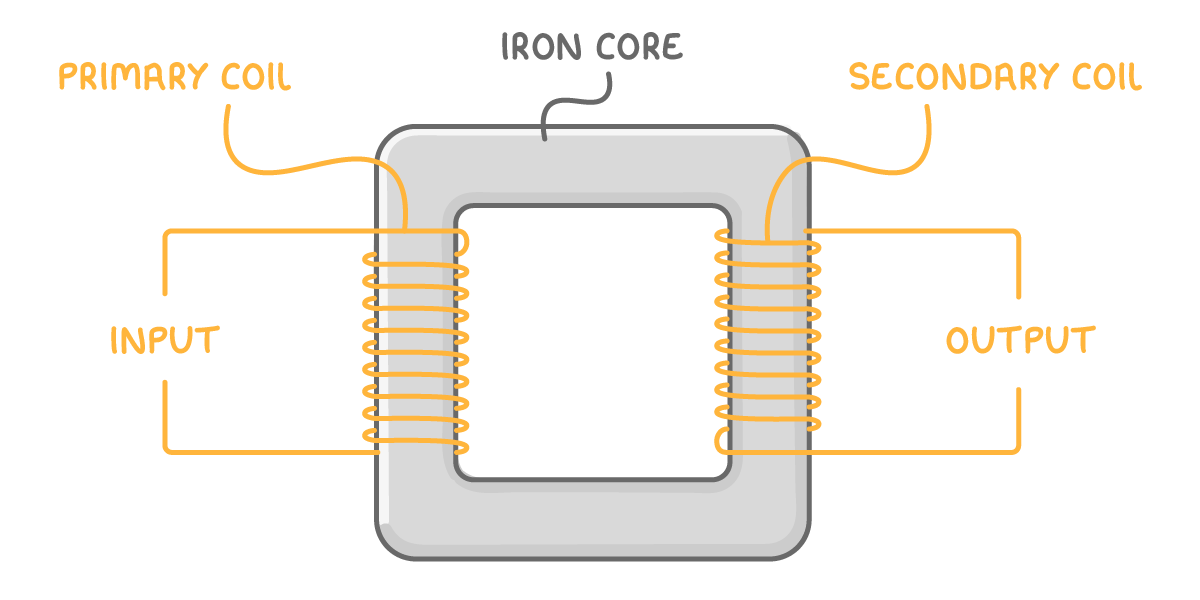
- Every transformer has three main parts:
- A primary coil, which the input voltage is connected across.
- A secondary coil, which provides the output voltage.
- An iron core, which both coils are wound around.
- The two coils are not joined electrically - there's no wire connecting them.
- The iron core links the two coils magnetically.
How a transformer changes the voltage
A transformer works by electromagnetic induction, and only works with alternating current.
Inducing a voltage in the secondary coil
- An alternating voltage across the primary coil drives an alternating current through it.
- This sets up a changing magnetic field in the iron core.
- The secondary coil is on the same core, so this changing magnetic field passes through it.
- A changing magnetic field induces an alternating voltage across the secondary coil (and an alternating current if it's part of a complete circuit).
Why iron and alternating current are used
- Iron is used because it's a magnetic material that's easily magnetised and demagnetised, so the magnetic field closely follows the alternating current.
- The input must be alternating current. A steady direct current gives a constant, unchanging magnetic field, which induces no voltage in the secondary coil.
Step-up and step-down transformers
- The number of turns on each coil decides whether the voltage increases or decreases:
- Step-up transformer - Increases the voltage. It has more turns on the secondary coil than the primary, so output voltage is greater than input voltage.
- Step-down transformer - Decreases the voltage. It has more turns on the primary coil than the secondary, so output voltage is smaller than input voltage.
- The coil with more turns has the larger voltage across it.
TermDefinition
TransformerA device that changes the size of an alternating potential difference (voltage).
Primary coilThe coil in a transformer that the input voltage is connected across.
Secondary coilThe coil in a transformer that provides the output voltage.
Electromagnetic inductionThe production of a potential difference (voltage) across a conductor when it moves relative to a magnetic field or when the magnetic field around it changes. It is also called the generator effect.
Step-up transformerA transformer that increases the potential difference (voltage) and decreases the current. It has more turns on its secondary coil than on its primary coil.
Step-down transformerA transformer that decreases the potential difference (voltage) and increases the current. It has fewer turns on its secondary coil than on its primary coil.
Key points to remember
How were these notes?