3.17 - Electromagnetic Induction
The generator effect - Inducing a potential difference
- The generator effect (or electromagnetic induction) is the production of a potential difference across a conductor when the conductor moves relative to a magnetic field, or when the magnetic field around the conductor changes.
- If the conductor is part of a complete circuit, this induced potential difference drives an induced current.
Situations that produce the effect
- A conductor and a magnetic field move relative to each other (e.g. moving a wire so it cuts across magnetic field lines, or moving a magnet in and out of a coil).
- The magnetic field through a conductor changes (getting stronger, weaker, or reversing), even without movement.
In both cases, field lines must be cut by the conductor.
- Moving a magnet into a coil gives a brief pulse of current while the magnet is moving.
- Once the magnet stops moving, there's no induced current because field lines are no longer being cut.
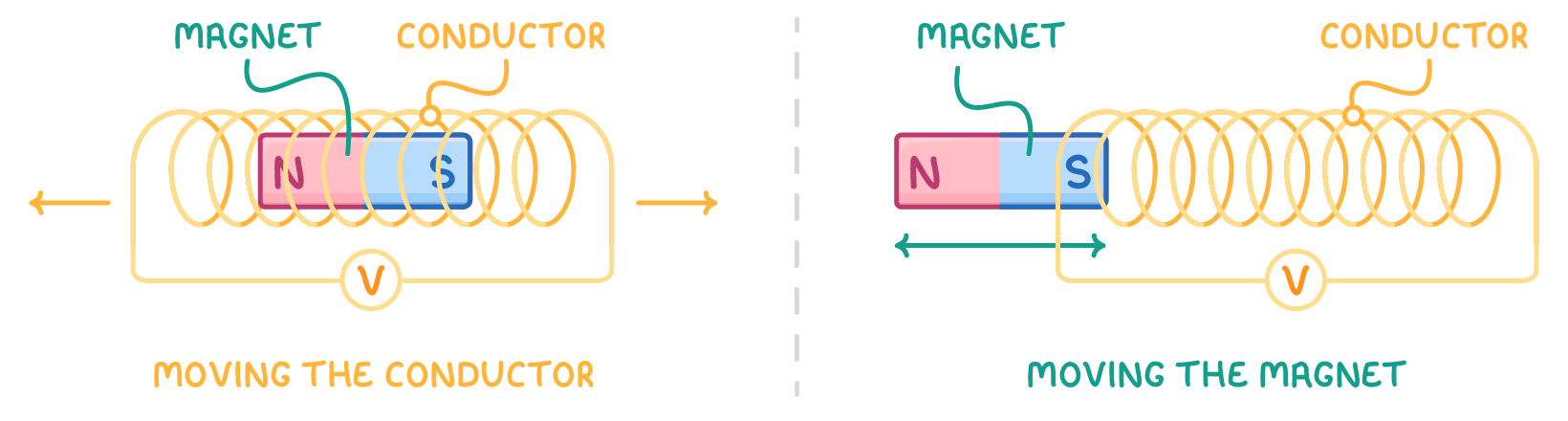
Direction of the induced potential difference and current
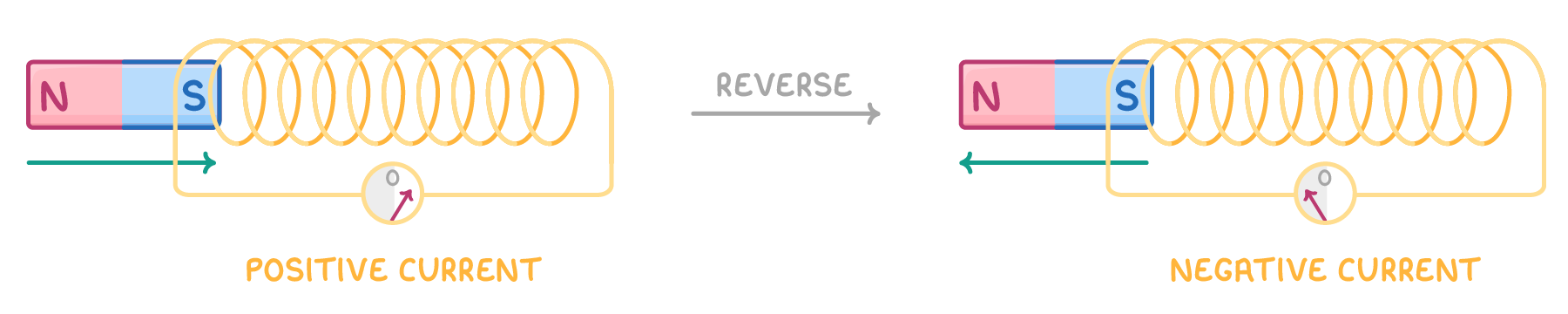
- Reversing the movement (pulling the magnet out instead of pushing it in) reverses the direction of the induced pd and current.
- Reversing the magnetic field (swapping the poles) also reverses the direction of the induced pd and current.
- Moving a magnet continuously backwards and forwards inside a coil produces an alternating current.
- Electromagnetic induction is the reverse of the motor effect: in the motor effect, a current in a field creates movement; in induction, movement in a field creates a current.
Inducing an alternating current by rotation
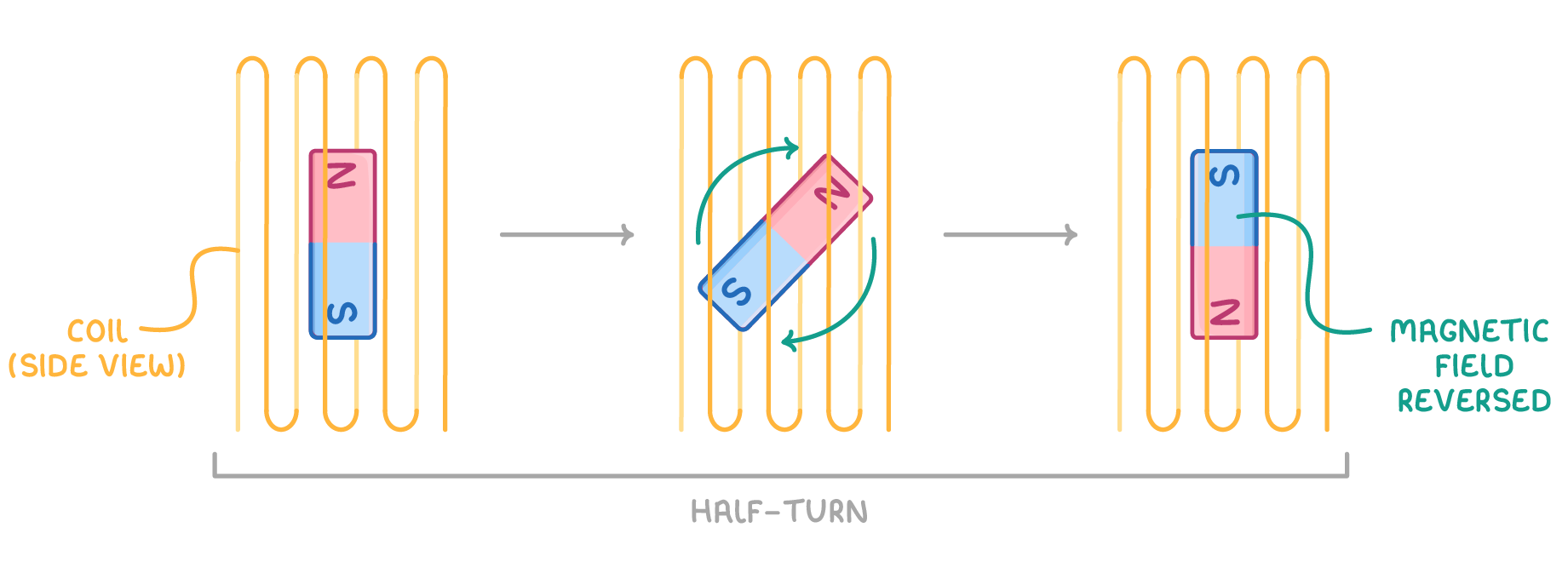
Rotating a coil inside a magnetic field, or rotating a magnet inside a coil, continually changes the magnetic field passing through the coil.
How rotation produces an alternating current
- As the magnet (or coil) turns, the magnetic field through the coil changes, inducing a potential difference (and a current in a complete circuit).
- After half a turn, the direction of the field through the coil has reversed, which reverses the direction of the induced pd and current.
- Continuous rotation makes the pd reverse every half turn, producing an alternating current.
This continuous rotation is the principle used in a generator.
Changing the size of the induced potential difference
The size of the induced potential difference and current can be increased by:
- Increasing the speed of the movement (or how fast the field changes)
- Increasing the magnetic field strength (e.g. using a stronger magnet)
- Increasing the number of turns on the coil
Each of these increases the rate at which magnetic field lines are cut.
The induced current opposes the change that made it
An induced current creates its own magnetic field that always opposes the change that produced it.
How this works
- Pushing a magnet's north pole into a coil induces a current that creates a north pole at that end of the coil, which repels the magnet.
- Pulling the magnet out reverses the induced current, creating a south pole that attracts the magnet back in.
- Work must be done to overcome this opposing force, and that work transfers energy into the electrical circuit.
TermDefinition
Electromagnetic inductionThe production of a potential difference (voltage) across a conductor when it moves relative to a magnetic field or when the magnetic field around it changes. It is also called the generator effect.
Key points to remember
How were these notes?