6.8 - Pressure Equation & How It Works
Pressure is force per unit area
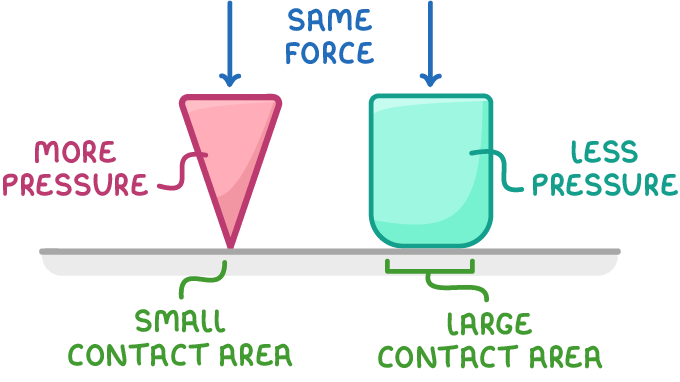
- Pressure tells you how concentrated a force is over the area it acts on.
- The same force over a small area gives a high pressure; over a large area it gives a low pressure.
- For example, a sharp knife concentrates force onto a tiny area to produce high pressure, while snowshoes spread weight over a large area to produce low pressure.
Fluid pressure
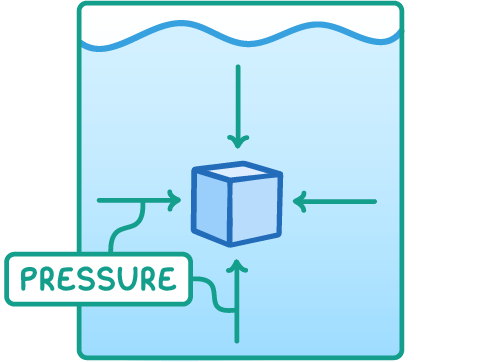
- Gases and liquids are both fluids - their particles are free to move around and flow.
- As particles move, they collide with surfaces and exert a force on them, creating pressure.
- The force from fluid pressure always acts normal (at right angles) to the surface.
Formula for pressure
Where:
- = Pressure, in pascals (Pa)
- = Force acting normal to the surface, in newtons (N)
- = Area of that surface, in square metres (m2)
The pressure on a surface is found from the force acting normal to the surface and the area of that surface.
Units:
- One pascal is one newton per square metre (1 Pa = 1 N/m2).
- 1 kilopascal (kPa) = 1,000 Pa.
- The same equation works for solids, liquids and gases.
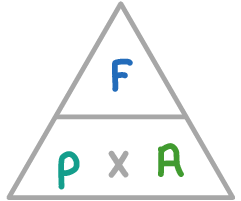
Cover the quantity you want to find to get the equation to use.
Worked example - Pressure from force and area
A box rests on the floor. It presses down with a force of 200 N over a contact area of 0.5 m2. Calculate the pressure the box exerts on the floor.
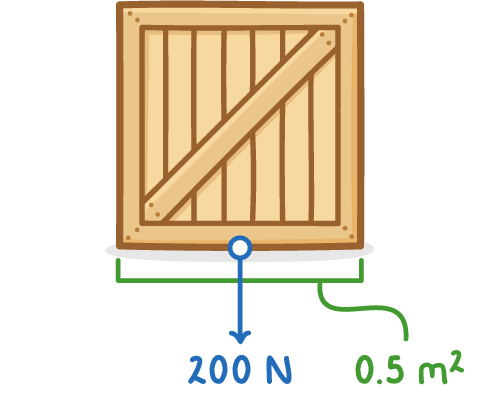
Step 1 - Formula
Step 2 - Substitution and calculation
The box exerts a pressure of 400 Pa on the floor.
TermDefinition
PressureThe force acting at right angles to a surface per unit area of that surface.
FluidA liquid or a gas, whose particles can move past one another so it can flow.
NormalA line drawn at right angles to a surface or boundary at the point where a ray or wave meets it. A force or pressure that acts at right angles to a surface is also said to act normal to it.
PascalA unit of pressure equal to one newton per square metre.
Key points to remember
How were these notes?