2.10 - Newton's 1st & 2nd Laws
Newton's First Law - Resultant force changes motion
- Newton's First Law - If the resultant force on an object is zero, its velocity doesn't change:
- A stationary object stays stationary.
- A moving object continues at the same velocity (same speed and direction).
- When an object is stationary or moving at a constant velocity, the forces on it are balanced.
- Velocity only changes if the forces are unbalanced, giving a non-zero resultant force that causes an acceleration in the direction of the force.

A non-zero resultant force can cause an object to:
- start moving
- stop moving
- speed up
- slow down
- change direction
Newton's Second Law - Acceleration and resultant force
- The larger the resultant force on an object, the more it accelerates - force and acceleration are directly proportional ().
- Acceleration is inversely proportional to mass: for a fixed resultant force, a larger mass accelerates less than a smaller one.
Formula for Newton's Second Law
Where:
- = Resultant force, in newtons (N)
- = Mass, in kilograms (kg)
- = Acceleration, in metres per second squared (m/s2)
is always the resultant force, found by adding or subtracting the forces acting along the same line.
Worked example - Acceleration of a car
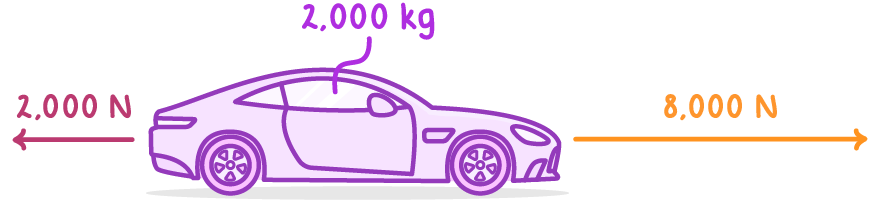
A car of mass 2,000 kg has an engine providing a driving force of 8,000 N. The drag force on the car is 2,000 N. Find its acceleration.
Step 1 - Work out the resultant force
The driving force and drag force act along the same line in opposite directions, so subtract them.
Step 2 - Rearrange F = ma for acceleration
Step 3 - Substitution and calculation
The car accelerates at 3 m/s2 in the direction of the resultant force.
Investigating Newton's Second Law
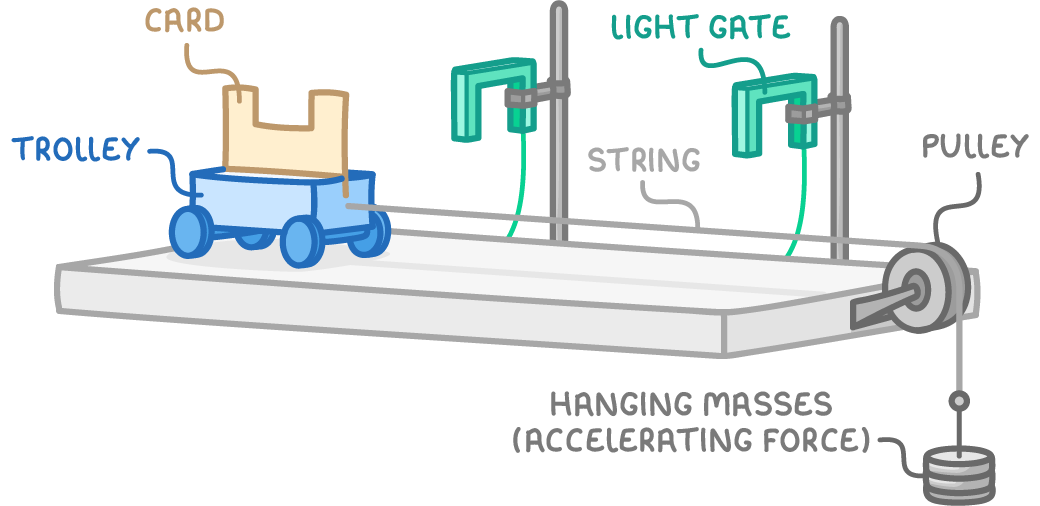
- The link between resultant force, mass and acceleration can be investigated using a trolley on a track.
- A hanging mass connected over a pulley provides the accelerating force, and light gates measure the trolley's acceleration.
Method
- Release the hanging mass so its weight pulls the trolley along the track.
- A card on top of the trolley interrupts the light gates as it passes, and the speed and time recorded are used to calculate the trolley's acceleration.
- To vary the force while keeping total mass constant, move masses one at a time from the trolley to the hanging mass and repeat.
- To vary the mass while keeping the force constant, add masses to the trolley and repeat.
Results
- Acceleration against resultant force (constant mass) is a straight line through the origin - acceleration is directly proportional to resultant force.
- Acceleration against 1/mass (constant force) is a straight line through the origin - acceleration is inversely proportional to mass.
Friction can be reduced with an air track, or compensated for by tilting the runway until the trolley rolls at constant speed when given a gentle push.
Inertia and inertial mass
- Inertia is the tendency of an object to continue in its current state of motion (at rest or moving at a constant velocity).
- The larger an object's mass, the larger its inertia, and the harder it is to change its velocity.
Inertial mass
- An object's inertial mass measures how difficult it is to change its velocity.
- It's defined as the ratio of resultant force to acceleration:
Large decelerations and vehicle safety features
- A large deceleration requires a large force ().
- Large decelerations are dangerous because the large forces can cause serious injuries, as well as:
- causing brakes to overheat and lose effectiveness
- causing the vehicle to skid
Increasing the collision time
Safety features increase the collision time, which reduces deceleration and lowers the force on passengers:
- Seat belts - Stretch slightly so the occupant slows down over a longer time
- Air bags - Compress to slow the occupant down gradually
- Crumple zones - Crumple on impact to increase the time taken to stop
When braking, friction does work on the wheels, transferring energy from the vehicle's kinetic energy store to the thermal energy store of the brakes.
Worked example - Force on a car stopping quickly
Estimate the resultant force on a car stopping quickly from 18 m/s.
Step 1 - Estimate the deceleration
The car comes to a stop in about 2 s, so:
The acceleration is negative because it acts against the motion.
Step 2 - Estimate the mass
The mass of a car is about 1,200 kg.
Step 3 - Apply Newton's Second Law
The force is about -10,800 N. The negative sign shows it acts opposite to the car's motion, and its large size is why a sharp stop is dangerous.
Perpendicular force causes circular motion
When a resultant force acts at 90 degrees (perpendicular) to an object's direction of motion, the object moves in a circle at constant speed.

- An object moving in a circle is continuously changing direction, so its velocity is constantly changing even if its speed is constant.
- Because its velocity is changing, the object is accelerating, which requires a resultant force.
- This force acts towards the centre of the circle, perpendicular to the motion.
- The force that keeps an object moving in a circle is called the centripetal force.
- Because the force has no component along the line of motion, it changes the direction without changing the speed.
- For example, gravity provides the perpendicular force that keeps planets and satellites in circular orbits.