5.15 - Visible Light & Colour
The primary colours of light
- Each colour has its own narrow band of wavelengths (and frequencies) within the visible spectrum.
- The visible spectrum runs from around 400 nm at the violet end to around 700 nm at the red end.
The three primary colours
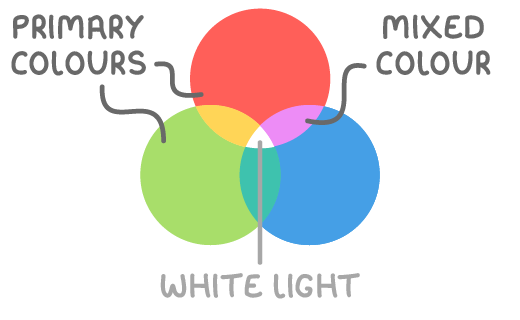
- The primary colours of light are pure red, green and blue - they cannot be made by mixing other colours.
- Adding all three together produces white light.
- Other colours are produced by mixing the primaries in different amounts (e.g. red and green light mix to make yellow).
Why objects appear coloured
When light hits an object, the wavelengths it absorbs, transmits or reflects determine its colour.
Opaque objects
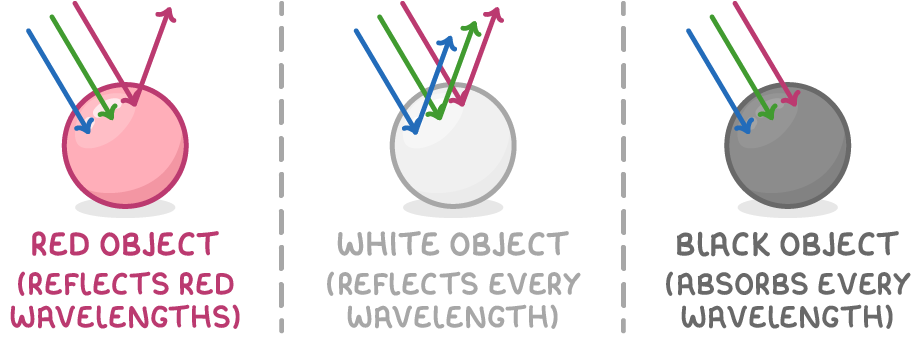
- Opaque objects let no light through. They absorb some wavelengths and reflect others.
- The colour of an opaque object depends on which wavelengths it reflects most strongly.
| Colour of object | Reflects | Absorbs |
|---|---|---|
| Black | none | all wavelengths |
| White | all wavelengths equally | none |
| A primary colour | that colour | all other wavelengths |
| A non-primary colour | that colour, and/or the primary colours that mix to make it | all other wavelengths |
Transparent and translucent objects
- Transparent and translucent objects transmit light - light passes through rather than being absorbed or reflected.
- They appear the colour of the wavelengths they transmit most strongly.
Colour filters
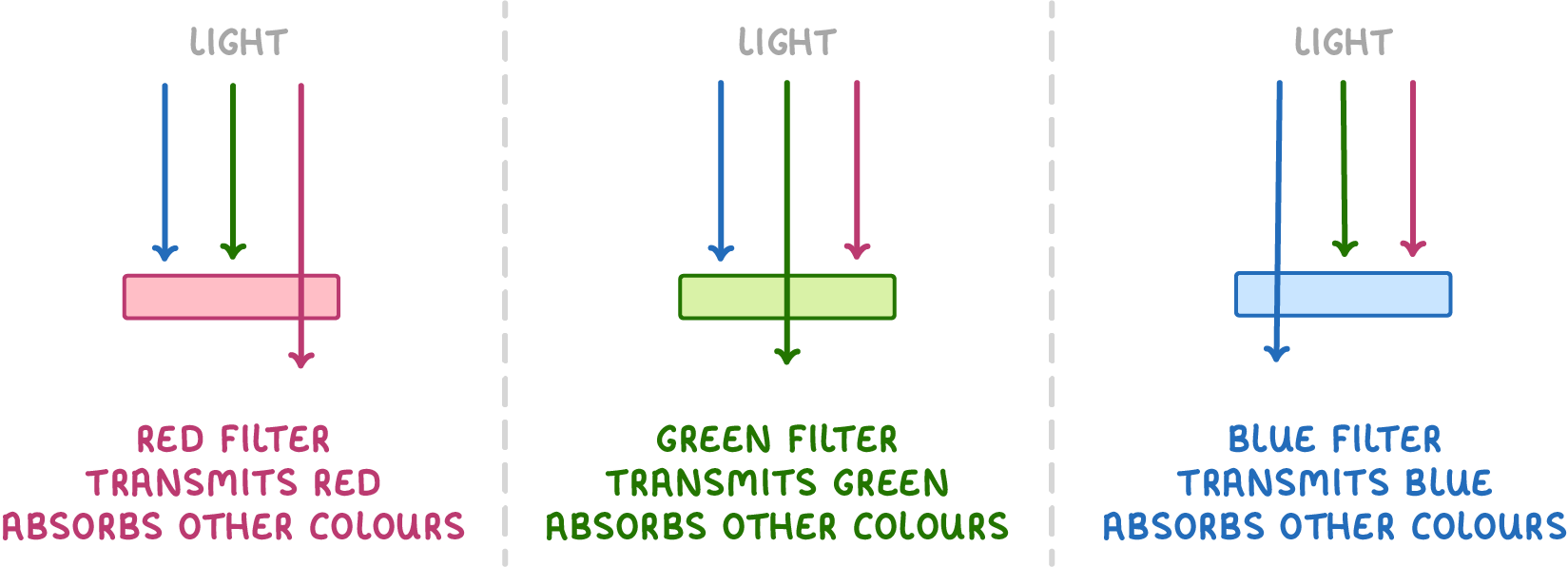
- A colour filter transmits some wavelengths of light and absorbs the rest, so only certain colours pass through.
- A primary colour filter transmits only its own colour. For example, a blue filter transmits only blue light and absorbs the rest.
Viewing objects through a filter
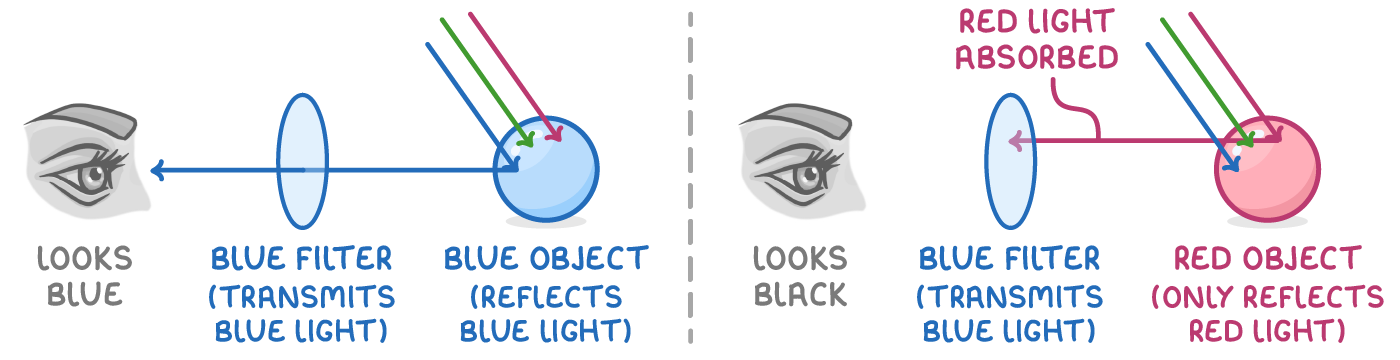
- A blue object seen through a blue filter looks blue - it reflects blue light, which the filter transmits.
- A red object looks black through a blue filter - the red light it reflects is absorbed by the filter, so no light reaches the eye.
Non-primary filters
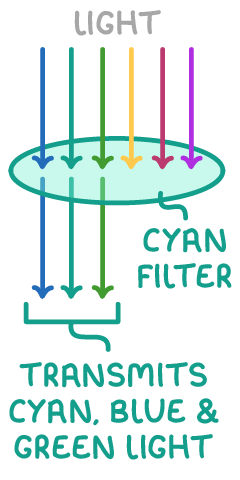
- A filter that is not a primary colour transmits its own colour and the primary colours that mix to make it.
- For example, a cyan filter transmits cyan, blue and green light.
Optical fibres carry visible light
Optical fibres are thin glass or plastic fibres that carry data over long distances as pulses of light.
How the light travels
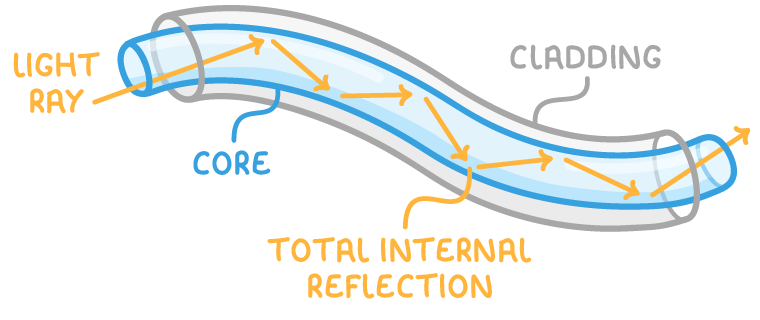
- Light enters the narrow core at a shallow angle and bounces off the boundary with the outer cladding until it emerges at the far end.
- The light stays trapped inside the core by total internal reflection.
- Visible light is used because it's not easily absorbed or scattered as it travels.
Uses
- Telephone and broadband internet cables.
- Medicine - To see inside the body without surgery.
TermDefinition
Primary colours of lightThe three colours of light (red, green and blue) that cannot be made by mixing other colours.
OpaqueDescribes a material that does not let light pass through it. The light is absorbed or reflected instead.
Colour filterA material that transmits certain wavelengths of light and absorbs the rest.
Optical fibreA thin glass or plastic fibre that carries data over long distances as pulses of light or infrared radiation.
Total internal reflectionThe complete reflection of light back into a material when it meets a boundary with a material in which light travels faster (for example from glass into air), at an angle of incidence greater than the critical angle.
Key points to remember
How were these notes?