9.9 - Reflection & Refraction of Light
The experiment
Aim
To investigate how light is reflected by different types of surface, and how it is refracted by different substances.
Background
- The normal is a line at 90° to a surface, at the point where a ray hits it.
- At a mirror, the angle of reflection equals the angle of incidence.
- Light slows down as it passes from air into glass, so it bends towards the normal. This is refraction. On the way out, it speeds up and bends away from the normal.
- Different substances slow light by different amounts, so they bend it by different amounts.
- You can't measure how much a substance slows light, but you can measure how much it bends a ray.
- So in this practical you trace rays and measure their angles from the normal, for different surfaces, substances, and angles.
Variables
- Independent variable - The surface or substance the light hits, or the angle of incidence.
- Dependent variable - The angle of reflection or the angle of refraction.
- Control variables - The ray box and slit, and the position of the mirror or block on the paper.
Method - Reflection at different surfaces
- Set up in a dim room - Draw a line on paper with the normal at 90° to it, and stand a plane mirror along the line.
- Mark the rays - Shine a thin ray from a ray box where the normal meets the mirror. Mark two crosses on each ray, far apart.
- Measure the angles - Lift the mirror off, join the crosses, and measure both angles from the normal.
- Change the angle - Repeat for angles of incidence from about 15° to 75°.
- Try other surfaces - Replace the mirror with white paper, a shiny metal sheet, and matt black card, and record what happens to the light.
Method - Refraction through different substances
- Mark the rays - Draw round a rectangular glass block and shine a thin ray at one long side. Mark two crosses on the ray going in and two on the ray coming out.
- Draw the path inside the block - Lift the block off, join the crosses, and join the point where the ray went in to the point where it came out. Measure both angles from the normal.
- Change the angle - Repeat for angles of incidence from about 20° to 70°.
- Try other substances - At an angle of incidence of 50°, measure the angle of refraction in a Perspex block and in a clear plastic box of water.
Safety
- Hot ray box - Hold it by its base.
- Dim room - Clear bags and stools out of the way first.
- Bright light - Don't look straight into the ray.
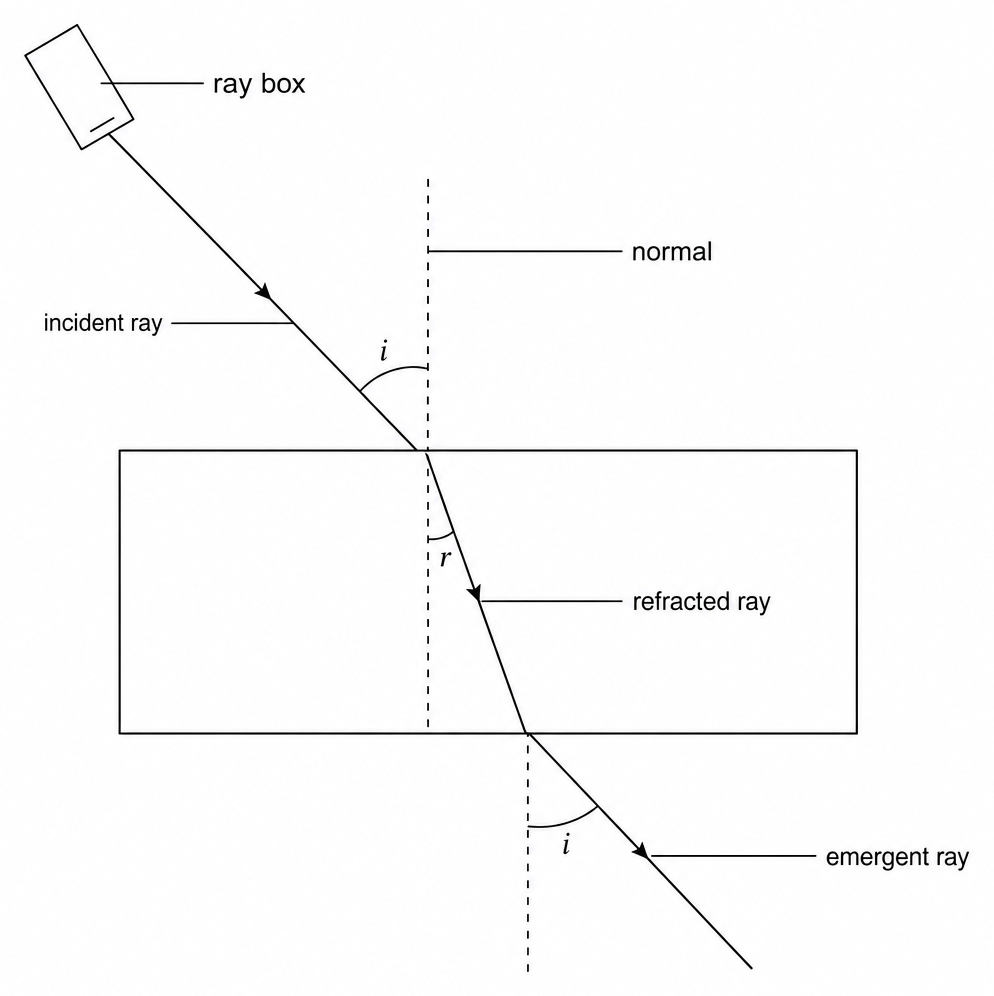
The ray leaves at the same angle it entered, so it emerges parallel.
Worked example - Analysing refraction results
A student shone a ray into a rectangular glass block at six angles of incidence, and measured the angle of refraction each time.
| Angle of incidence, i (°) | 20 | 30 | 40 | 50 | 60 | 70 |
|---|---|---|---|---|---|---|
| Angle of refraction, r (°) | 13 | 19 | 25 | 31 | 35 | 39 |
At an angle of incidence of 50°, they also measured the angle of refraction in water and in Perspex.
| Substance | Water | Perspex | Glass |
|---|---|---|---|
| Angle of refraction at i = 50° (°) | 35 | 32 | 31 |
With a plane mirror, the angle of reflection always equalled the angle of incidence. White paper gave no single reflected ray, and matt black card reflected very little light.
Analyse the glass results, compare the substances, and explain the reflection results.
Step 1 - Describe what happens to the ray
The angle of refraction is always smaller than the angle of incidence, so the ray bends towards the normal.
Step 2 - Plot the graph
Plot the angle of incidence on the y-axis against the angle of refraction on the x-axis. The line starts at the origin and curves gently upwards.
Step 3 - Check whether the angles are proportional
Work out i ÷ r for each pair.
- 20 ÷ 13 = 1.54
- 30 ÷ 19 = 1.58
- 40 ÷ 25 = 1.60
- 50 ÷ 31 = 1.61
- 60 ÷ 35 = 1.71
- 70 ÷ 39 = 1.79
The ratio isn't constant, so the two angles are not directly proportional.
Step 4 - Compare the substances
Water gives the largest angle of refraction, so it bends light least. Glass and Perspex differ by only 1°, which is within the uncertainty of a protractor, so the results can't separate them.
Step 5 - Explain the reflection results
A mirror is smooth, so its normal points the same way everywhere and the ray reflects in one direction. Paper is rough, so its normal points a different way at each point, and the light scatters. Black card absorbs most of the light.
Common exam questions
Question 1
Why are the two crosses on each ray marked far apart?
A small error in placing a cross tilts a long line much less than a short one, so the line you draw follows the ray more closely.
Question 2
Why does the ray leave a rectangular block parallel to the ray that went in?
The two sides of the block are parallel, so the ray bends away from the normal on the way out by the same amount it bent towards it on the way in.
Question 3
A ray is aimed along the normal into the block. What happens to it?
It carries straight on without bending. It still slows down, but it meets the surface head-on, so its direction doesn't change.
Question 4
A student's readings scatter either side of a smooth curve. Suggest why, and what they should do.
Each protractor reading and traced line has a small random error. Drawing a line of best fit through all the points reduces its effect.