3.9 - Energy & Power Formulas
Energy transferred from power and time
- The total energy an appliance transfers depends on its power and how long it's switched on for.
- Power is the electrical energy an appliance transfers each second, measured in watts (W), where 1 W = 1 J/s.
Formula for energy transferred
Where:
- = Energy transferred, in joules (J)
- = Power, in watts (W)
- = Time, in seconds (s)
Worked example - Comparing two kettles
A 2,000 W kettle is switched on for 3 minutes. How long, in minutes, would a 3,000 W kettle take to transfer the same amount of energy?
Step 1 - Convert the time to seconds
Step 2 - Find the energy transferred by the 2,000 W kettle
Step 3 - Rearrange E = Pt for the time taken by the 3,000 W kettle
Step 4 - Convert the time back to minutes
Potential difference is energy per charge - E = QV
- When charge moves through a potential difference, energy is transferred.
- The potential difference across a component is the energy transferred per coulomb of charge passing through it (1 V = 1 J/C).
Formula for energy transferred
Where:
- = Energy transferred, in joules (J)
- = Charge, in coulombs (C)
- = Potential difference, in volts (V)
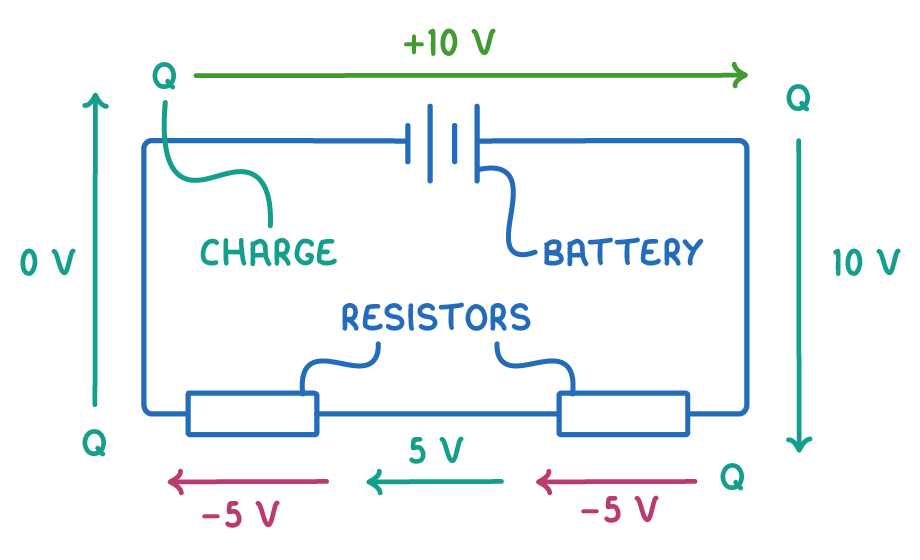
The charge gains energy at the battery and transfers it in the two resistors.
Worked example - Energy transferred by a motor
The motor in a battery-powered toy car is connected to a 6 V battery. 90 C of charge passes through the motor while the car is running. Calculate the energy transferred.
Step 1 - Identify the values
- Charge: C
- Potential difference: V
Step 2 - Substitute into E = QV
Formula for electrical power
Where:
- = Power, in watts (W)
- = Current, in amperes (A)
- = Potential difference, in volts (V)
Electrical power can be found from the potential difference across an appliance and the current through it.
Worked example - Finding the current with P = IV
A 1.8 kW electric iron is connected to a 230 V supply. Calculate the current through the iron. Give your answer to two significant figures.
Step 1 - Convert the power to watts
1.8 kW = 1,800 W
Step 2 - Rearrange P = IV for the current
Step 3 - Substitute the values
Formula for power from current and resistance
The power of a component can be found from its current and resistance by substituting into .
Where:
- = Power, in watts (W)
- = Current, in amperes (A)
- = Resistance, in ohms (Ω)
Worked example - Power from current and resistance
A fan heater connected to a 230 V supply has a current of 6.0 A through it. Calculate the power of the heater and its resistance. Give each answer to two significant figures.