1.4 - Changes of State
Heating or cooling changes temperature or state
- Heating transfers energy to the particles in a substance; cooling transfers energy away.
- Heating or cooling leads to a temperature change or a change of state.
Heating and cooling
- Temperature change - Heating makes particles move or vibrate faster, raising the temperature. Cooling slows particles down, lowering the temperature.
- Change of state - If heated enough, the energy breaks the bonds between particles rather than raising their temperature. When cooled enough, bonds form between particles.
Temperature stays constant during a change of state
- While a substance is changing state, its temperature does not change.
- During melting or boiling, energy is absorbed to break bonds rather than raise the temperature.
- During condensing or freezing, bonds form and release energy, so the temperature does not fall until the change of state is complete.
- Melting point is the temperature at which a substance melts; boiling point is the temperature at which it boils.
- For pure water at normal atmospheric pressure: melting point 0 °C, boiling point 100 °C.
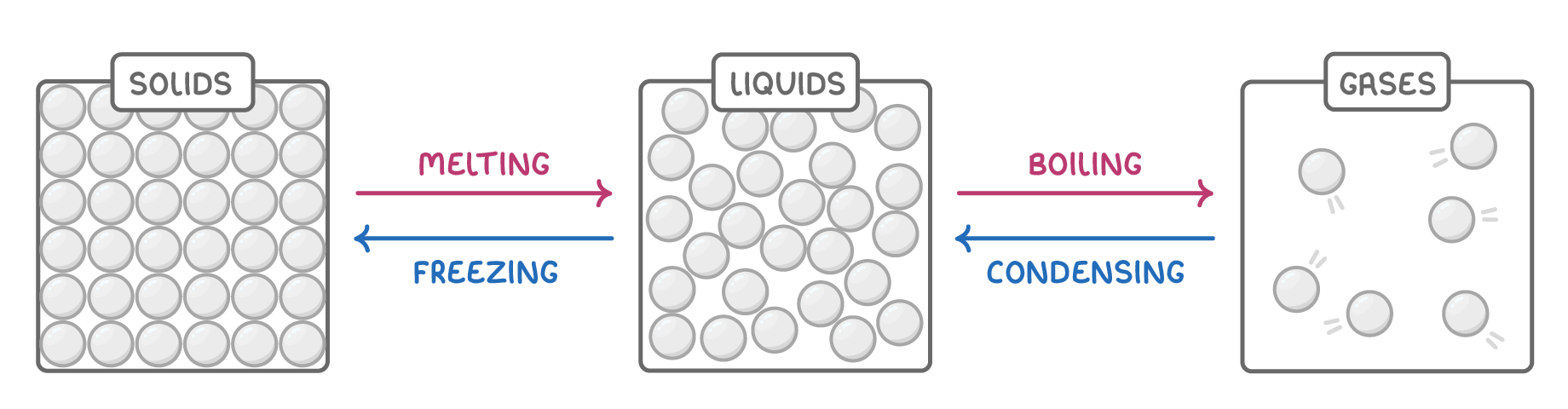
A change of state conserves mass
A change of state is when a substance changes from one state of matter to another:
- Melting and freezing (between solid and liquid)
- Boiling (or evaporating) and condensing (between liquid and gas)
- Subliming (between solid and gas)
A change of state is a physical change
- It's a physical change, not a chemical one - no new substance is formed.
- The change can be reversed to recover the original material with its original properties.
Why mass is conserved
- During a change of state, the number of particles stays the same - they're only rearranged.
- Mass is the total mass of the particles, so mass is conserved.
TermDefinition
Melting pointThe temperature at which a substance melts.
Boiling pointThe temperature at which a liquid changes into a gas throughout the liquid, not only at its surface.
Physical changeA change in which no new substance is formed and the original material can be recovered.
SublimingA change of state directly between a solid and a gas.
Key points to remember
How were these notes?