5.17 - How to Draw Ray Diagrams
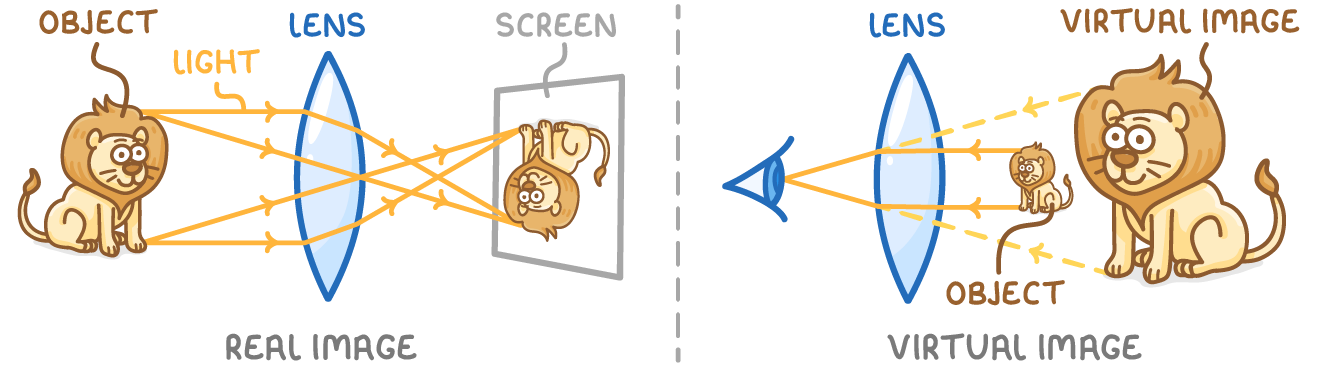
Real and virtual images
- Real image - Forms where light rays actually meet. It can be captured on a screen (e.g. the image formed on the retina).
- Virtual image - Forms where light rays only appear to come from because the rays are diverging. It cannot be captured on a screen (e.g. a reflection in a plane mirror or the image seen through a magnifying glass).
To describe an image fully, state three things:
- Size compared with the object - enlarged (magnified), the same size, or diminished (smaller)
- Orientation - Upright or inverted (upside down)
- Nature - Real or virtual
Ray diagram for a converging (convex) lens
Only two rays from any point on an object are needed to locate that point on the image.
Finding the top of the image
- From the top of the object, draw a ray parallel to the principal axis. After the lens it refracts through the principal focus (F) on the far side.
- From the top of the object, draw a second ray straight through the centre of the lens - this ray carries on without bending.
- Where the two refracted rays cross is the top of the image.
If the bottom of the object sits on the principal axis, draw the image straight down from the crossing point to the axis.
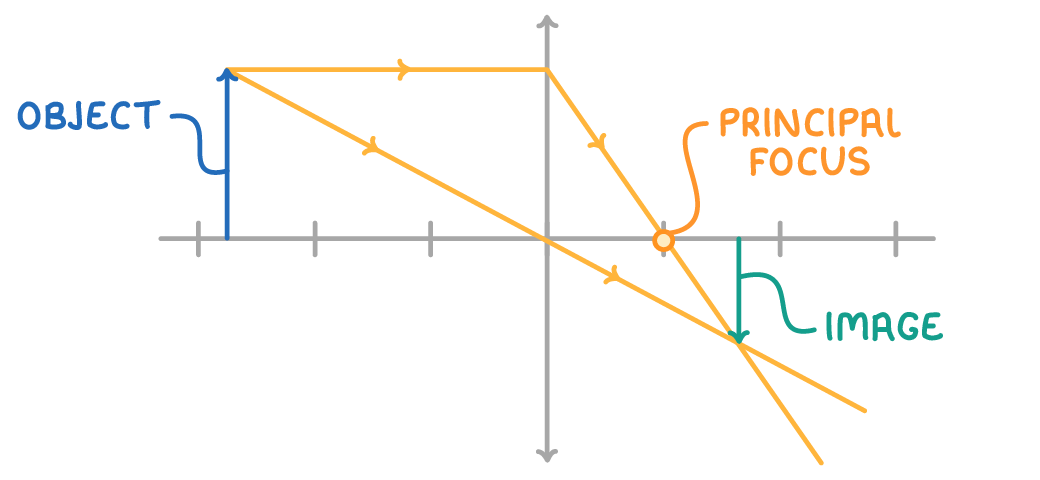
Drawing conventions
- A real image is drawn as a solid arrow; a downward arrow shows it is inverted.
- The lens is drawn as a single vertical line, with rays bent once at that line rather than at each surface.
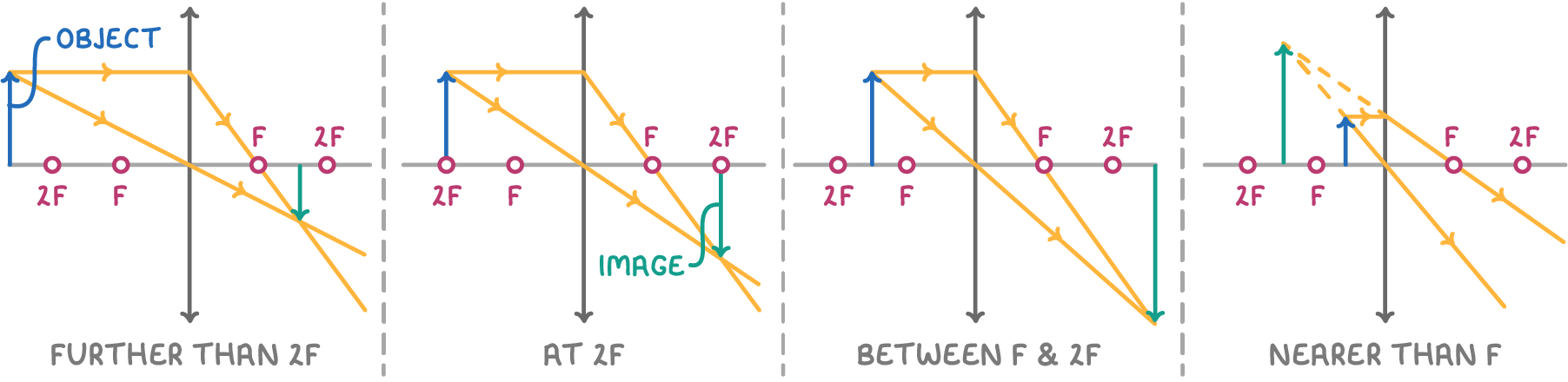
How object distance affects the image (converging lens)
For a converging (convex) lens, where the object is placed relative to the principal focus (F) and 2F determines the image formed.
| Object's position | Image size | Upright/inverted | Real/virtual | Image position |
|---|---|---|---|---|
| Further than 2F | Smaller | Inverted | Real | Between F and 2F |
| At 2F | Same size | Inverted | Real | At 2F |
| Between F and 2F | Bigger | Inverted | Real | Beyond 2F |
| Nearer than F | Bigger | Upright | Virtual | Same side as the object |
- When the object is beyond F, the image is always real and inverted on the far side.
- When the object is inside F, the image is virtual, upright and enlarged on the same side as the object.
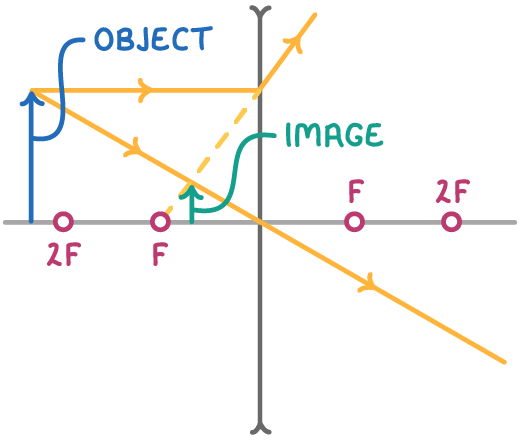
Ray diagram for a diverging (concave) lens
Finding the top of the image
- From the top of the object, draw a ray parallel to the principal axis. After the lens it refracts so that it appears to come from the principal focus (F) on the same side as the object. Draw the refracted ray as a solid line and trace it back to F as a dashed line.
- From the top of the object, draw a second ray straight through the centre of the lens - it carries on without bending.
- The top of the image is where the central ray meets the dashed line.
A diverging lens always produces an image that is:
- Virtual
- Upright
- Smaller than the object (diminished)
- On the same side of the lens as the object
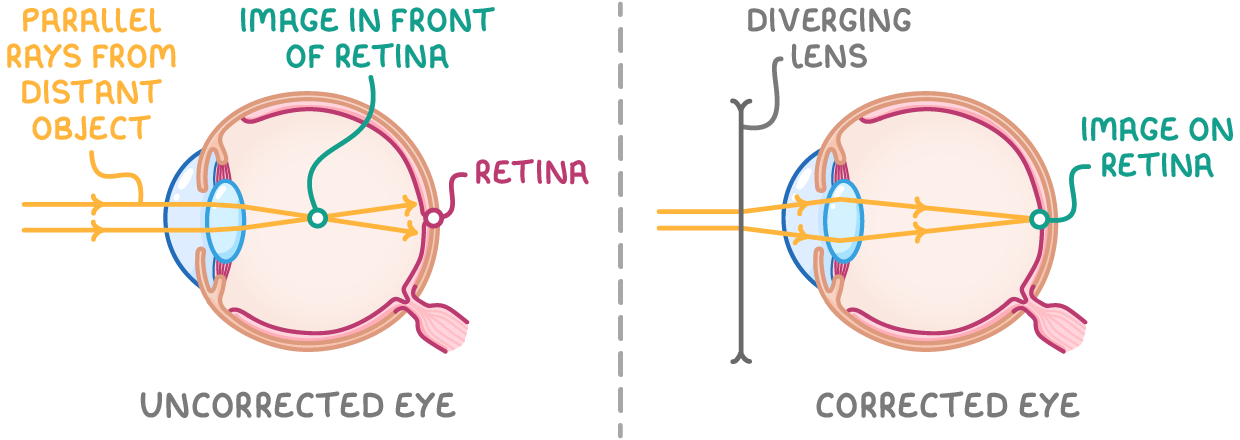
Ray diagram for correcting short sight
- Short sight is when distant objects look blurred because light is focused in front of the retina.
- It is corrected using a diverging (concave) lens.
How the correction works
- Uncorrected eye - Parallel rays from a distant object are refracted too strongly and meet at a focus in front of the retina.
- Corrected eye - A diverging lens in front of the eye spreads the rays slightly before they enter, so they focus on the retina.
The diverging lens is drawn as a single vertical line that bends rays outwards, moving the focus point back onto the retina.
Ray diagram for correcting long sight
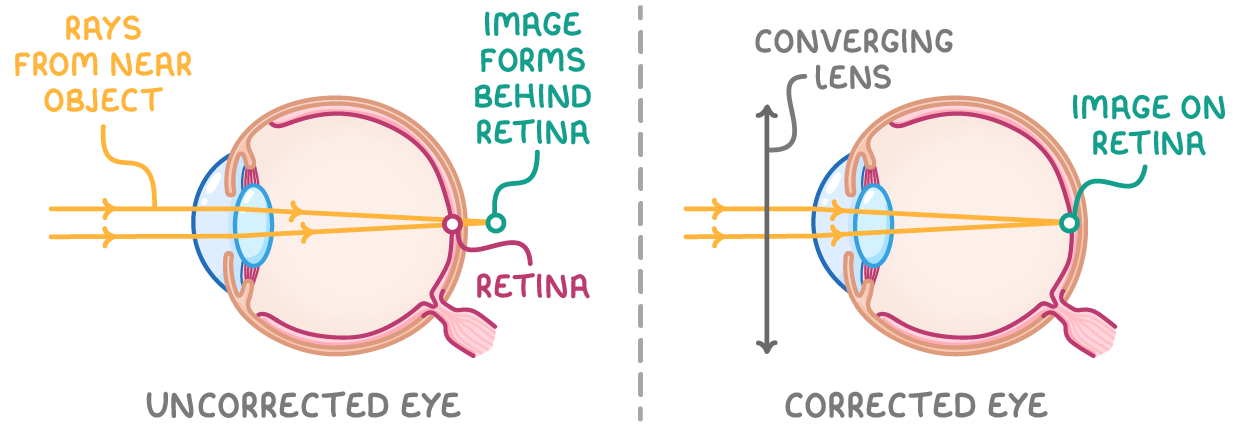
- Long sight is when near objects look blurred because light is focused behind the retina.
- It is corrected using a converging (convex) lens.
How the correction works
- Uncorrected eye - Rays from a near object are not refracted strongly enough and head towards a focus behind the retina.
- Corrected eye - A converging lens in front of the eye starts converging the rays before they enter, so they focus on the retina.
The converging lens is drawn as a single vertical line that bends rays inwards, moving the focus point forward onto the retina.
TermDefinition
Real imageAn image formed where light rays actually meet, which can be captured on a screen.
Virtual imageAn image formed where light rays only appear to come from, which cannot be projected onto a screen.
Short sightA vision defect where distant objects look blurred because light is focused in front of the retina.
Long sightA vision defect where near objects look blurred because light is focused behind the retina.
Key points to remember
How were these notes?