5.16 - How Lenses Work
Convex and concave lenses
- Lenses form images by refracting light and changing its direction.
- There are two main types of lens, and they have opposite effects on the rays passing through them.
Convex (converging) lenses
- A convex lens bulges outwards, so it's thickest at its centre and thinnest at its edges.
- It brings parallel rays of light together (it converges them).
- Rays hitting the lens parallel to its axis meet at the principal focus.
Concave (diverging) lenses
- A concave lens caves inwards, so it's thickest at its edges and thinnest at its centre.
- It makes parallel rays of light spread out (it diverges them).
- Rays hitting the lens parallel to its axis appear to come from the principal focus - tracing the emerging rays back, they all appear to meet at this point.
How rays bend
- A ray bends towards the normal as it enters the lens, and away from the normal as it leaves.
- A ray that passes through the optical centre of either lens isn't bent - it carries straight on without refraction.
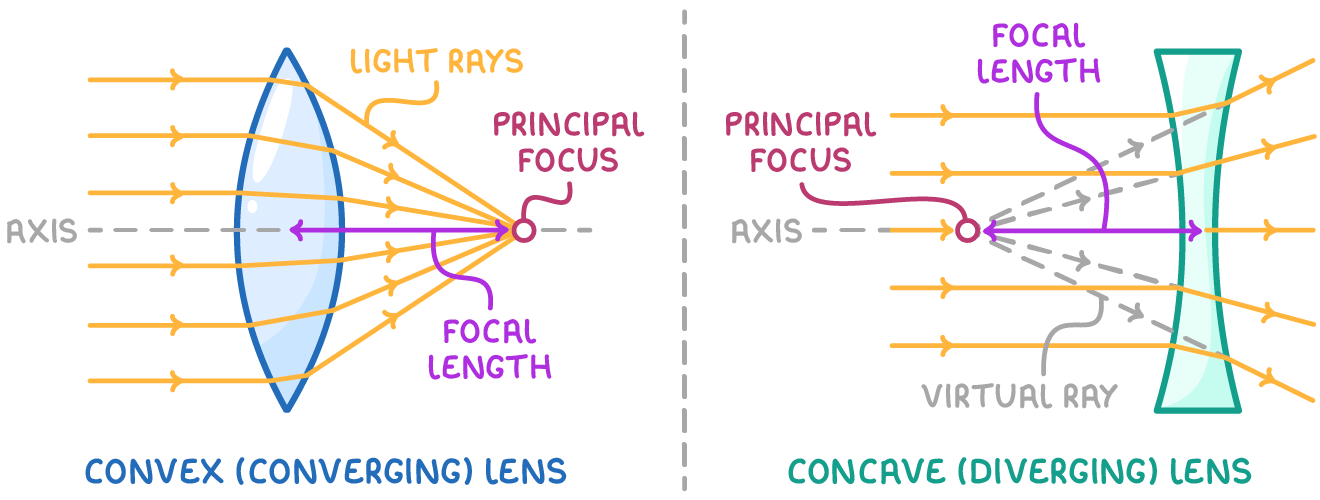
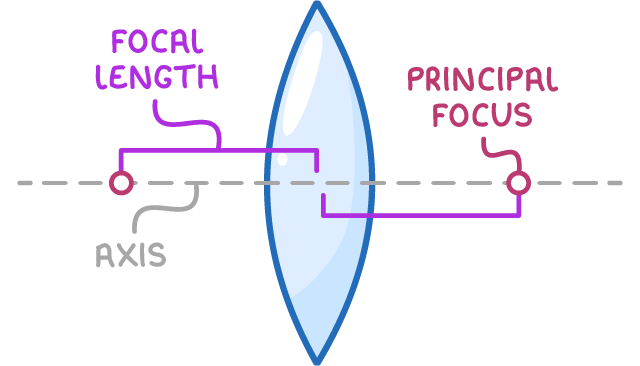
Focal length is the distance from the lens to the principal focus.
Axis, principal focus and focal length
Three terms describe how a lens behaves:
- Axis - An imaginary straight line through the middle of the lens, perpendicular to it. Also called the principal axis.
- Principal focus - For a convex lens, the point where rays hitting the lens parallel to the axis are brought together. For a concave lens, the point those rays appear to come from when traced back. There's a principal focus on each side of the lens.
- Focal length - The distance from the centre of the lens to the principal focus.
Real and virtual images
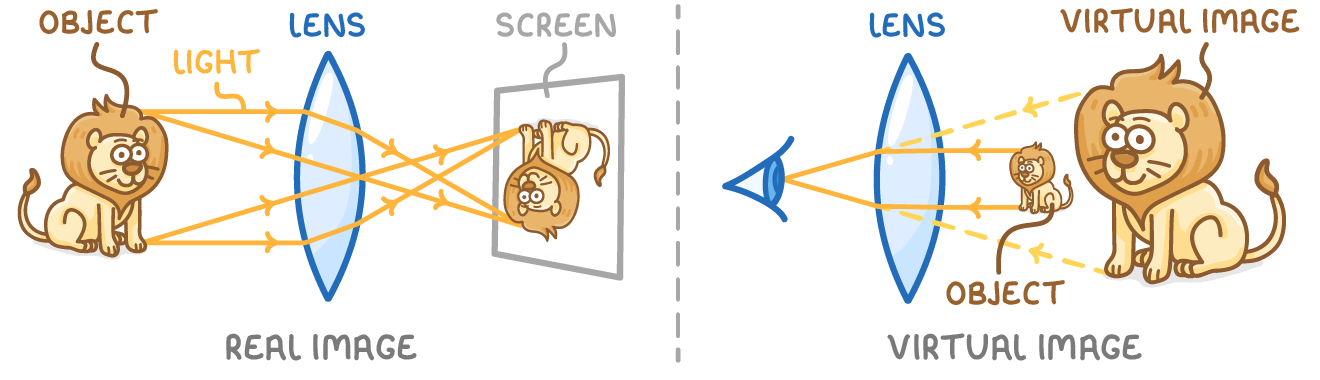
An image forms where all the light rays from a point on an object come together, or appear to come together.
The two kinds of image
- Real image - The light rays actually meet at the image. Because the light really is there, a real image can be captured on a screen (for example, on the retina at the back of the eye).
- Virtual image - The light rays only appear to come from the image. Tracing the emerging rays back, they meet at a point the light never actually reaches, so a virtual image cannot be captured on a screen (for example, the image seen through a magnifying glass).
To describe an image fully, state:
- whether it's bigger or smaller than the object,
- whether it's upright or inverted,
- whether it's real or virtual.
A concave lens always forms a virtual image
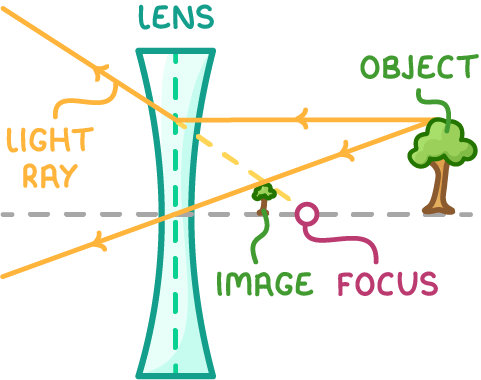
A concave (diverging) lens always produces a virtual image, wherever the object is placed. The image is always:
- upright (the right way up),
- smaller than the object,
- on the same side of the lens as the object, between the object and the lens.
The further the object is from the lens, the smaller the image becomes.
How a convex lens image depends on object distance
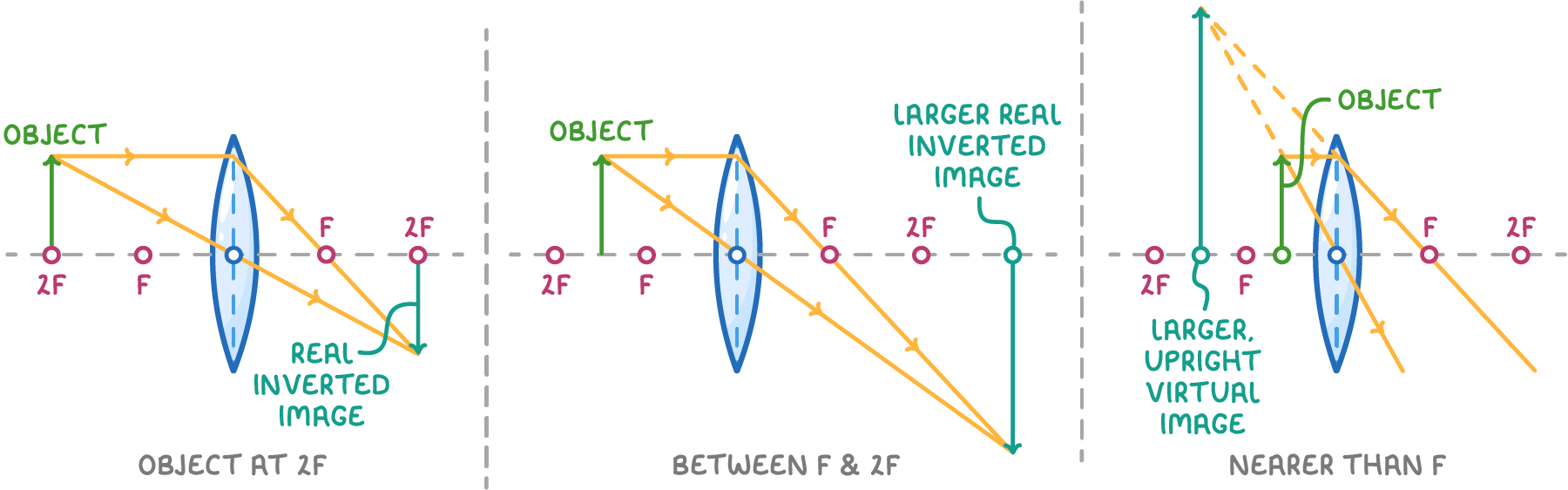
A convex (converging) lens forms different types of image depending on how far the object is from the lens, measured in focal lengths (F is one focal length, 2F is two).
- Object at 2F - A real, inverted image, the same size as the object, formed at 2F on the other side of the lens.
- Object between F and 2F - A real, inverted image, larger than the object, formed beyond 2F.
- Object nearer than F - A virtual, upright, larger image, formed on the same side of the lens as the object. The closer the object is to F, the larger it appears.
Correcting short sight and long sight
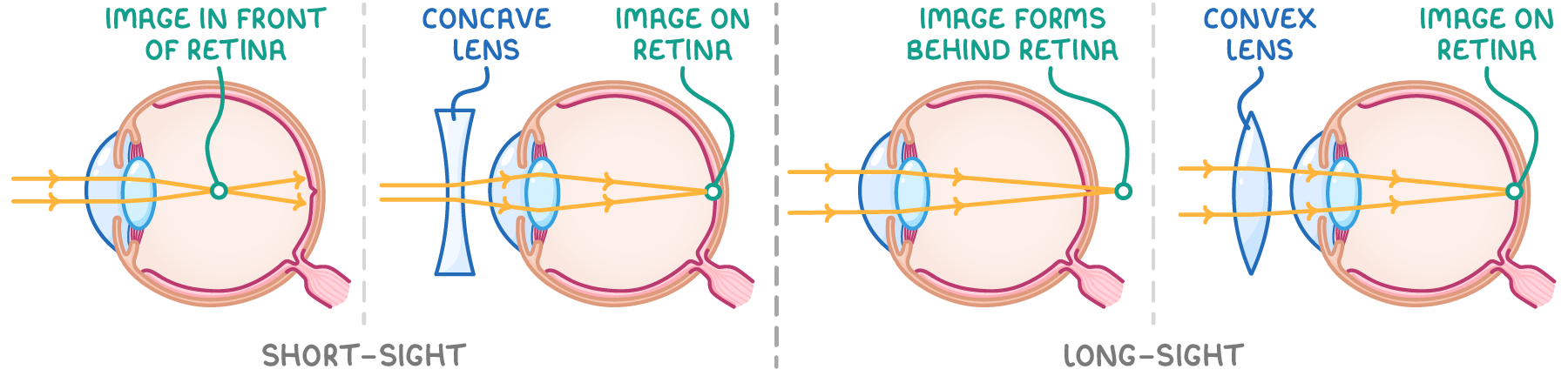
- The eye contains a convex lens that focuses light onto the retina at the back of the eye, forming a real image.
- If the image doesn't fall on the retina, it looks blurry.
- Lenses worn in front of the eye correct this.
Short sight
- A short-sighted person can't focus on distant objects.
- The eye is too powerful, or the eyeball too long, so the image of a distant object forms in front of the retina.
- A concave (diverging) lens spreads the light out before it enters the eye, focusing the image onto the retina.
Long sight
- A long-sighted person can't focus on near objects.
- The eye is too weak, or the eyeball too short, so the image of a near object forms behind the retina.
- A convex (converging) lens begins converging the light before it enters the eye, focusing the image onto the retina.
TermDefinition
Convex lensA lens that is thickest at its centre and brings parallel rays of light together.
Concave lensA lens that is thinnest at its centre and makes parallel rays of light spread out.
Principal focusThe point where parallel rays of light meet, or appear to come from, after passing through a lens.
Focal lengthThe distance from the centre of a lens to its principal focus.
Real imageAn image formed where light rays actually meet, which can be captured on a screen.
Virtual imageAn image formed where light rays only appear to come from, which cannot be projected onto a screen.
Key points to remember
How were these notes?