4.4 - Motor Effect
A current in a magnetic field experiences a force
- When a current-carrying wire is placed in a magnetic field, the magnetic field around the wire interacts with the magnetic field between the poles.
- The two fields exert a force on each other, causing the wire to move. This is called the motor effect.
- By Newton's third law, the magnet and the wire exert an equal and opposite force on each other.
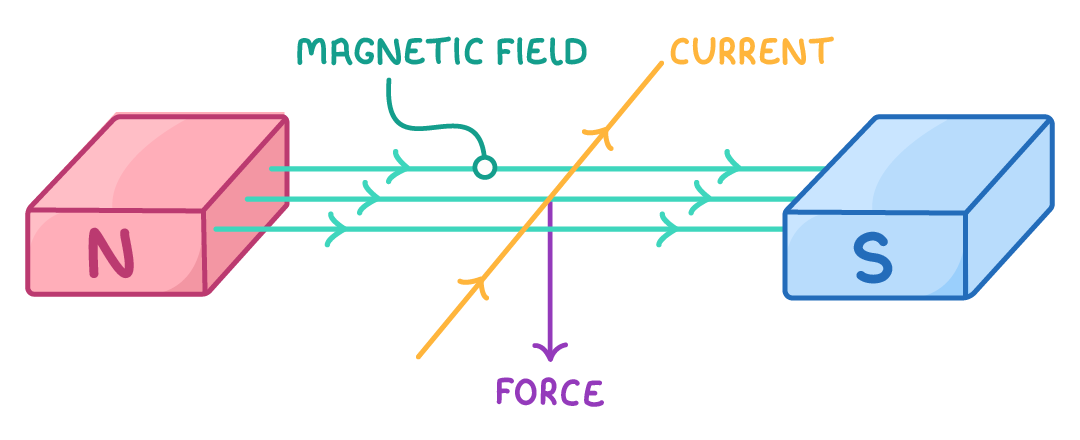
Factors affecting the force
- Angle:
- The full force acts when the wire is at 90° (right angles) to the magnetic field.
- A wire running parallel to the field experiences no force.
- The force always acts at right angles to both the magnetic field and the current.
- Magnitude - The force increases if the current increases, a stronger magnet is used, or a longer length of wire lies in the field.
- Direction - Reversing either the current or the magnetic field reverses the direction of the force.
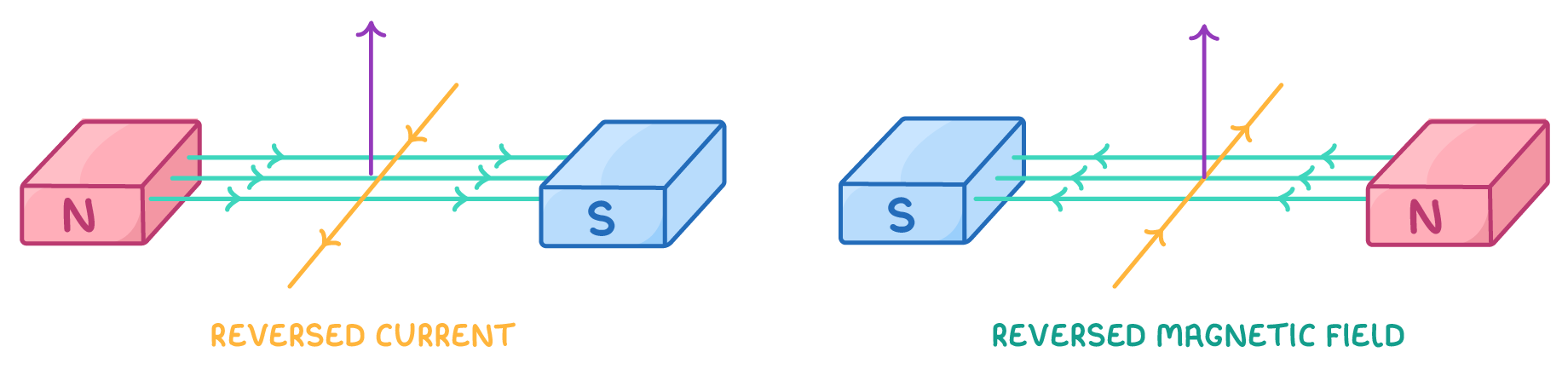
In both panels the force now acts upwards, the reverse of the figure above.
Demonstrating the motor effect
- Place a light metal rod across a pair of parallel rails inside a horseshoe magnet to complete a circuit.
- When current flows, the magnetic force pushes the rod so it rolls along the rails.
- The rails and rod are made from a non-magnetic metal (such as aluminium or brass) so they aren't simply attracted to the magnet.
Fleming's left-hand rule
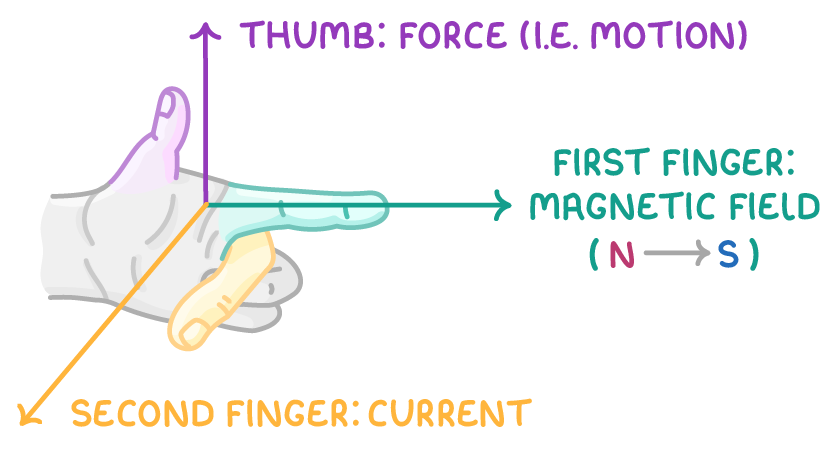
Fleming's left-hand rule finds the direction of the force on a current-carrying conductor in a magnetic field. Hold the thumb, first finger, and second finger of the left hand at right angles to each other:
| Left hand | Direction |
|---|---|
| First finger | Magnetic Field (North to South) |
| Second finger | Current (positive to negative) |
| Thumb | Force / Motion |
- The magnetic field always runs from north to south.
- The current is conventional current, which flows from positive to negative.
- Reversing either the current or the field reverses the direction of the force.
Calculating the force on a conductor ()
The force on a conductor carrying a current at right angles to a magnetic field is calculated using:
Where:
- = Force, in newtons (N)
- = Magnetic flux density, in teslas (T)
- = Current, in amperes (A)
- = Length of conductor in the field, in metres (m)
Magnetic flux density () measures the strength of the magnetic field. This equation only applies when the conductor is at 90° to the field lines. If the conductor is parallel to the field, the force is zero.
Worked example - Force on a current-carrying bar
A bar of length 0.25 m carries a current of 12 A. It lies at right angles to a magnetic field of flux density 0.15 T. Calculate the force on the bar.
Step 1 - Formula
Step 2 - Substitution and calculation
The force on the bar is 0.45 N.