2.13 - Newton's 3rd Law
Newton's third law and objects in equilibrium
Newton's third law: when two objects interact, the forces they exert on each other are equal in size and opposite in direction, and act on different objects.
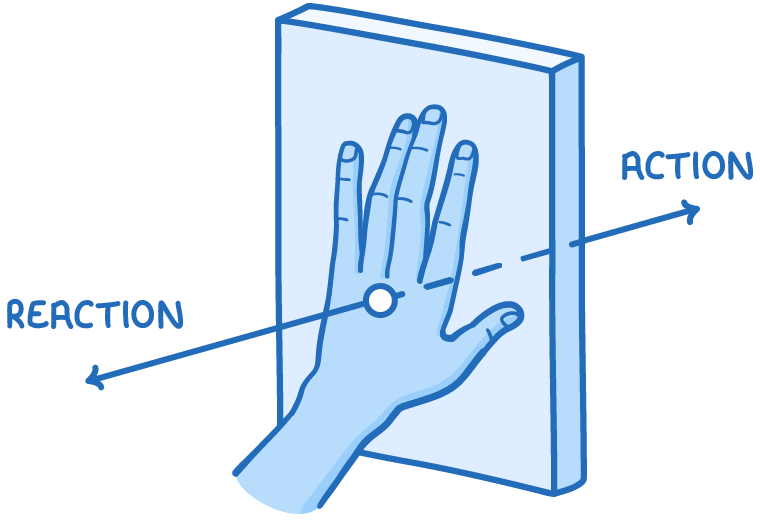
A person pushing a wall
- When a person pushes on a wall, the wall pushes back on the person with a normal contact force of the same size in the opposite direction.
- These two forces are a third-law pair:
- Same type of force (both contact)
- Equal in size, opposite in direction
- Act on different objects (one on the wall, one on the person)
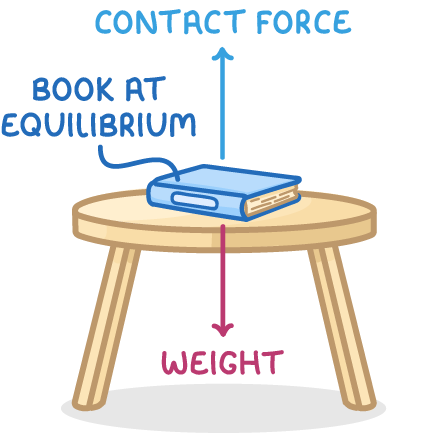
A book resting on a table
- A book resting on a table is in equilibrium. Its weight pulls it down, and the normal contact force from the table pushes it up.
- These forces are equal in size and opposite in direction, but they are not a third-law pair:
- They're different types of force (one gravitational, one contact)
- They both act on the same object (the book)
The actual third-law pairs are:
- The Earth pulls the book down with gravity, and the book pulls the Earth up with an equal and opposite gravitational force.
- The table pushes up on the book with a normal contact force, and the book pushes down on the table with an equal and opposite normal contact force.
TermDefinition
Newton's third lawThe law that whenever two objects interact, the forces they exert on each other are equal in size and opposite in direction.
EquilibriumThe state of an object when the forces acting on it are balanced, so the resultant force is zero. For an object that can turn, the moments must also balance, so there is no resultant moment.
Key points to remember
How were these notes?