5.3 - Reflection
Waves at a boundary - Absorbed, transmitted or reflected
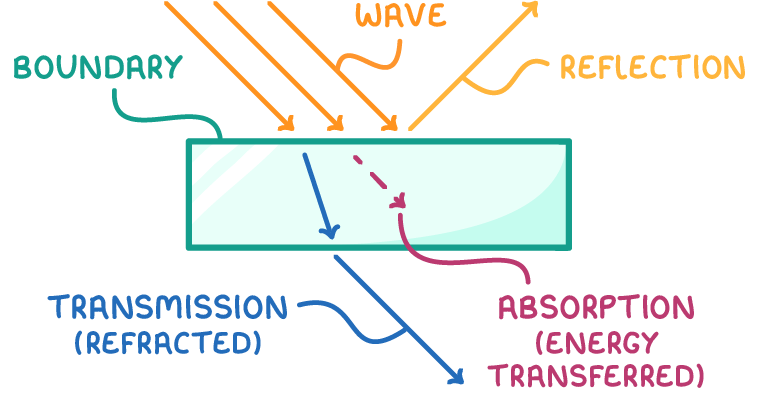
When a wave reaches a boundary between two different materials, one of three things can happen:
- Absorption - The wave's energy is transferred to the second material (for example, microwaves heating food).
- Transmission - The wave carries on travelling through the new material, which often leads to refraction (a change in direction).
- Reflection - The wave bounces back off the boundary instead of passing through or being absorbed.
Factors affecting the outcome:
- Which of these happens depends on the wavelength of the wave and the properties of the two materials.
- This applies to all types of wave, including electromagnetic waves, sound waves and water waves.
What reflection is
Reflection happens when a wave hits a boundary between two materials and bounces back, instead of being absorbed or passing into the new material.
Reflection happens with every kind of wave
- Light reflects off surfaces - it's how we see objects and how mirrors form images.
- Sound reflects off hard surfaces such as walls and cliffs, producing echoes.
- Water waves bounce back off a harbour wall or the side of a tank.
Hard surfaces reflect sound strongly, while softer surfaces absorb more of it and reflect less.
The law of reflection
The law of reflection applies to every reflected wave:
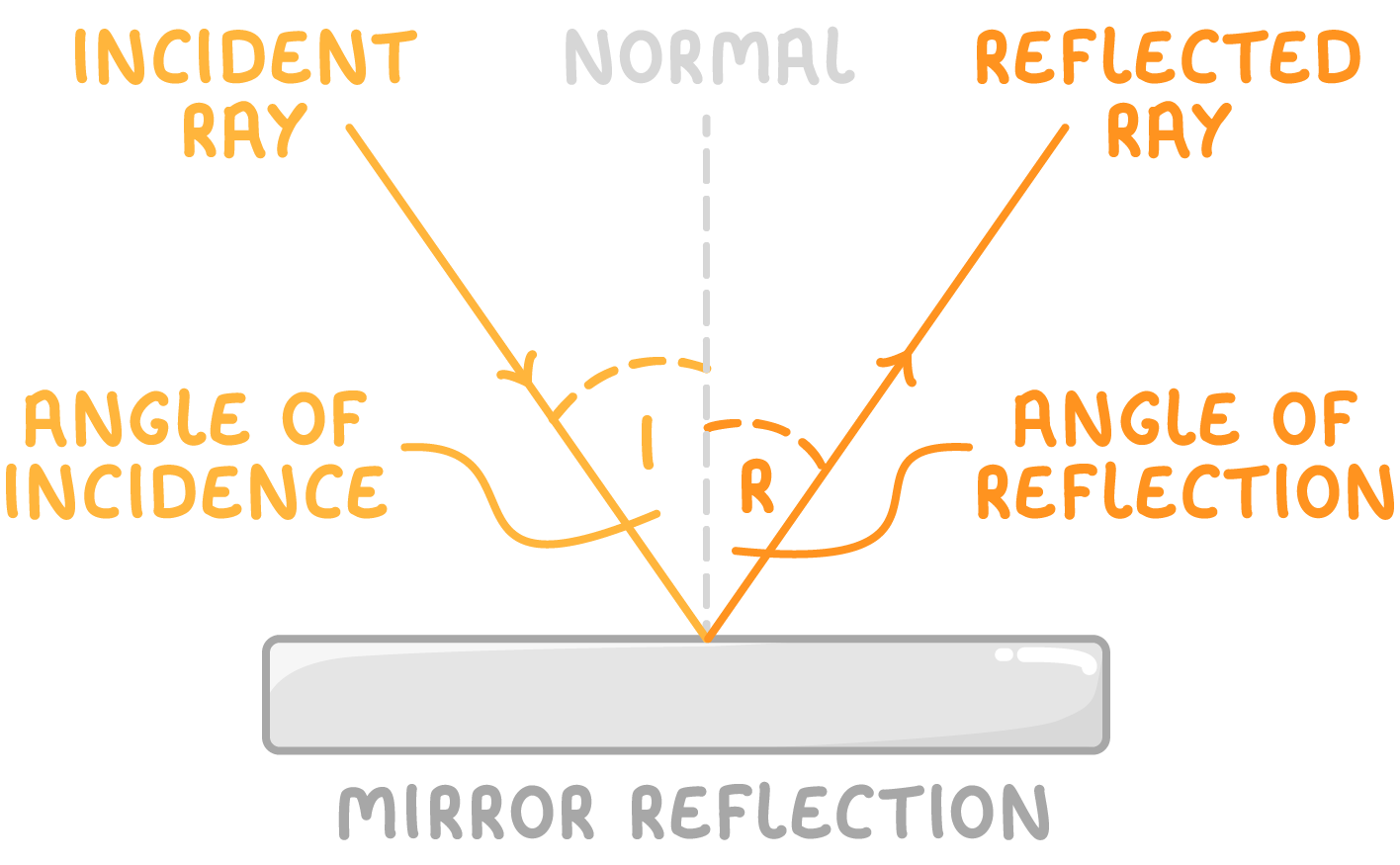
Angle of incidence = angle of reflection
- Both angles are measured from the normal - an imaginary line drawn perpendicular (at right angles) to the surface at the point of incidence. It's usually drawn as a dotted line.
- Angle of incidence - The angle between the incident ray and the normal.
- Angle of reflection - The angle between the reflected ray and the normal.
Drawing a reflection ray diagram
- A ray diagram shows the path a wave travels along. Rays are drawn as straight lines with arrows showing their direction.
- Draw the normal and the incident ray meeting it at the surface, then draw the reflected ray so the angle of reflection equals the angle of incidence.
Reflection of white light and water waves
- White light is a mixture of colours with different wavelengths. Every wavelength obeys the law of reflection, so all colours reflect at the same angle - white light does not split into colours when it reflects.
- Water waves obey the same law: plane waves in a ripple tank reflect off a straight barrier with the angle of incidence equal to the angle of reflection.
Specular and diffuse reflection
Waves reflect off different surfaces in two ways:
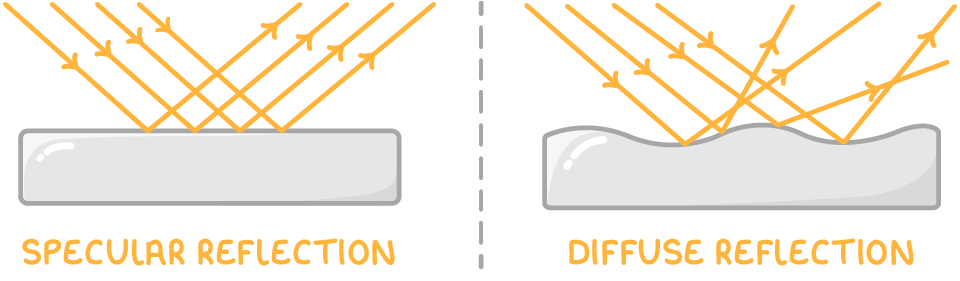
- Specular reflection - Happens at a smooth surface, such as a mirror. Parallel incident rays are all reflected in the same direction, producing a clear image.
- Diffuse reflection - Happens at a rough surface, such as paper. The reflected rays are scattered in many directions, so the surface appears matt and no clear image is formed.
How the law of reflection applies:
- The law of reflection holds for every individual ray in both cases.
- At a rough surface, the normal points in a different direction at each point, so rays hit at different angles of incidence and reflect in different directions.
TermDefinition
AbsorptionThe transfer of a wave's energy to the material it enters or travels through.
TransmissionA wave carrying on through a new material after hitting a boundary.
ReflectionA wave bouncing back off a boundary between two materials instead of passing through or being absorbed.
NormalA line drawn at right angles to a surface or boundary at the point where a ray or wave meets it. A force or pressure that acts at right angles to a surface is also said to act normal to it.
Angle of incidenceThe angle between the incident ray and the normal.
Angle of reflectionThe angle between a reflected ray and the normal.
Specular reflectionReflection off a smooth surface where parallel rays are all reflected in the same direction.
Diffuse reflectionReflection off a rough surface where rays are scattered in many directions.
Key points to remember
How were these notes?