8.14 - Orbits
Gravity provides the force that creates orbits
- Planets orbit the Sun, and moons and artificial satellites orbit planets, in almost circular orbits.
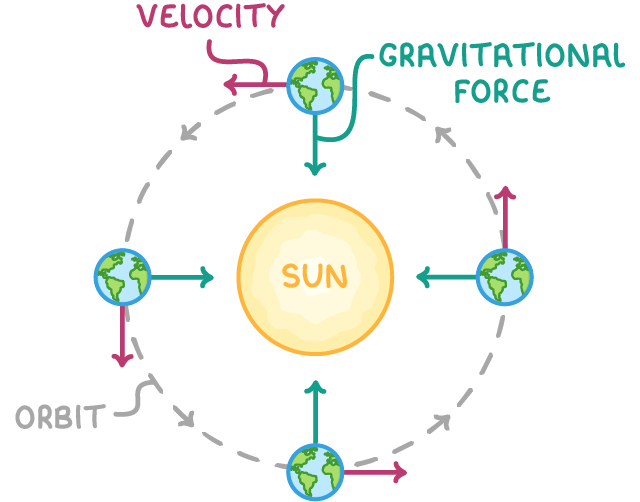
- An object moving in a circle is constantly changing direction, so even at a constant speed its velocity is constantly changing.
- A changing velocity means the object is accelerating, which requires a resultant force.
- This force acts towards the centre of the circle.
Gravity provides the inward force
- For an orbiting object, this inward force is provided by gravity:
- The Sun's gravitational pull keeps planets and comets in orbit.
- A planet's gravitational pull keeps moons and artificial satellites in orbit.
- Because the object is already moving, the gravitational pull doesn't pull it straight in - it constantly bends its path into a circle.
Orbital speed and the size of the orbit
- For a circular orbit, the gravitational force acts at right angles to the object's motion.
- This changes the object's direction without changing its speed.
Orbital speed depends on the radius
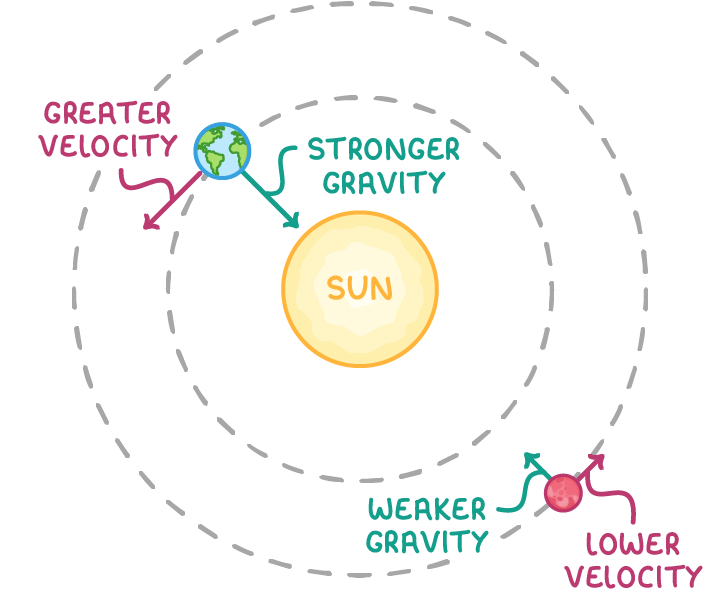
- Gravitational pull is stronger the closer an object is to the body it orbits.
- The stronger the pull, the faster the object must travel to maintain a stable orbit.
- If the speed of an orbiting object changes, its radius must change too:
- A faster object orbits with a smaller radius.
- A slower object orbits with a larger radius.
- This is why planets closer to the Sun travel faster and have shorter orbital periods than planets further out.
Key points to remember
How were these notes?