5.6 - Sound Waves & Hearing
Sound is a longitudinal wave that needs a medium
- A sound wave is produced by a vibrating object, which passes vibrations into the particles of the surrounding material.
- Sound is a longitudinal wave: the particles vibrate back and forth along the same direction the wave travels.
- As they vibrate, particles bunch into regions of high pressure called compressions, and spread apart into regions of low pressure called rarefactions.
- The wave is this travelling pattern of compressions and rarefactions. The particles vibrate about fixed positions - it's the wave, not the material, that travels.
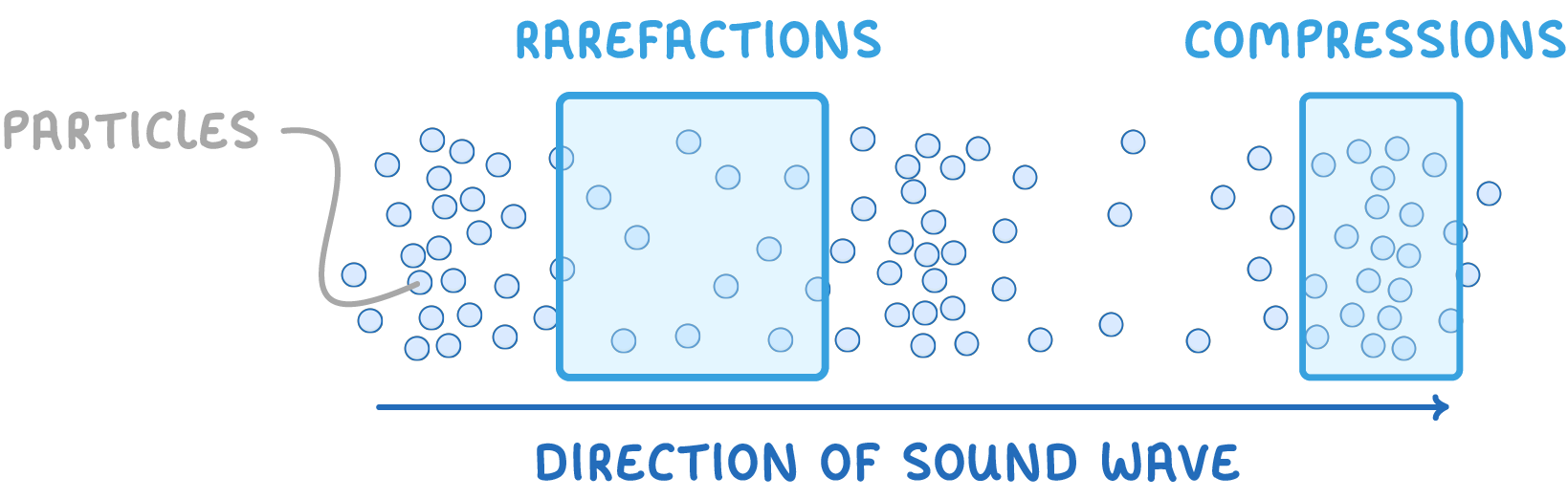
Sound needs a medium
- Because it is carried by vibrating particles, sound needs a medium - a solid, a liquid, or a gas.
- Sound cannot travel through a vacuum (such as space) because there are no particles to pass the vibrations on.
The speed of sound in different materials and measuring it
- Sound travels at different speeds in different materials: in general, it travels fastest in solids, slower in liquids, and slowest in gases.
- The denser the medium, the more closely packed its particles are, so vibrations pass from particle to particle more quickly.
- In air, sound travels at roughly 330 to 350 m/s, depending mainly on air temperature.
Measuring the speed of sound in air
Two common lab methods are used.
Method 1 - Two microphones and a known wavelength
A signal generator and speaker produce sound of a known frequency. Two microphones connected to an oscilloscope each display a trace. Starting with both by the speaker, one microphone is moved away until the traces align again at exactly one wavelength apart. The speed is calculated using .
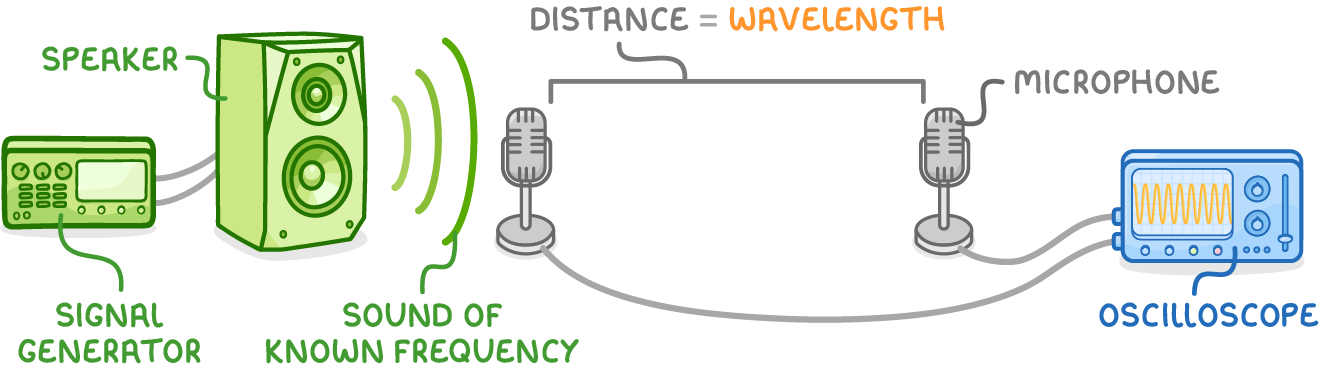
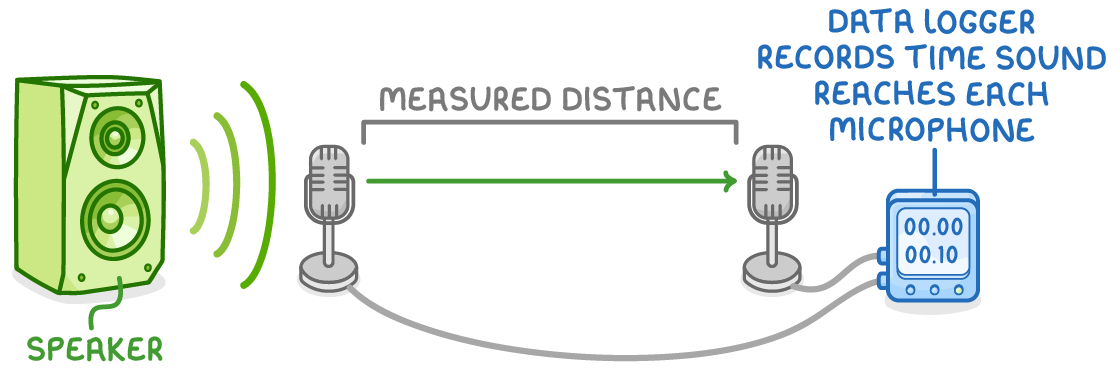
Method 2 - Distance and time directly
Two microphones are placed a measured distance apart in a line with a sound source. A data logger records the time the sound reaches each microphone to find the travel time. Speed is calculated using .
A data logger is used because sound travels too fast over short distances to be timed accurately with a stopwatch.
How sound travels through solids and how we hear it
- When a sound wave in air reaches a solid, the vibrating air particles strike the surface and set the particles in the solid vibrating too.
- Those particles pass the vibration along to neighbouring particles, carrying the sound through the solid.
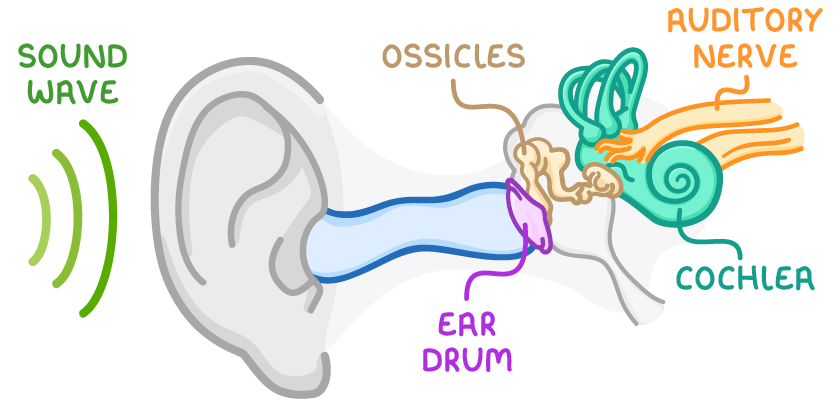
How the ear detects sound
- Sound waves reaching the ear drum make it vibrate.
- These vibrations pass to the ossicles (three tiny bones in the middle ear) and through to the cochlea.
- The cochlea converts the vibrations into electrical signals, which travel along the auditory nerve to the brain.
A higher-frequency wave is heard as a higher pitch, and a larger amplitude is heard as a louder sound.
Range of hearing and microphones
- The human ear can detect frequencies between about 20 Hz and 20,000 Hz (20 kHz). This range is limited by the size and shape of the vibrating parts of the ear.
- As a person ages, the upper frequency limit falls.
- A microphone works similarly: a sound wave makes a diaphragm vibrate, which is converted into an electrical signal.
Refraction of sound between materials
- When a sound wave passes from one material into another, its speed changes.
- Because and the frequency stays the same across the boundary, the wavelength changes: it gets longer when the wave speeds up and shorter when it slows down.
- This change in speed causes the sound wave to change direction (refract).
- Sound speeds up when it enters a denser material.
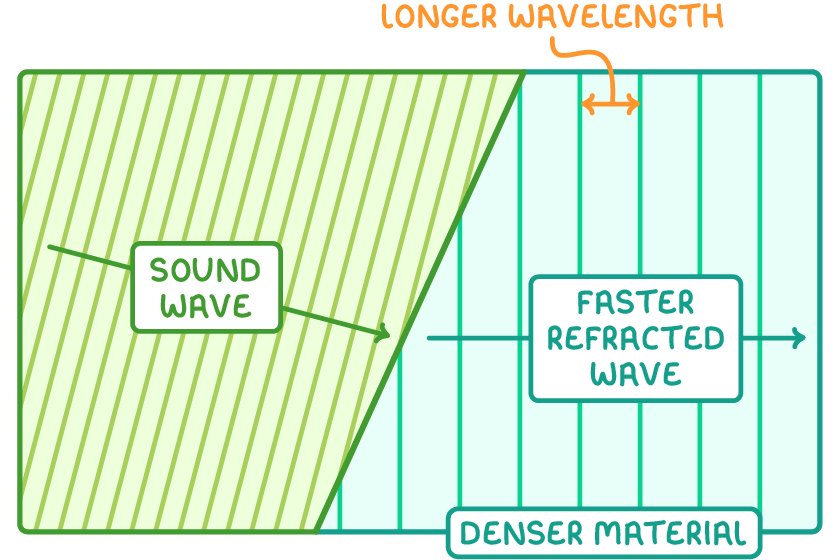
The lines are wavefronts, spreading further apart as the sound speeds up.