6.7 - Nuclear Fission
What nuclear fission is
- Nuclear fission is the splitting of a large, unstable nucleus (such as uranium-235 or plutonium) into two smaller nuclei, releasing energy.
- Spontaneous fission - Where a nucleus splits on its own - is rare. Usually the nucleus has to absorb a neutron first.
How fission is triggered
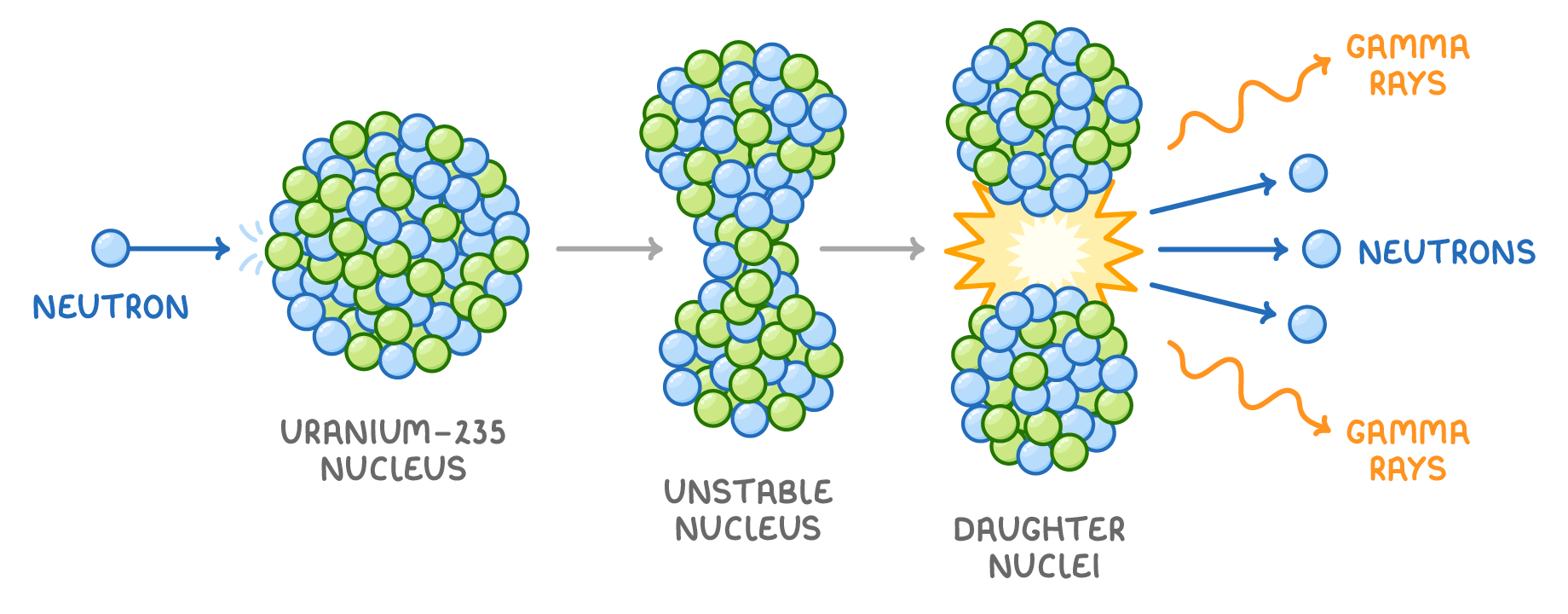
- A slow-moving neutron is absorbed by the nucleus, making it even more unstable and causing it to split.
- A neutron is absorbed easily because it has no charge, so it isn't repelled by the positive nucleus.
- Nuclei like uranium-235 that can absorb slow neutrons this way are described as fissile.
What fission produces
- The heavy nucleus splits into two lighter daughter nuclei, roughly the same size as each other. These are usually radioactive.
- Two or three neutrons are also released, along with a large amount of energy.
- Most of the energy ends up as kinetic energy of the fast-moving fission products; some is carried away as gamma radiation.
The chain reaction
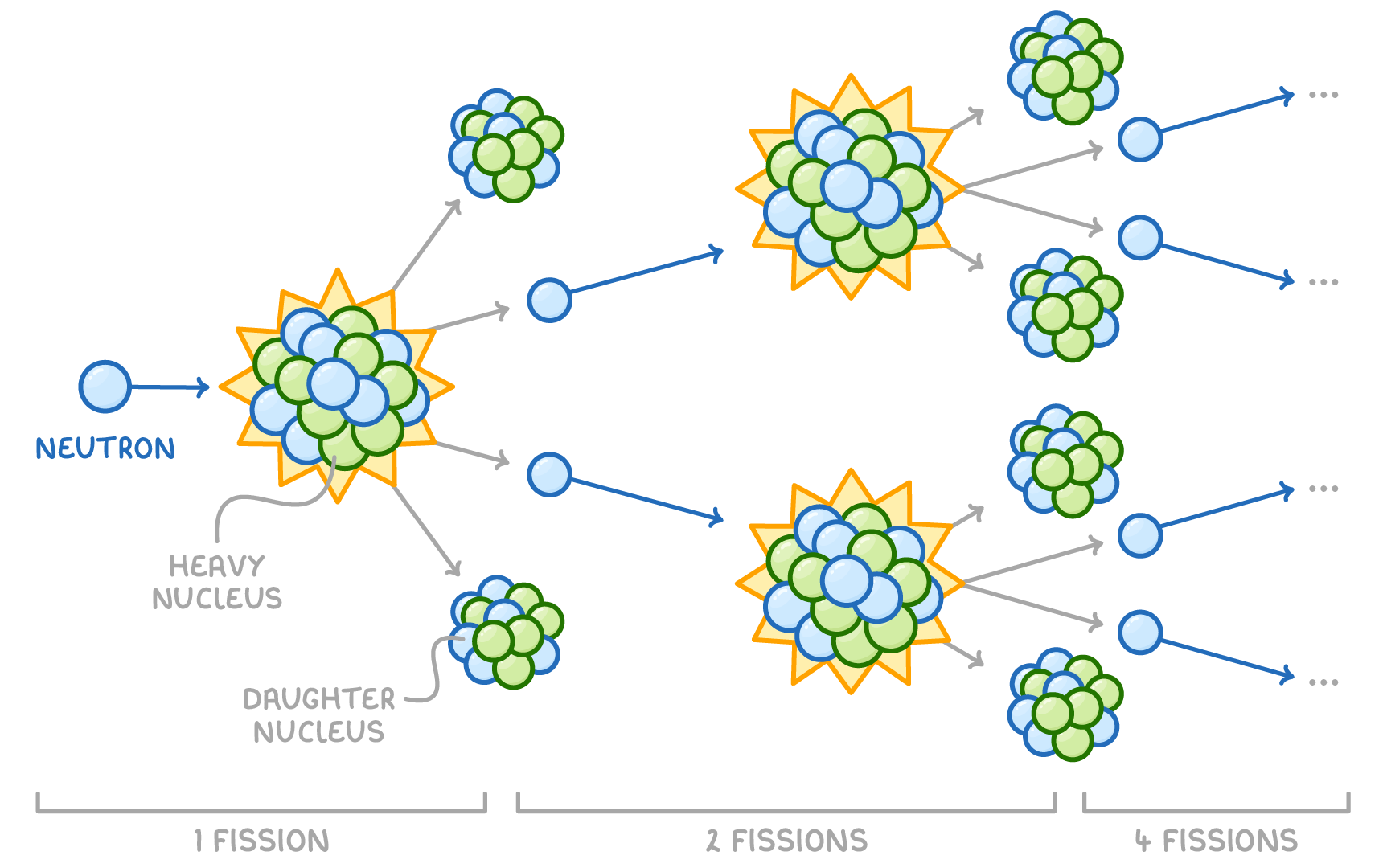
- Each fission releases two or three neutrons. The diagram below follows the case where two are released and both go on to cause another fission.
- If any of these neutrons are absorbed by other nuclei, they cause them to split too, releasing more neutrons and creating a self-sustaining chain reaction.
- Left uncontrolled, the number of fissions grows rapidly, and so does the rate at which energy is released.
Generating electricity from fission
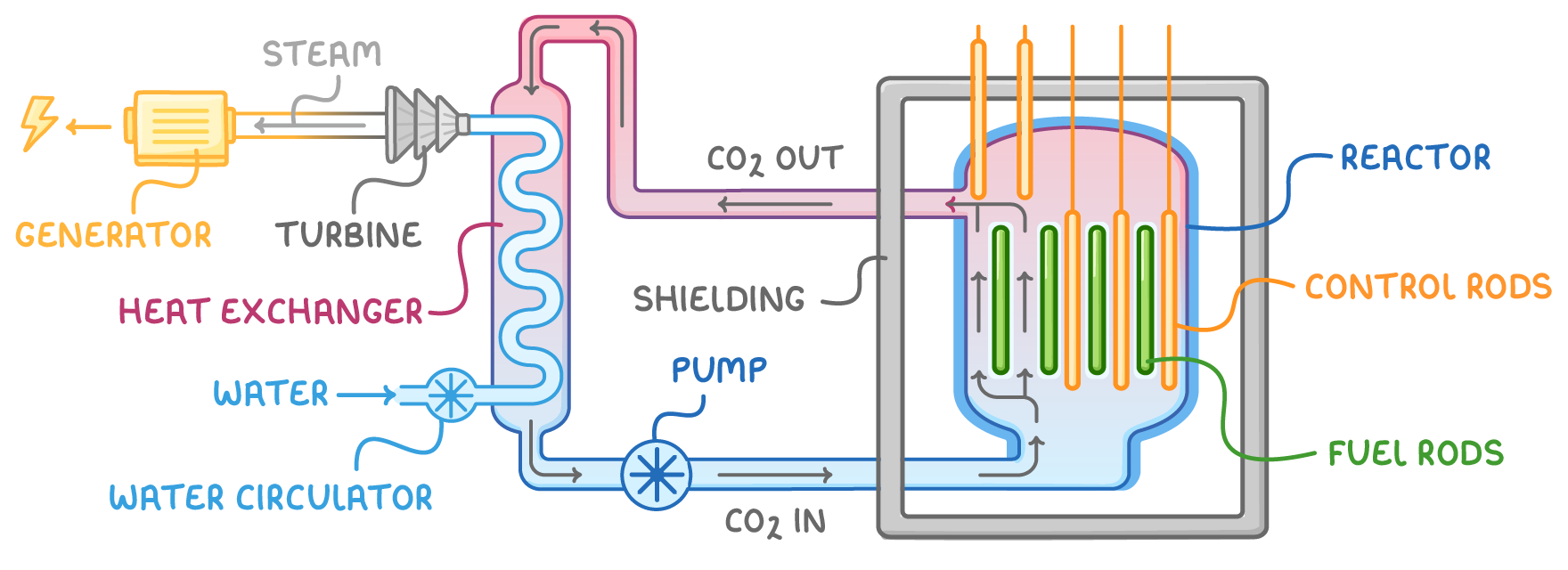
- The energy released by fission heats water into steam.
- The steam drives a turbine, which turns a generator to produce electricity.
Using a coolant
- In many reactors the energy isn't passed straight to the water.
- A coolant (such as carbon dioxide) is pumped around the reactor core to carry heat to a heat exchanger, where it boils the water into steam.
- This keeps the water supply separate from the reactor core.
Benefits and risks of nuclear power
| Benefits | Risks and drawbacks |
|---|---|
| Reliable, generating large amounts of energy from very small amounts of fuel. | Produces radioactive waste with long half-lives, staying dangerous for thousands of years. |
| Releases no greenhouse gases during operation, so it doesn't contribute directly to global warming. | High overall cost to build plants and safely decommission them. |
| Low fuel costs compared to fossil fuels. | Risk of major accidents or radiation leaks. |
Disposing of radioactive waste
- High-level radioactive waste is sealed in steel canisters or vitrified (set into glass) and stored deep underground.
- Stored waste poses a long-term risk if containers leak over time or are damaged by geological activity, contaminating groundwater and soil.
TermDefinition
Nuclear fissionThe splitting of a large, unstable nucleus into two smaller nuclei, releasing energy.
Daughter nucleiThe smaller nuclei formed when a larger nucleus splits during nuclear fission.
Chain reactionA self-sustaining process where neutrons released by one fission trigger further fissions.
Key points to remember
How were these notes?