2.7 - Energy & Power Formulas
The heating effect of a current in a resistor
- When there's a current in a resistor, energy is transferred that heats the resistor up.
- This energy is dissipated to the thermal energy stores of the resistor and its surroundings.
Why the resistor heats up
- As free electrons flow through the resistor, they collide with the ions in the metal lattice.
- Each collision transfers energy to the ions, making them vibrate more.
- The more the ions vibrate, the hotter the metal becomes.
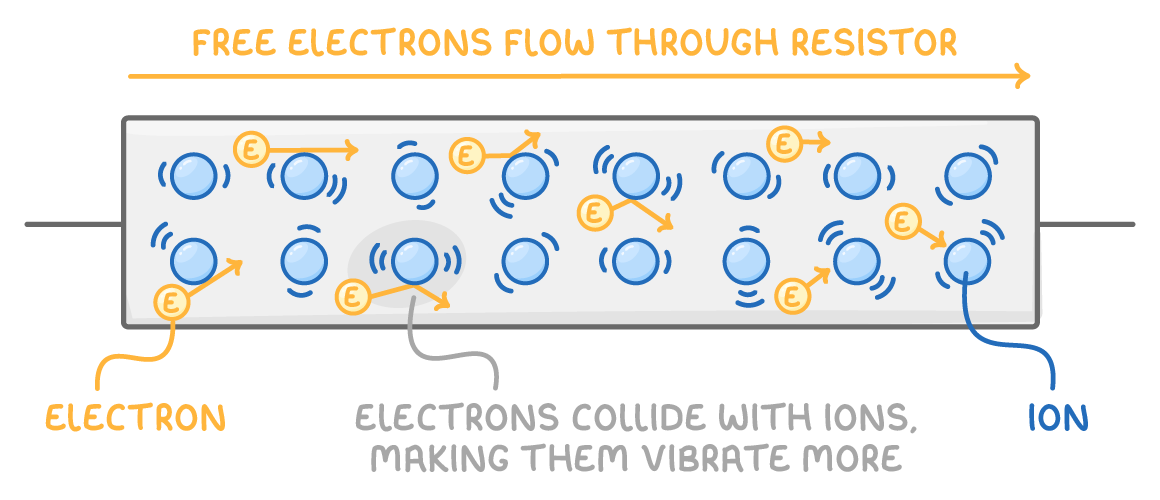
Advantages and disadvantages
| When heat is the useful output (advantage) | When heat is not the useful output (disadvantage) |
|---|---|
| Heaters and toasters use high-resistance wire to transfer energy to the surroundings | Energy transferred to thermal stores is wasted, reducing efficiency |
| A fuse melts and breaks the circuit if the current gets too high | Components that get too hot can be damaged, and heating can change how the circuit behaves |
Power ratings of appliances
- Appliances are labelled with a power rating - the maximum power the appliance transfers when in use.
- A higher power rating transfers energy faster, which means an appliance needs less time to do the same job.
- A higher power rating doesn't always mean more useful energy is transferred - an inefficient appliance transfers more energy to wasted thermal stores.
Potential difference is energy per charge - E = QV
- When charge moves through a potential difference, energy is transferred.
- The potential difference across a component is the energy transferred per coulomb of charge passing through it (1 V = 1 J/C).
Formula for energy transferred
Where:
- = Energy transferred, in joules (J)
- = Charge, in coulombs (C)
- = Potential difference, in volts (V)
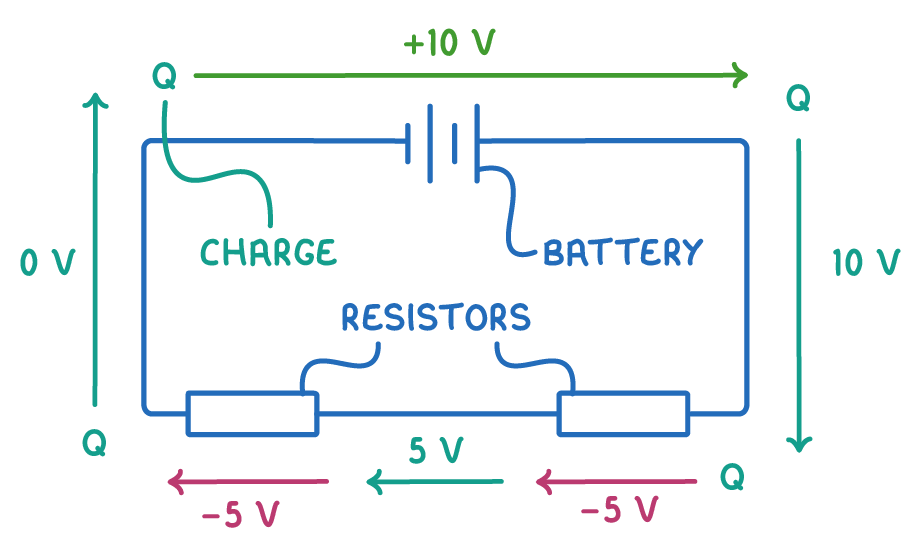
The charge gains energy at the battery and transfers it in the two resistors.
Worked example - Energy transferred by a motor
The motor in a battery-powered toy car is connected to a 6 V battery. 90 C of charge passes through the motor while the car is running. Calculate the energy transferred.
Step 1 - Identify the values
- Charge: C
- Potential difference: V
Step 2 - Substitute into E = QV
Formula for electrical power
Where:
- = Power, in watts (W)
- = Current, in amperes (A)
- = Potential difference, in volts (V)
Electrical power can be found from the potential difference across an appliance and the current through it.
Worked example - Finding the current with P = IV
A 1.8 kW electric iron is connected to a 230 V supply. Calculate the current through the iron. Give your answer to two significant figures.
Step 1 - Convert the power to watts
1.8 kW = 1,800 W
Step 2 - Rearrange P = IV for the current
Step 3 - Substitute the values
Formula for energy transferred from current, p.d. and time
Combining and gives a single equation for the energy transferred to a component.
Where:
- = Energy transferred, in joules (J)
- = Current, in amperes (A)
- = Potential difference, in volts (V)
- = Time, in seconds (s)
Worked example - Energy transferred by a motor
The motor in a battery-powered toy car is connected to a 4.5 V battery. A current of 0.60 A flows through the motor for 2.5 minutes. Calculate the energy transferred by the motor.