5.3 - Pressure in Liquids
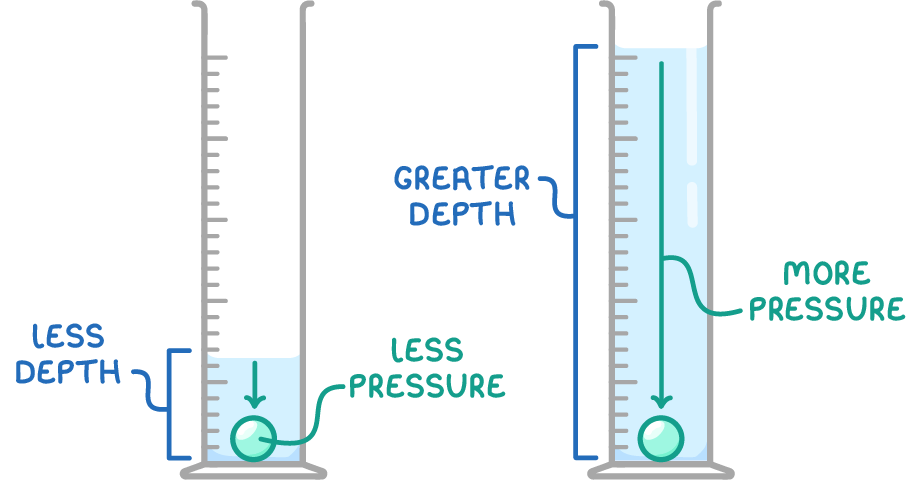
Pressure in a liquid increases with depth and density
- At a point inside a liquid, the pressure comes from the weight of the column of liquid directly above that point.
- In a fluid at rest, the pressure at any point acts equally in all directions.
Pressure increases with depth
- Going deeper means a taller column of liquid sits above the point.
- The extra weight adds to the pressure, so the deeper you go, the higher the pressure.
Pressure increases with density
- A denser liquid has more mass in a given volume, so the column above a point weighs more - creating a higher pressure at the same depth.
- Liquids can be squashed only slightly, so their density is treated as constant throughout.
Formula for pressure in a liquid
Where:
- = Pressure due to the column of liquid, in pascals (Pa)
- = Height of the column of liquid, or depth below the surface, in metres (m)
- = Density of the liquid, in kilograms per cubic metre (kg/m3)
- = Gravitational field strength, in newtons per kilogram (N/kg)
Worked example - Pressure difference between two depths
Calculate the change in pressure between a point 12 m below the surface of a lake and a point 42 m below the surface. The density of water is 1,000 kg/m3 and = 9.8 N/kg.
Step 1 - Calculate the pressure at a depth of 12 m
Step 2 - Calculate the pressure at a depth of 42 m
Step 3 - Subtract to find the change in pressure
411,600 - 117,600 = 294,000 Pa (294 kPa)