9.2 - Thermal Insulation
The experiment
Aim
To find out which materials are the best thermal insulators, and whether adding more layers of a material keeps water hot for longer, by following how the temperature of hot water falls over time in each case.
Background
- Hot water always loses energy to its cooler surroundings, by conduction, convection and radiation.
- A thermal insulator slows that energy transfer down, so the water stays hot for longer.
- You can't measure the energy escaping directly, but you can measure the water's temperature as it falls.
- So in this practical you record how fast hot water cools with different materials round it. The slower the temperature falls, the better the insulator.
Variables
- Independent variable - The insulating material, or the number of layers of one material.
- Dependent variable - The temperature of the water, every three minutes.
- Control variables - The volume and starting temperature of the water, the beakers and lid, and the thickness of each material.
Method
- Set up - Stand a small beaker inside a large one, and pack the gap between them with one of the insulating materials.
- Add the hot water - Pour 80 cm3 into the small beaker and cover it with a cardboard lid, with the thermometer through the lid and its bulb under the water.
- Take readings - Record the temperature straight away, then every three minutes for fifteen minutes.
- Repeat with each material - Use a different material each time, letting the apparatus cool to room temperature first, and do one run with nothing in the gap to compare against.
- Compare thicknesses - Wrap 2, 4 and then 6 layers of one material round the small beaker and repeat. The run with nothing in the gap counts as 0 layers.
- Plot cooling curves - Temperature against time, with every run on the same axes.
Safety
- Hot water scalds - Pour it with the beaker standing on the bench, and use water that has stood for a minute or two after boiling rather than straight off the boil.
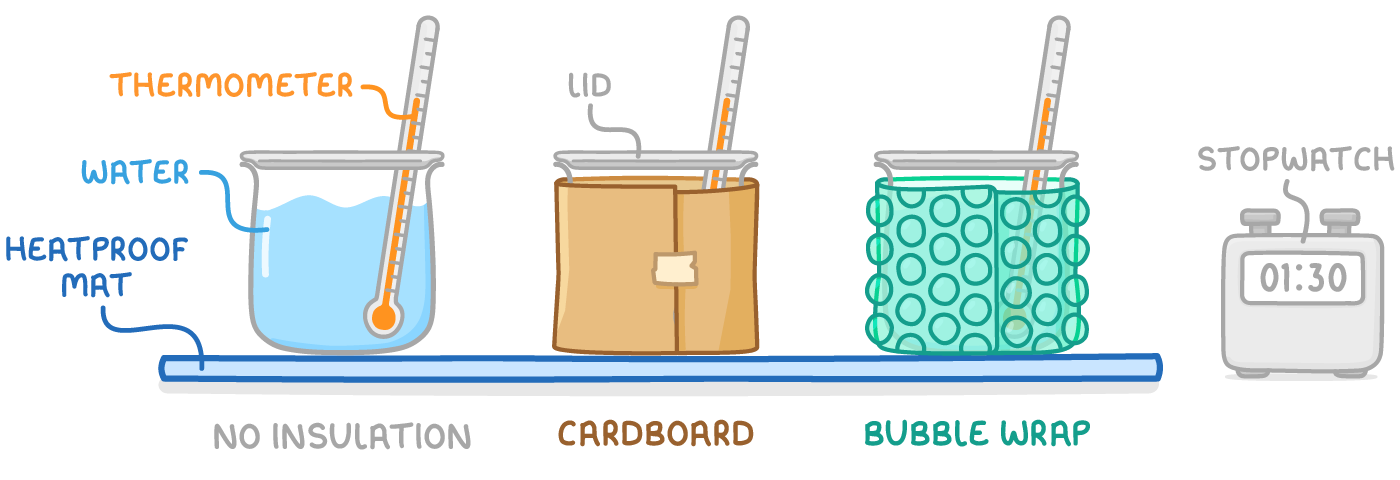
The insulation is wrapped round each beaker here, rather than packed into a gap.
Worked example - Comparing insulating materials
A student packed different materials round a small beaker of hot water. Each time, they poured in 80 cm3 of water at 80.0 °C and recorded its temperature every three minutes.
| Time (min) | 0 | 3 | 6 | 9 | 12 | 15 |
|---|---|---|---|---|---|---|
| No insulation (°C) | 80.0 | 70.0 | 62.0 | 56.0 | 51.0 | 47.0 |
| Newspaper (°C) | 80.0 | 74.0 | 69.0 | 65.0 | 61.5 | 58.5 |
| Bubble wrap (°C) | 80.0 | 76.5 | 73.5 | 71.0 | 68.5 | 66.5 |
They then wrapped 2, 4 and 6 layers of bubble wrap round the beaker, and recorded the temperature after 15 minutes each time.
| Layers of bubble wrap | 0 | 2 | 4 | 6 |
|---|---|---|---|---|
| Temperature after 15 min (°C) | 47.0 | 62.0 | 66.5 | 68.5 |
Rank the materials, work out how much energy the water lost with no insulation and with bubble wrap, describe the shape of the curves, and say what the extra layers do.
Step 1 - Find each temperature drop
Subtract the temperature after 15 minutes from the 80.0 °C start.
- With no insulation, the drop is 80.0 − 47.0 = 33.0 °C.
- With newspaper, the drop is 80.0 − 58.5 = 21.5 °C.
- With bubble wrap, the drop is 80.0 − 66.5 = 13.5 °C.
Step 2 - Rank the materials
The smaller the drop, the less energy escaped, so bubble wrap is the best insulator, followed by newspaper. Bubble wrap works best because it traps air in small pockets. Air conducts poorly, and trapped air can't move to carry energy away by convection.
Step 3 - Turn the temperature drops into energy
Use . The 80 cm3 of water has a mass of 0.080 kg, and the specific heat capacity of water is 4,200 J/kg°C.
With no insulation:
With bubble wrap:
Bubble wrap cut the energy lost in 15 minutes from about 11,100 J to 4,500 J.
Step 4 - Describe the shape of the curves
Every cooling curve is steepest at the start and flattens over time. The water cools fastest when it's much hotter than the room, and more slowly as it gets closer to room temperature.
Step 5 - Look at what extra layers do
Work out the temperature drop for each number of layers.
- With 0 layers, the drop is 80.0 − 47.0 = 33.0 °C.
- With 2 layers, the drop is 80.0 − 62.0 = 18.0 °C.
- With 4 layers, the drop is 80.0 − 66.5 = 13.5 °C.
- With 6 layers, the drop is 80.0 − 68.5 = 11.5 °C.
The first 2 layers cut the drop by 15.0 °C, the next 2 by 4.5 °C, and the last 2 by only 2.0 °C. Each extra layer makes less difference than the one before.
Common exam questions
Question 1
Why is a lid put on the beaker?
So energy can't escape by evaporation and by warm air rising out of the top. Then the insulation is the only thing being compared.
Question 2
Why is the same thickness of each material used?
Thickness affects how well a material insulates, so using different thicknesses would make it impossible to tell whether a smaller temperature drop was down to the material or to having more of it.
Question 3
Which material is the best insulator, and how do you tell from the graph?
The one whose cooling curve falls least steeply and finishes highest, because the least energy escaped through it.
Question 4
Explain how the air gap in a cavity wall reduces energy transfer through the wall.
Air is a poor conductor, so much less energy is conducted from the warm inner wall to the cold outer wall than would pass through solid brick.
Question 5
A student says six layers of insulation should keep the water three times as warm as two layers. Why don't the results show that?
Each extra layer helps less than the one before, so the temperature drop doesn't fall in proportion to the number of layers.