2.12 - Static Electricity - Uses & Dangers
Useful applications of static electricity
Inkjet printers
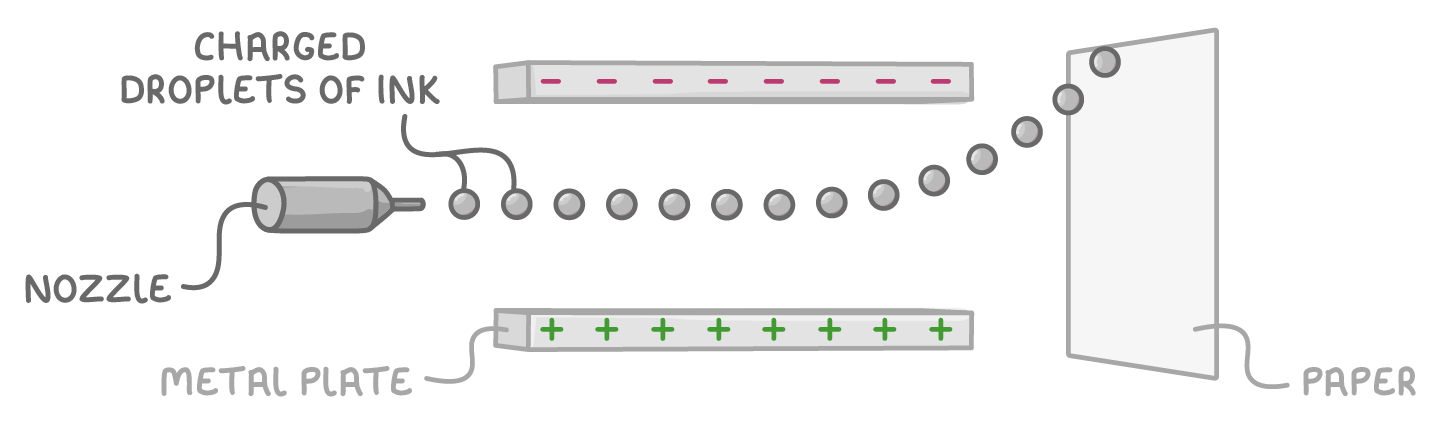
Charged droplets of ink are used to print onto paper:
- Tiny droplets of ink are forced out of a fine nozzle, which gives them an electric charge.
- The droplets pass between two metal plates with a voltage across them, making one plate negative and the other positive.
- Each droplet is attracted towards the oppositely charged plate and repelled by the similarly charged plate, deflecting it sideways.
- Changing the size and direction of the voltage steers each droplet to a specific place on the paper.
- Thousands of tiny dots build up to produce the image.
Photocopiers
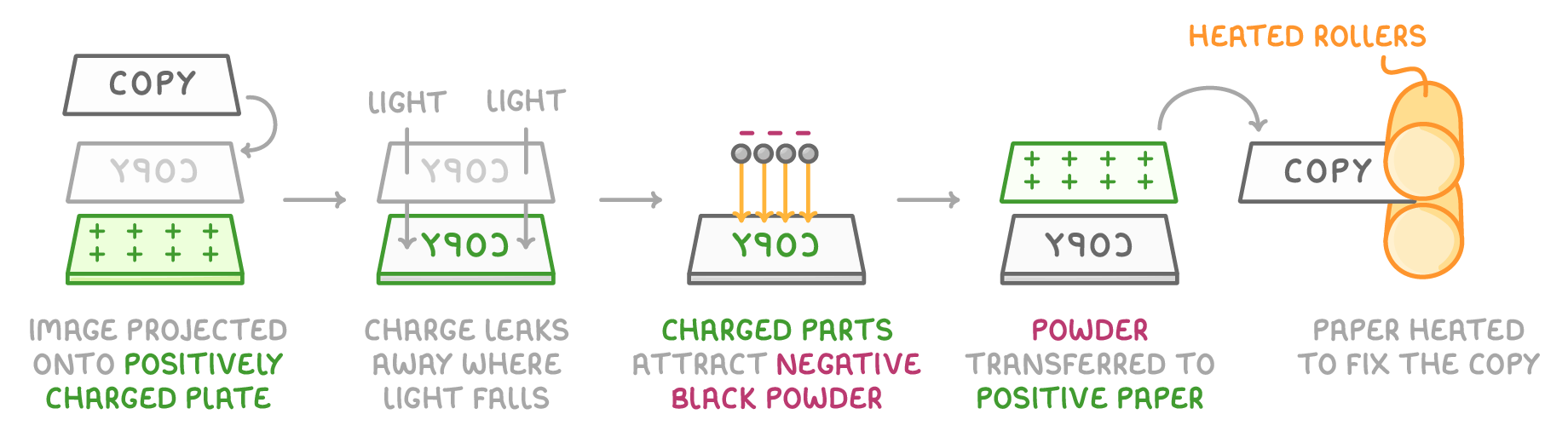
Static electricity copies an image onto a charged plate before printing it onto paper:
- The image plate is given a positive charge, and an image of the original is projected onto it.
- Where light falls on the plate (the white parts), the charge leaks away, leaving charge only on the dark areas.
- The charged parts attract negatively charged black powder, which is transferred onto positively charged paper.
- The paper is heated so the powder melts and sticks, fixing the copy.
Dangers of static electricity
A build-up of static charge can be dangerous when the charge suddenly discharges as a spark.
Where the dangers occur
- Refuelling - As fuel flows through a filler pipe, friction makes static charge build up. A spark can ignite the fuel vapour and cause an explosion.
- The risk is reduced by making nozzles from metal to conduct charge away, and by fitting earthing straps between the fuel tank and the pipe.
- Lightning - Inside a storm cloud, raindrops and ice bump together and knock off electrons, leaving the top of the cloud positively charged and the bottom negatively charged. This builds up a huge potential difference, released as a giant spark.
- Clothing crackles - Dragging synthetic clothes over each other (such as in a tumble dryer) scrapes off electrons, charging both surfaces. The clothes stick together by attraction and produce crackles and small shocks as charge discharges.
Earthing to prevent charge build-up
Dangerous sparks are prevented by earthing a charged object: connecting it to the ground through a conductor, such as a copper wire or metal strap.
How the electrons move
Because charge is carried by electrons:
- If the object is negatively charged, electrons flow down the conductor from the object to the ground.
- If the object is positively charged, electrons flow up the conductor from the ground to the object.
In both cases, the object becomes neutral. For example, fuel tankers are earthed during filling and unloading so static charge flows safely away before a spark can form.
TermDefinition
EarthingConnecting an object, such as a charged object or the metal case of an appliance, to the ground through a conductor so that charge can flow safely away.