3.15 - Absorbing & Emitting Radiation
Infrared emission and absorption
- Every object constantly emits and absorbs infrared radiation from its surface.
- The hotter an object is, the more infrared radiation it emits in a given time.
Emission vs absorption sets the temperature
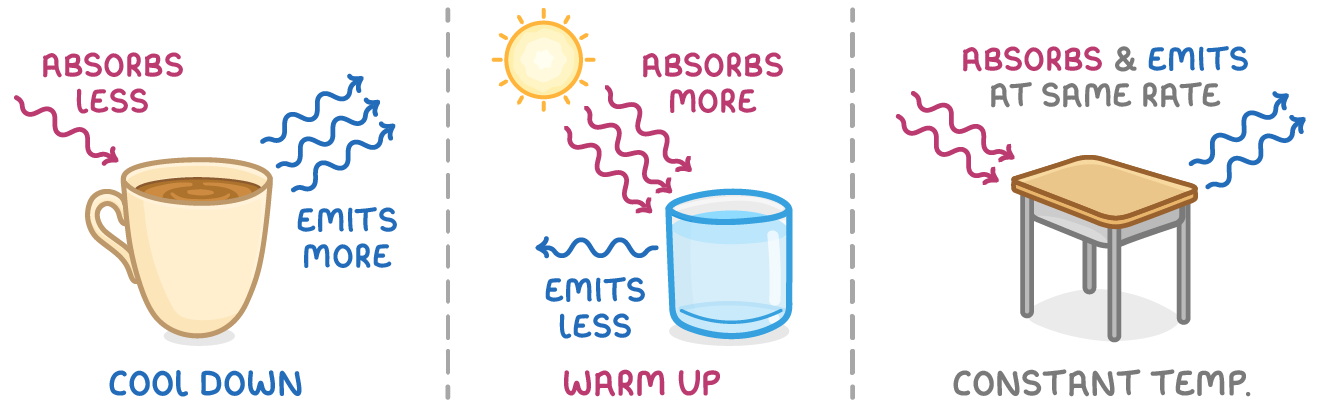
- Emits more than it absorbs - The object cools down (e.g. a mug of hot tea cooling).
- Emits less than it absorbs - The object warms up (e.g. a glass of iced water on a warm day).
- Emits at the same rate as it absorbs - The object stays at the same temperature.
How surfaces affect emission and absorption
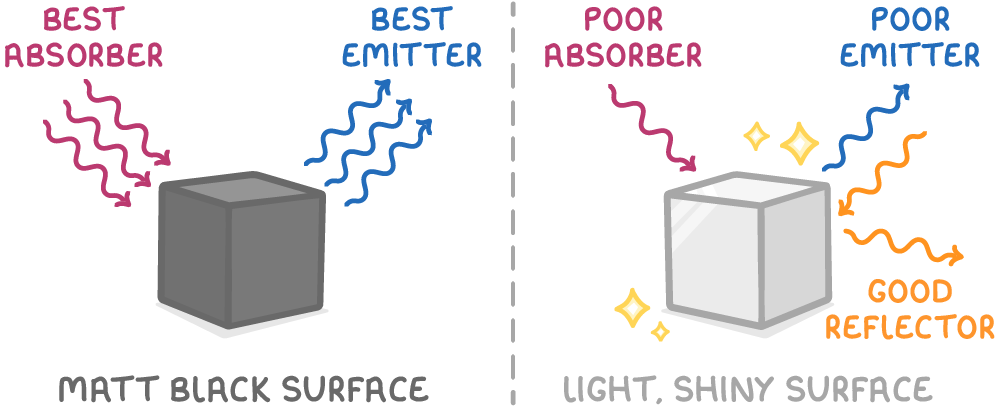
- A matt black surface is the best absorber and the best emitter of radiation.
- A light, shiny surface is a poor absorber and a poor emitter, but the best reflector of radiation.
Investigating IR emission and absorption by surfaces
Comparing emission with a Leslie cube
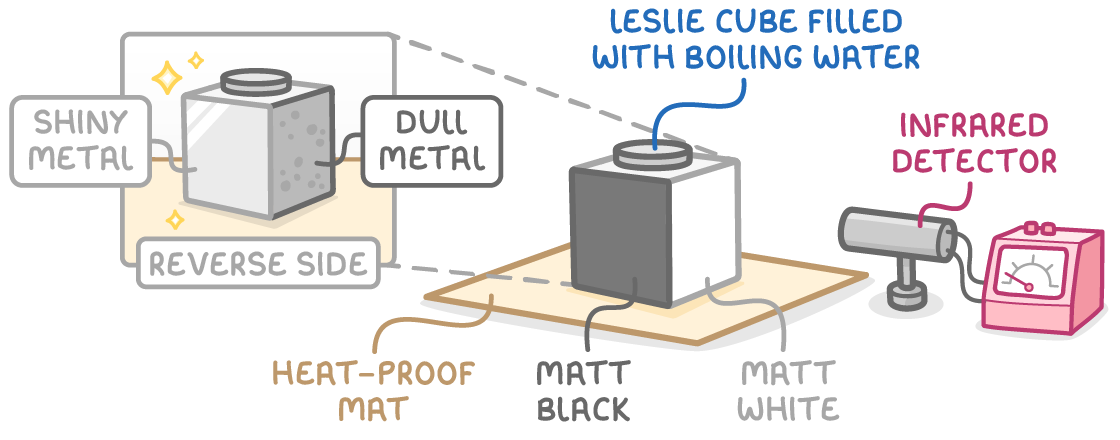
A Leslie cube is a hollow metal cube whose four vertical faces have different finishes (e.g. matt black, matt white, shiny metal and dull metal).
- Stand an empty Leslie cube on a heat-proof mat and fill it with boiling water.
- Check with a thermometer that all four faces are at the same temperature.
- Hold an infrared detector a fixed distance from one face and record the amount of radiation detected.
- Repeat for each face, keeping the detector the same distance away each time.
Result: Matt black is the best emitter, followed by matt white, dull metal, and shiny metal. Dark, matt surfaces are the best emitters; light, shiny surfaces are the poorest.
Comparing absorption with melting wax
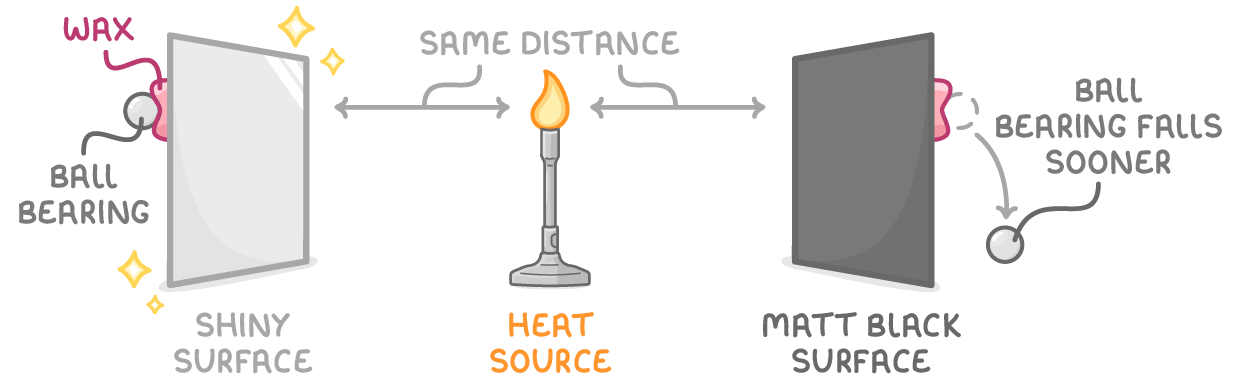
- Stick a ball bearing to the back of two different surfaces using wax.
- Place both an equal distance from a heat source and time how long it takes each ball bearing to fall off.
- The wax behind the better absorber melts sooner, so its ball bearing falls first.
Comparing cooling rates
- Wrap identical containers of hot water in different surfaces (e.g. matt black and shiny silver).
- Record how quickly each cools - the water cools fastest in the container wrapped in the best emitter.
How temperature changes the radiation curve
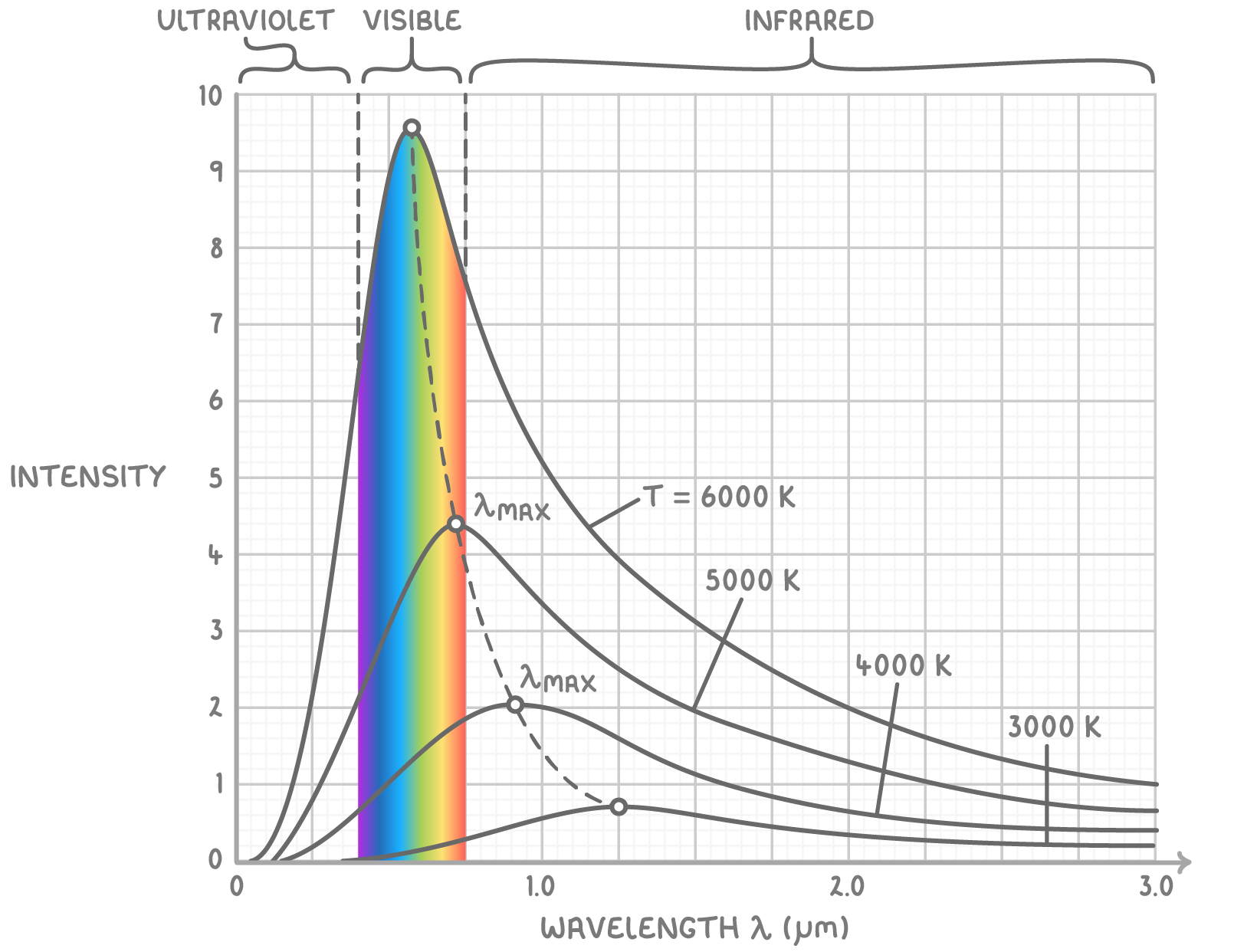
- An object emits radiation across a continuous range of wavelengths.
- How that radiation is spread across wavelengths depends on the object's temperature.
As the temperature increases
- The intensity of every wavelength increases.
- The intensity increases more rapidly for shorter wavelengths than for longer ones.
- The peak wavelength (the wavelength emitted with the highest intensity) decreases, shifting the peak towards shorter wavelengths.
Visible changes with heating
- At everyday temperatures, the peak wavelength lies in the infrared.
- As an object gets hotter, it begins to glow red and then white as more of its radiation moves into the visible light spectrum.
Radiation balance and the Earth's temperature
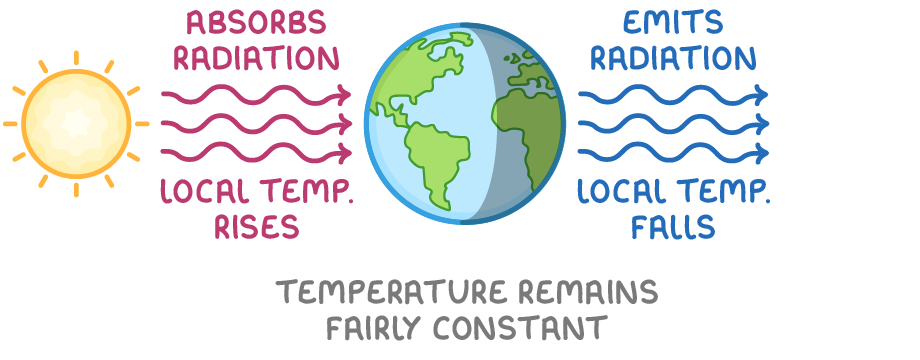
The Earth's temperature depends on the balance between the radiation it absorbs and the radiation it emits.
- Absorbs faster than it emits - Temperature rises.
- Emits faster than it absorbs - Temperature falls.
- Absorbs and emits at the same rate - Temperature stays constant.
Day and night
- During the day - Radiation from the Sun is absorbed by the atmosphere and surface, so local temperatures rise.
- At night - Less radiation is absorbed than is emitted, so local temperatures fall.
The greenhouse effect
- Greenhouse gases in the atmosphere (such as carbon dioxide and methane) absorb infrared radiation emitted by the Earth's surface.
- They re-emit this radiation in all directions, including back towards the surface.
- This reduces the rate at which energy is lost to space, causing the Earth's temperature to rise until absorption and emission balance again at a higher temperature.
TermDefinition
Leslie cubeA hollow metal cube whose vertical faces have different surface finishes, used to compare how well each surface emits infrared radiation.
Peak wavelengthThe wavelength emitted with the highest intensity.
Key points to remember
How were these notes?