5.1 - The Solar System & the Universe
The Solar System and the objects in it
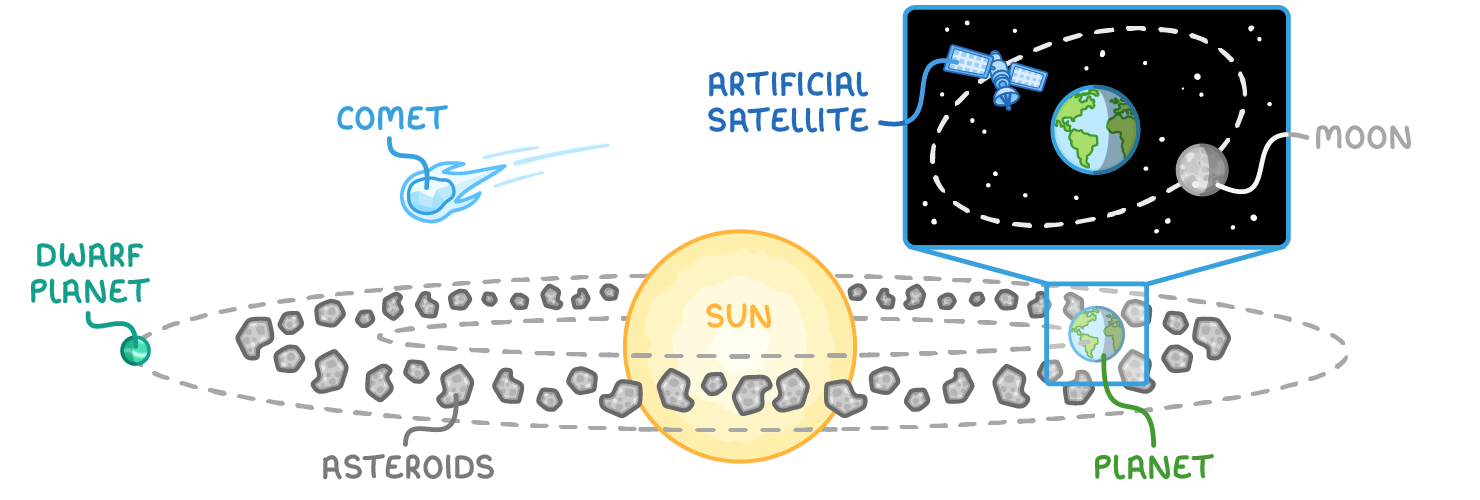
- The Solar System is the Sun together with everything that orbits it.
- At its centre is the Sun, our nearest star: a hot sphere of gas.
Objects that orbit the Sun
- Planets - Large bodies that orbit a star. To count as a planet, a body must be massive enough that its gravity has cleared its orbit of other objects (apart from its own moons).
- Dwarf planets - Planet-like bodies that orbit the Sun but aren't big enough to count as planets, such as Pluto.
- Moons - Natural satellites: bodies that orbit a planet, the way planets orbit the Sun.
- Artificial satellites - Objects humans have built and put into orbit, most of which orbit the Earth.
- Asteroids - Lumps of rock and metal that orbit the Sun, mostly in the asteroid belt between Mars and Jupiter.
- Comets - Balls of rock, dust and ice that orbit the Sun, often on long, stretched-out paths.
A satellite is any object that orbits a larger one, so both moons (natural satellites) and artificial satellites are types of satellite.
The eight planets in order from the Sun
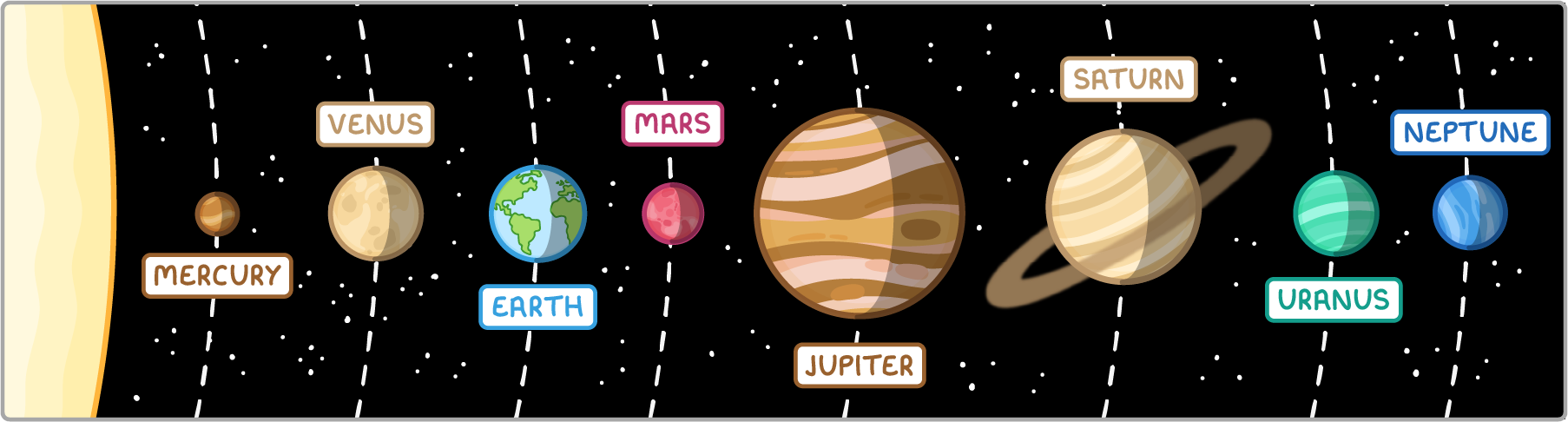
- There are eight planets in the Solar System.
- In order of distance from the Sun, moving outwards: Mercury, Venus, Earth, Mars, Jupiter, Saturn, Uranus and Neptune.
- The four inner planets (Mercury, Venus, Earth, Mars) orbit closest to the Sun.
- The four outer planets (Jupiter, Saturn, Uranus, Neptune) lie beyond the asteroid belt.
- All eight orbit the Sun in roughly the same plane.
Galaxies and the scale of the Universe
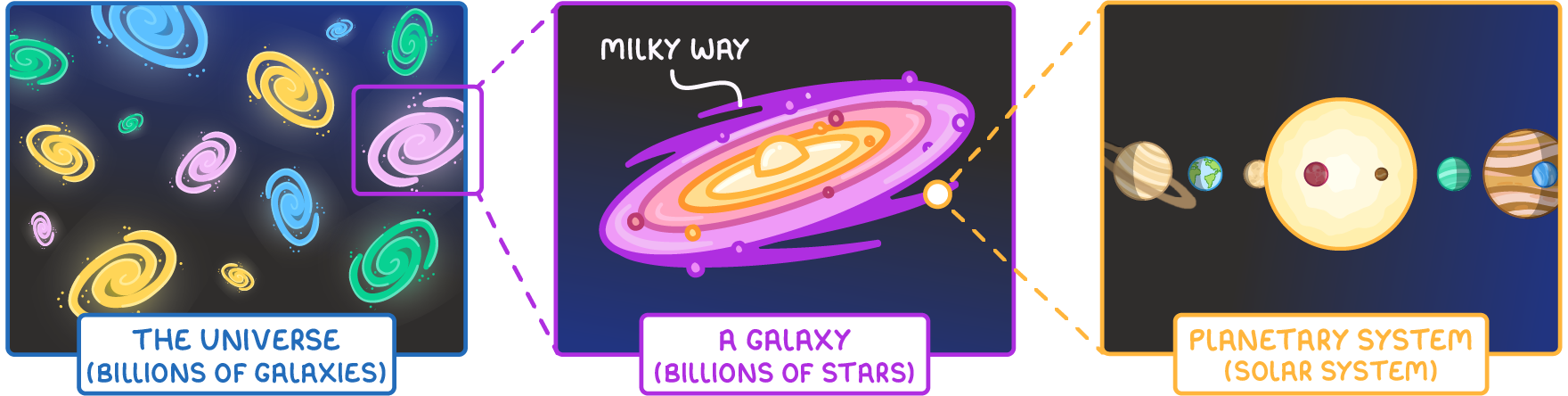
- A galaxy is a huge collection of billions of stars, held together by gravity.
- Our galaxy is the Milky Way. The Sun is just one of its many billions of stars, lying about halfway along one of its spiral arms.
- Other stars in the Milky Way are vastly further from Earth than the Sun is, which is why they appear as tiny points of light while the Sun looks large and bright.
- Distances between neighbouring stars are typically hundreds of thousands of times greater than the distance from the Earth to the Sun.
The Universe
- The Milky Way is just one of billions of galaxies. Together, all of these galaxies make up the Universe.
- Galaxies are separated by even larger distances than the stars within them, so the Universe is mostly empty space.
- The ladder of scale:
- The Universe contains billions of galaxies.
- Each galaxy contains billions of stars.
- Around a star like the Sun lies a planetary system.
Why weight and g differ from one body to another
The weight of an object is the force of gravity acting on it:
Mass does not change with location, but gravitational field strength () does.
What determines g at a body's surface
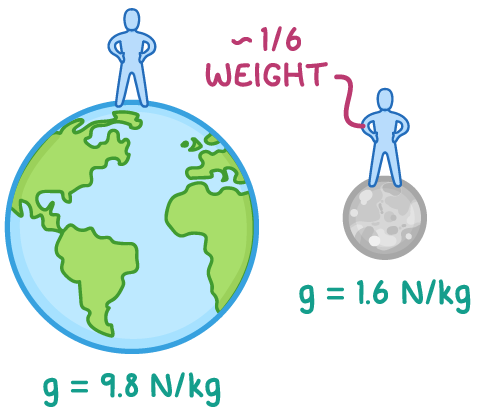
- Mass of the body - A more massive body creates a stronger gravitational field at its surface. Earth is much more massive than the Moon, so on Earth (about 9.8 N/kg) is greater than on the Moon (about 1.6 N/kg).
- Radius of the body - Gravitational field strength decreases as distance from the centre of mass increases.
Weight on the Moon
Because on the Moon is roughly one sixth of its value on Earth, an astronaut weighs about one sixth as much on the Moon as on Earth, even though their mass remains identical.
TermDefinition
Solar SystemThe Sun together with everything that orbits it.
PlanetA large body that orbits a star.
Dwarf planetA planet-like body that orbits the Sun but is not big enough to count as a planet.
MoonA natural satellite that orbits a planet.
Artificial satelliteA satellite that humans have built and put into orbit.
AsteroidA lump of rock and metal that orbits the Sun, mostly in the asteroid belt between Mars and Jupiter.
CometA ball of rock, dust and ice that orbits the Sun, often on a long, stretched-out path.
GalaxyA huge collection of billions of stars, held together by gravity.
Key points to remember
How were these notes?