10.8 - Waves in Water & in a Solid
The experiment
Aim
To measure the frequency, the wavelength and the speed of water waves in a ripple tank and of waves in a solid, and to work out which apparatus is suitable for measuring each of those three quantities.
Background
- The frequency of a wave is the number of waves passing a point each second. Its wavelength is the distance from one crest to the next.
- The wave speed is . It can also be found by timing one wavefront over a distance, with .
- The speed of a water wave depends on the depth of the water, not on what is making the waves.
- Waves are too fast and too small to measure one at a time, but you can count many waves over a set time and measure across many wavelengths.
- So in this practical you measure the frequency and wavelength of waves in water, on a string, and in a metal rod, and use them to find the speed.
Variables
- Independent variable - None in the ripple tank or the rod, where you only take measurements. On the string, the frequency.
- Dependent variable - In the ripple tank and the rod, the frequency, the wavelength and the speed. On the string, the wavelength and the speed.
- Control variables - The depth of water in the tank, and the mass hanging on the string.
Method - Water waves in a ripple tank
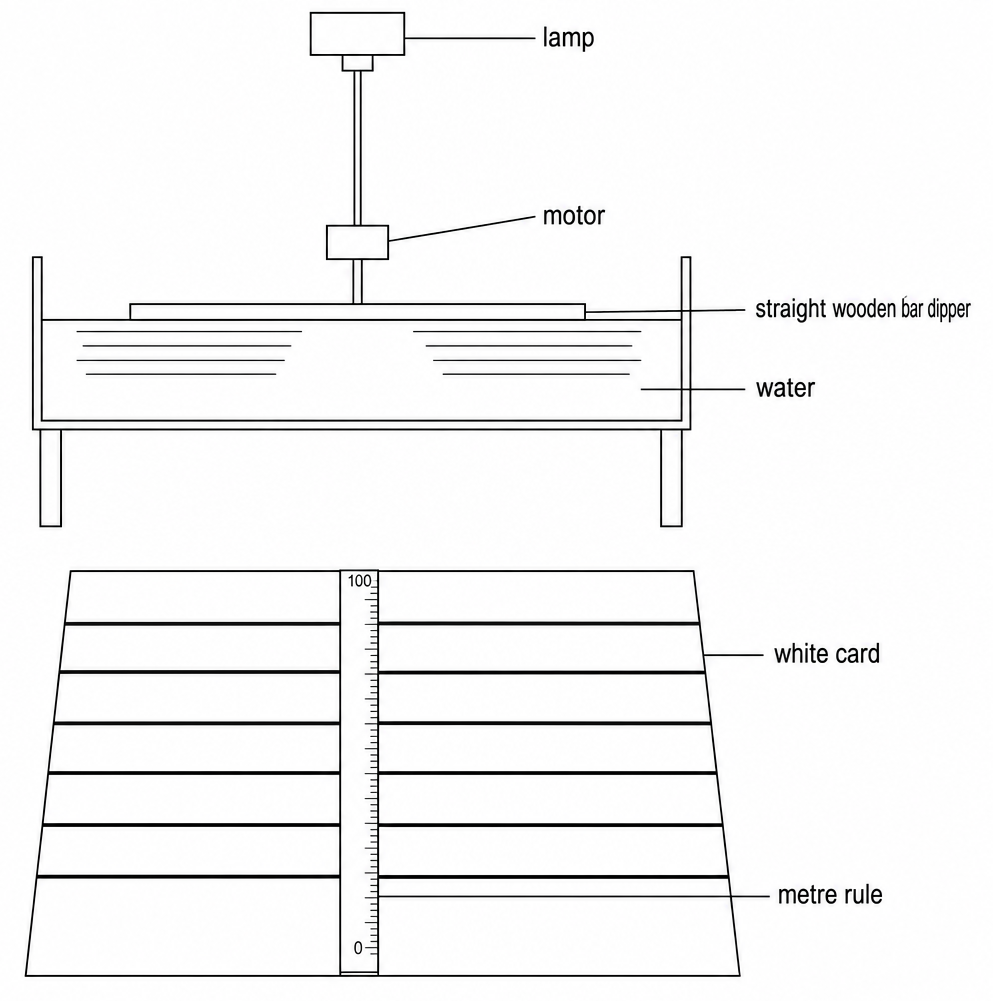
- Set up the tank - Stand it level with water about 5 mm deep, and a wooden rod just touching the surface. A motor on the rod, run slowly, makes straight waves.
- Show the waves on a card - Put a lamp above the tank and white card on the floor below, and darken the room. Look at the bands on the card, not down through the water.
- Measure the frequency - Count the waves passing a point on the card in 10 seconds, and divide by 10.
- Measure the wavelength - Lay a metre rule on the card at right angles to the bands, measure across as many waves as fit, and divide by the number of waves.
- Measure the speed - Time one wavefront across a measured distance and use . Compare it with .
Method - Waves on a stretched string
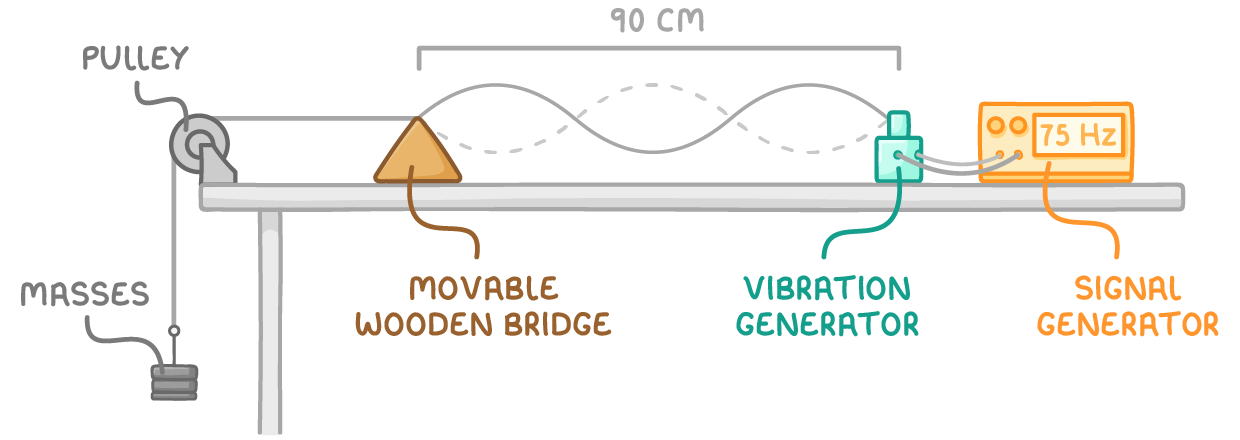
- Set up the string - Run a string from a vibration generator over a pulley, with a 100 g mass on the end, and connect the vibration generator to a signal generator.
- Get a steady pattern - Change the frequency slowly until the string forms loops that seem to stand still.
- Measure the wavelength - Measure across as many whole loops as you can and divide by the number of loops. Each loop is half a wavelength, so double it.
- Find the speed - Read the frequency off the signal generator and use . Repeat at three frequencies.
Method - Waves in a metal rod
- Strike the rod - Rest a long metal rod loosely on two stands, and hit one end with a hammer.
- Measure the frequency - Record the sound with a frequency app on a phone, and read off the loudest peak.
- Find the speed - The wavelength is twice the length of the rod, so measure the rod, double it, and use .
Safety
- Spilt water - Mop it up straight away, because the tank is near a lamp and its mains lead.
- String under tension - Wear eye protection, because a snapping string whips back.
- Stroboscope - If one is used, its flashing can trigger a seizure in someone with photosensitive epilepsy.
Worked example - Calculating wave speed
A student counted 45 waves passing a point on the card below a ripple tank in 10.0 s, and measured ten wavelengths across the pattern as 25.0 cm. They then set up waves on a stretched string at three frequencies, and measured the wavelength each time.
| Frequency (Hz) | 5.0 | 10.0 | 15.0 |
|---|---|---|---|
| Wavelength (m) | 3.38 | 1.68 | 1.12 |
Find the speed of the water waves, and say why ten wavelengths and 10.0 s were used. Then find the speed on the string, and say what the frequency does to it.
Step 1 - Find the frequency of the water waves
Step 2 - Find the wavelength of the water waves
Step 3 - Find the speed of the water waves
Step 4 - Say why ten wavelengths and 10.0 s were used
A longer length and a longer time make the reading error on the ruler, and the reaction-time error on the stopwatch, a smaller percentage of each measurement.
Step 5 - Find the speed of the waves on the string
Use at each frequency.
- At 5.0 Hz, the speed is 5.0 × 3.38 = 16.9 m/s.
- At 10.0 Hz, the speed is 10.0 × 1.68 = 16.8 m/s.
- At 15.0 Hz, the speed is 15.0 × 1.12 = 16.8 m/s.
Step 6 - Say what changing the frequency does to the speed
As the frequency goes up, the wavelength goes down by the same factor, so the speed stays the same. It depends on the string's tension and mass per unit length, not on the frequency.
Common exam questions
Question 1
Why is the pattern viewed on a card below the ripple tank, rather than by looking down into the water?
The ripples are hard to see and keep moving. The bright and dark bands on the card can be measured against a ruler.
Question 2
How can a stroboscope be used to find the frequency of the waves in a ripple tank?
Adjust its flash rate until the pattern appears to stand still. The flash rate is then the frequency of the waves.
Question 3
On a stretched string, four loops stretch across 60 cm and the signal generator reads 30 Hz. Calculate the speed of the wave.
Each loop is half a wavelength, so one loop is 15 cm and the wavelength is 30 cm, which is 0.30 m. Then v = fλ = 30 × 0.30 = 9.0 m/s.
Question 4
Why can't the speed of sound in a metal rod be found by timing it along the rod?
Sound crosses a one-metre steel rod in a fraction of a millisecond, which is far too short to time with a stopwatch. So the speed is worked out from the frequency and wavelength instead.