4.7 - Using Radiation in Medicine
Medical tracers (gamma sources)
- A medical tracer is a radioactive isotope put into the body so its movement can be followed from outside.
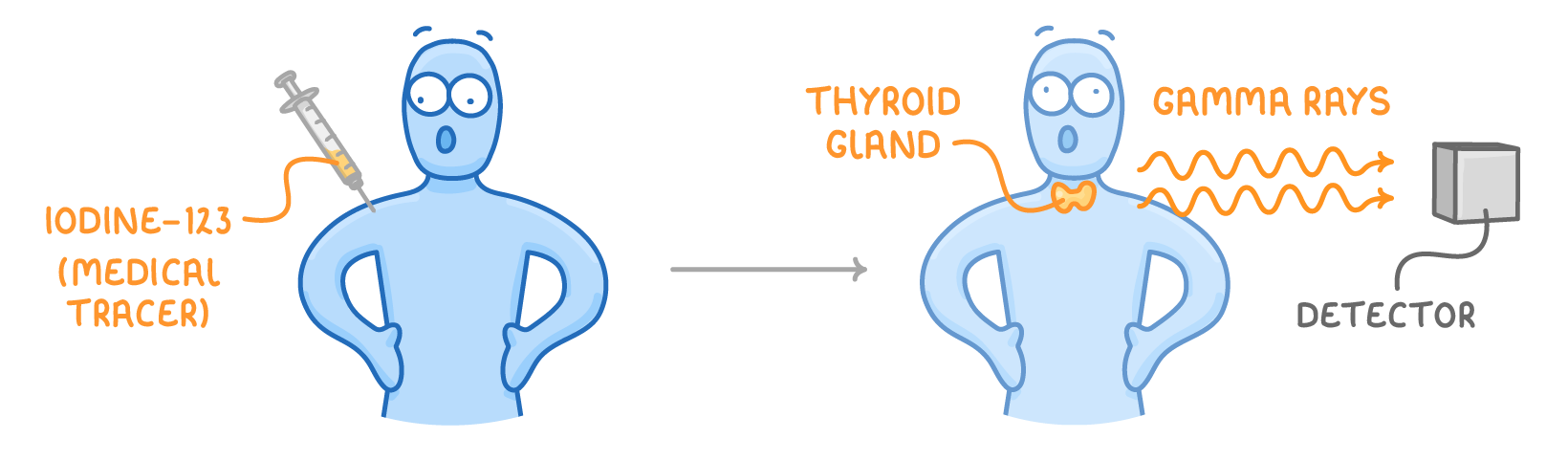
- The patient swallows it or has it injected, and an external detector tracks where the radiation comes from to show how an organ is working.
Why a gamma emitter with a short half-life
- A tracer is chosen to be a gamma emitter:
- Gamma passes out through body tissues without being absorbed, so it can be detected outside the patient.
- Gamma is only weakly ionising, so it does little damage on the way out.
- An alpha source would be useless because it would be stopped inside the body and never reach the detector. Alpha is also strongly ionising, so it would be very harmful inside the body.
- The isotope needs a short half-life, so its activity is high enough to give a clear reading at first but the radioactivity inside the patient dies away quickly. The half-life must still be long enough for the scan to be carried out.
Examples
- Iodine-123 - The thyroid gland absorbs radioactive iodine-123 the same way as non-radioactive iodine-127. The amount of gamma radiation detected from the thyroid shows whether the gland is working correctly.
- Tracer attached to a molecule - A tracer joined to a molecule taken up by cancer cells collects in those cells, so tumours show up clearly on the detector.
Radiotherapy - Treating cancer with radiation
- High doses of ionising radiation kill living cells, so radiation can treat cancer by killing the cancer cells. This is called radiotherapy.
- Radiotherapy can be given from outside the body or from inside.
External radiotherapy
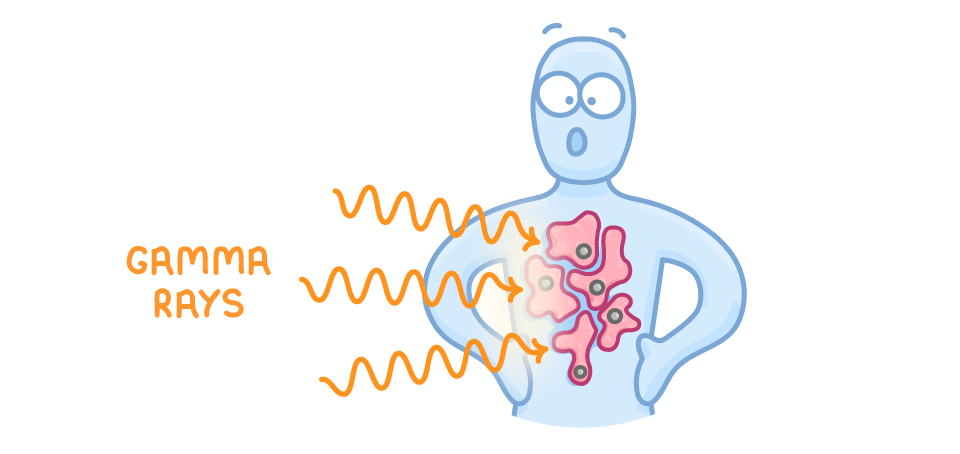
- Gamma rays are aimed at the tumour from outside because gamma can penetrate through the body to reach the tumour.
- The beam is carefully focused on the tumour at just the right dose, but some healthy cells near the tumour are still damaged.
- Sources used outside the body have a long half-life, so they don't need replacing often.
- The machines are kept in a shielded room to protect staff and other patients.
Internal radiotherapy
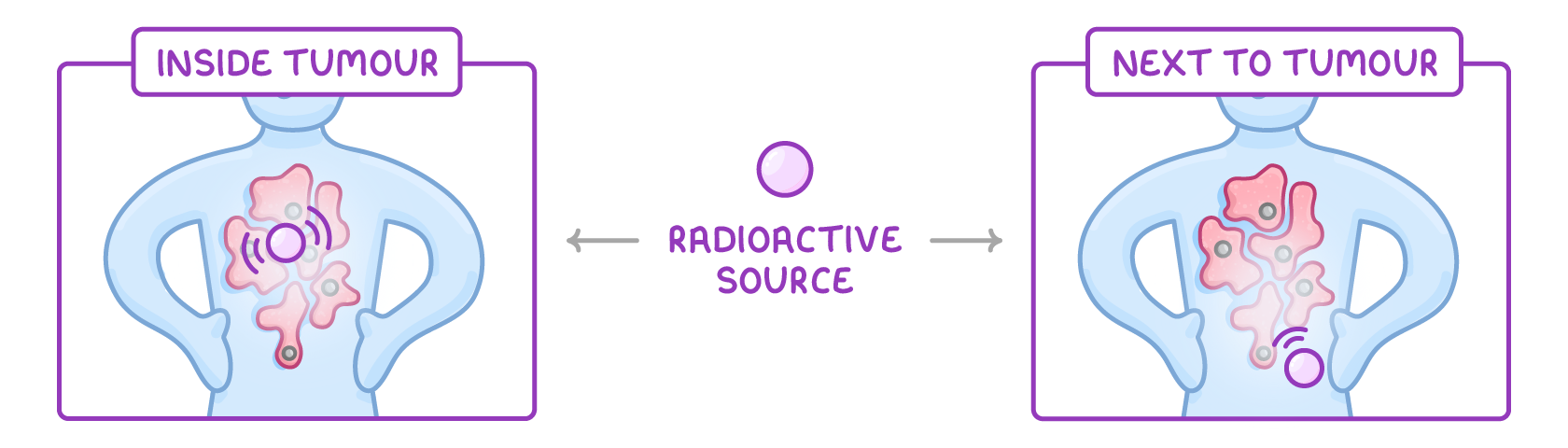
- A small amount of radioactive source is placed into or next to the tumour, as shown below.
- Alpha emitters can be injected close to the tumour. Alpha is strongly ionising, so it does a lot of damage to nearby cancer cells, while its very short range limits damage to surrounding healthy tissue.
- Beta emitters are often used in implants. Beta passes through the implant casing (which stops alpha) and has a longer range, reaching cancer cells a little further away.
- Sources used inside the body have a short half-life, to limit the time the radioactive material stays inside the patient.
Smoke alarms use alpha radiation
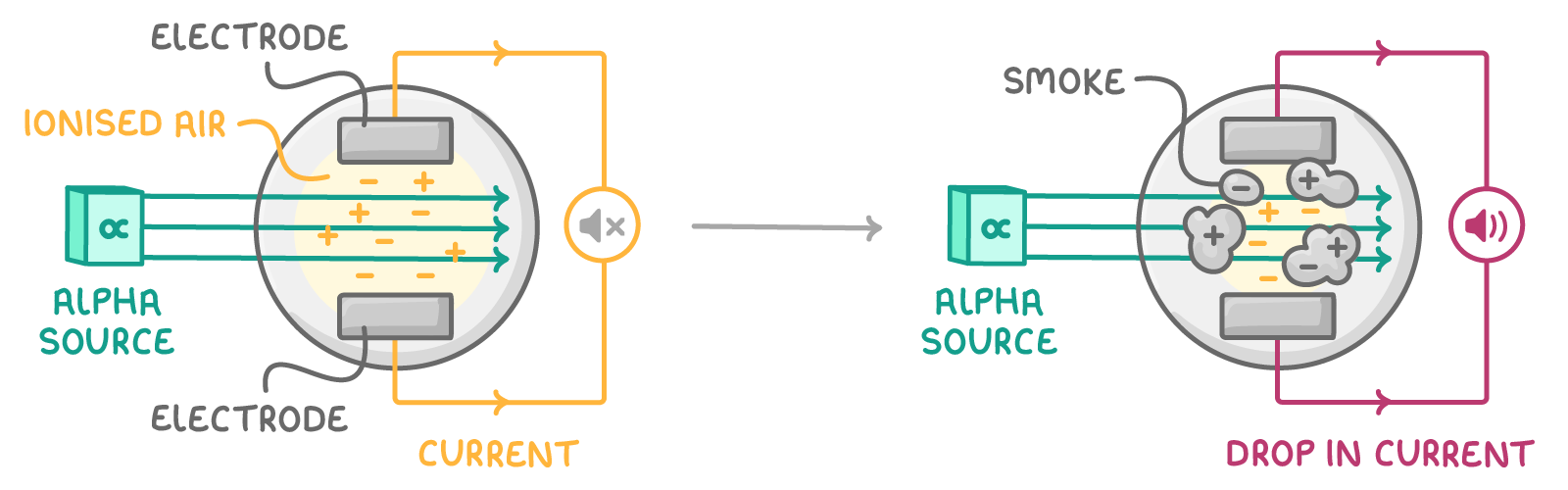
- A smoke alarm contains a weak alpha source next to two electrodes.
- The alpha particles ionise the air between the electrodes, and these charged particles let a small current flow.
How smoke sets it off
- Smoke enters the alarm.
- Smoke particles attach to the ionised air particles and neutralise them.
- The current falls, and this drop triggers the alarm.
Why alpha with a long half-life
- Alpha is strongly ionising, so it produces plenty of charged particles to carry the current.
- Alpha has a very short range in air, so it doesn't escape the alarm casing.
- The source needs a long half-life, so its activity stays roughly steady and it doesn't need replacing during the alarm's life.
Thickness control uses beta radiation
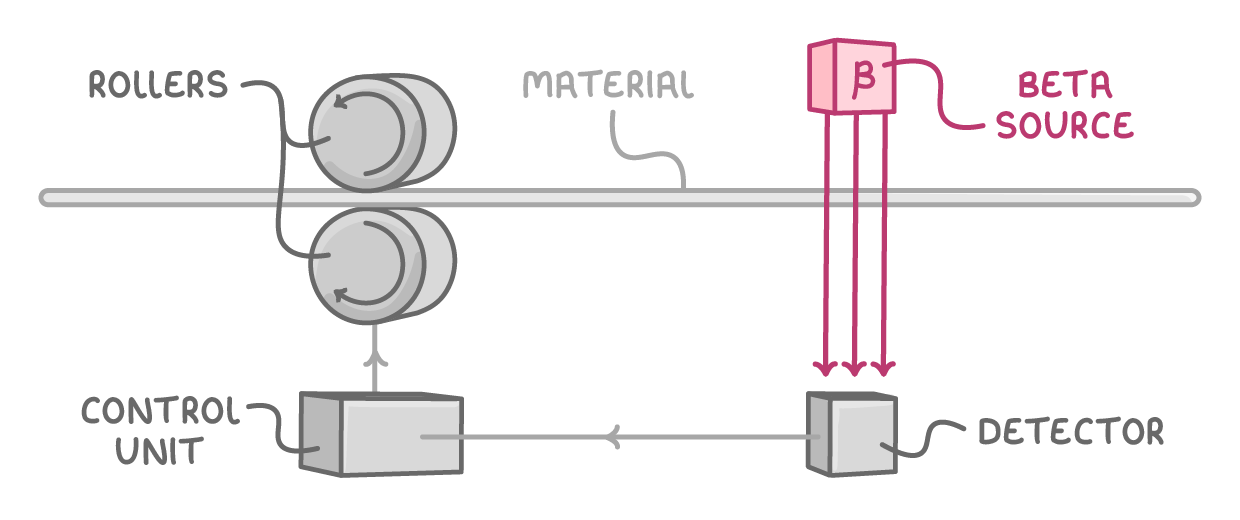
- Beta radiation controls the thickness of materials such as paper, plastic, and metal foil as they're made.
- The material passes between a beta source on one side and a detector on the other, with the detector connected to a control unit that adjusts the rollers.
How the control works
- The amount of beta reaching the detector depends on the thickness of the material.
- If the material comes out too thick, fewer beta particles get through and the detected radiation falls.
- The control unit then moves the rollers together to bring the thickness back to the right value.
Why beta with a long half-life
- The material only partly blocks beta:
- Alpha would be stopped completely by even thin material.
- Gamma would pass almost entirely through.
- In either case the reading wouldn't change with small changes in thickness.
- A long half-life source is used so the count rate stays steady and the source doesn't need replacing often.
Gamma rays sterilise food and equipment
- A high dose of gamma rays sterilises food and medical equipment by killing the microbes on them.
- Irradiating food kills bacteria and mould, so it stays fresh for longer.
- Medical equipment can be sterilised inside sealed plastic packaging.
Advantages and source choice
- No heat is involved, so heat-sensitive items (fresh fruit, plastic instruments) can be fully sterilised without being damaged.
- The source needs to be a gamma emitter with a long half-life, so it stays effective and doesn't need replacing often.
Tracers detect leaks in underground pipes
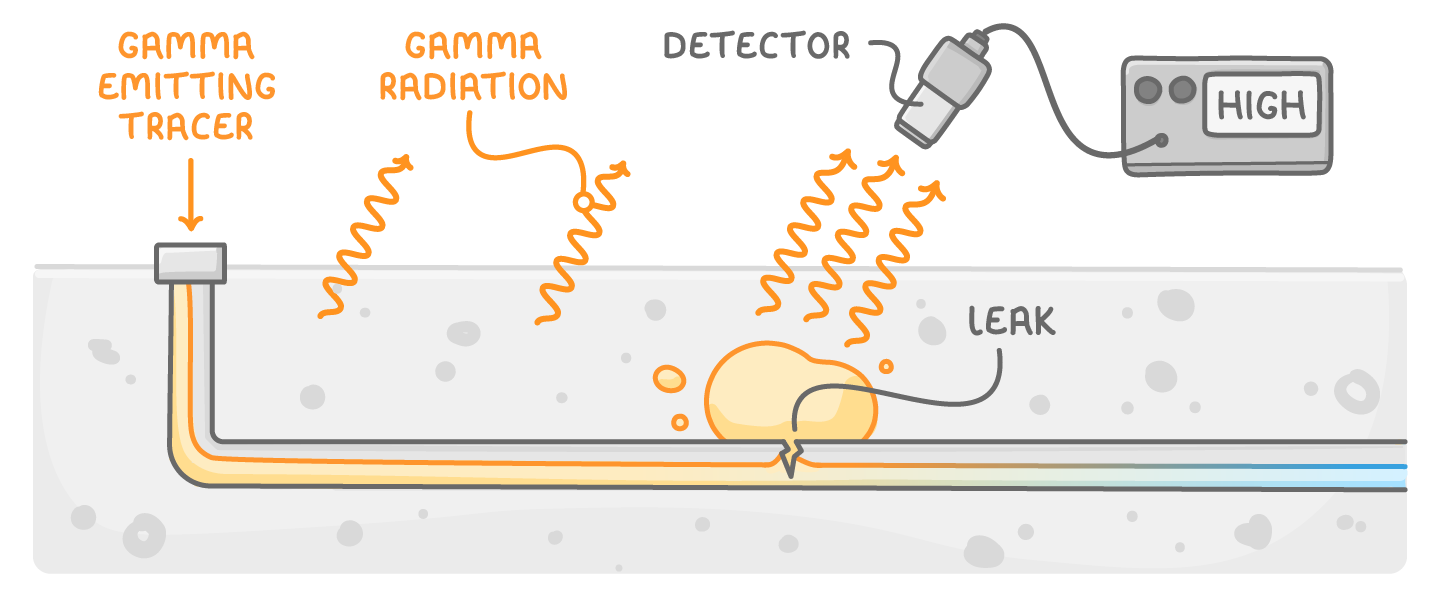
- A gamma-emitting tracer is used to find leaks in underground pipes.
- The radioactive source is added to the fluid in the pipe, while a detector is moved over the ground above.
How the leak is found
- Gamma is used because it can penetrate the rocks and soil around the pipe to reach the detector at the surface.
- Where there's a leak, fluid and tracer build up in the surrounding ground.
- The detector registers a sudden spike in radiation, pinpointing the leak.
- The tracer must have a short half-life, so it doesn't pose a lasting hazard.
Half-life and activity determine the hazard
- How dangerous a radioactive source is depends on both its activity and its half-life.
- The lower the activity, the safer it is to be near.
Why half-life matters over time
- For two sources of the same radiation type and initial activity, the one with the longer half-life remains hazardous for much longer.
- A source with a short half-life has its activity fall quickly, while a source with a long half-life stays radioactive for decades or centuries.
- Sources with long half-lives therefore require secure, long-term shielding and disposal.
TermDefinition
TracerA radioactive substance put into something, such as a patient's body or a pipe, to show where it goes. The radiation it gives out is detected from outside.
RadiotherapyThe treatment of cancer using high doses of ionising radiation to kill cancer cells.
Key points to remember
How were these notes?