9.11 - Liquid Pressure & Upthrust
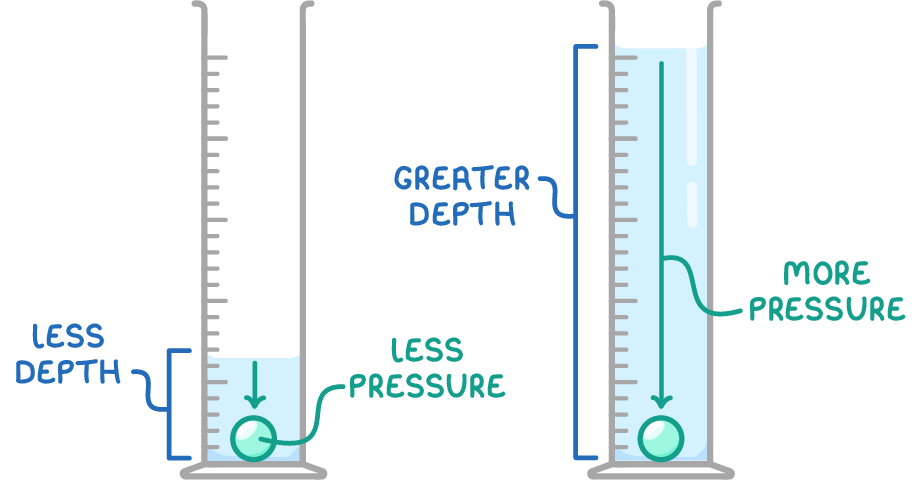
Pressure in a liquid increases with depth and density
- At a point inside a liquid, the pressure comes from the weight of the column of liquid directly above that point.
- In a fluid at rest, the pressure at any point acts equally in all directions.
Pressure increases with depth
- Going deeper means a taller column of liquid sits above the point.
- The extra weight adds to the pressure, so the deeper you go, the higher the pressure.
Pressure increases with density
- A denser liquid has more mass in a given volume, so the column above a point weighs more - creating a higher pressure at the same depth.
- Liquids can be squashed only slightly, so their density is treated as constant throughout.
Formula for pressure in a liquid
Where:
- = Pressure due to the column of liquid, in pascals (Pa)
- = Height of the column of liquid, or depth below the surface, in metres (m)
- = Density of the liquid, in kilograms per cubic metre (kg/m3)
- = Gravitational field strength, in newtons per kilogram (N/kg)
Worked example - Pressure difference between two depths
Calculate the change in pressure between a point 12 m below the surface of a lake and a point 42 m below the surface. The density of water is 1,000 kg/m3 and = 9.8 N/kg.
Step 1 - Calculate the pressure at a depth of 12 m
Step 2 - Calculate the pressure at a depth of 42 m
Step 3 - Subtract to find the change in pressure
411,600 - 117,600 = 294,000 Pa (294 kPa)
Objects in a fluid experience upthrust
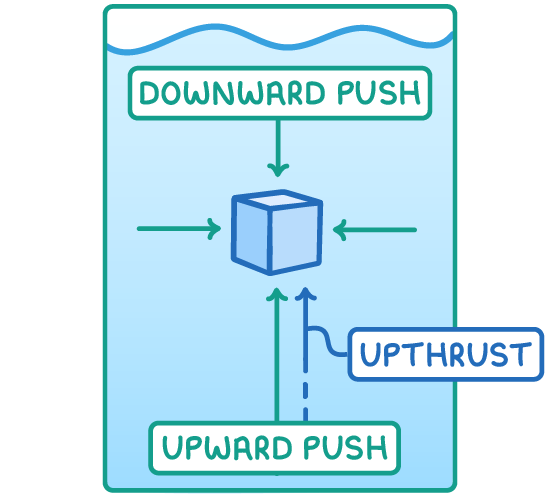
- When an object is submerged in a fluid, the fluid presses on it from every direction.
- Pressure increases with depth, so the upward push on the bottom is larger than the downward push on the top.
- These forces don't cancel, leaving an overall upward force called upthrust.
- The upthrust on an object equals the weight of the fluid it displaces.
Floating and sinking
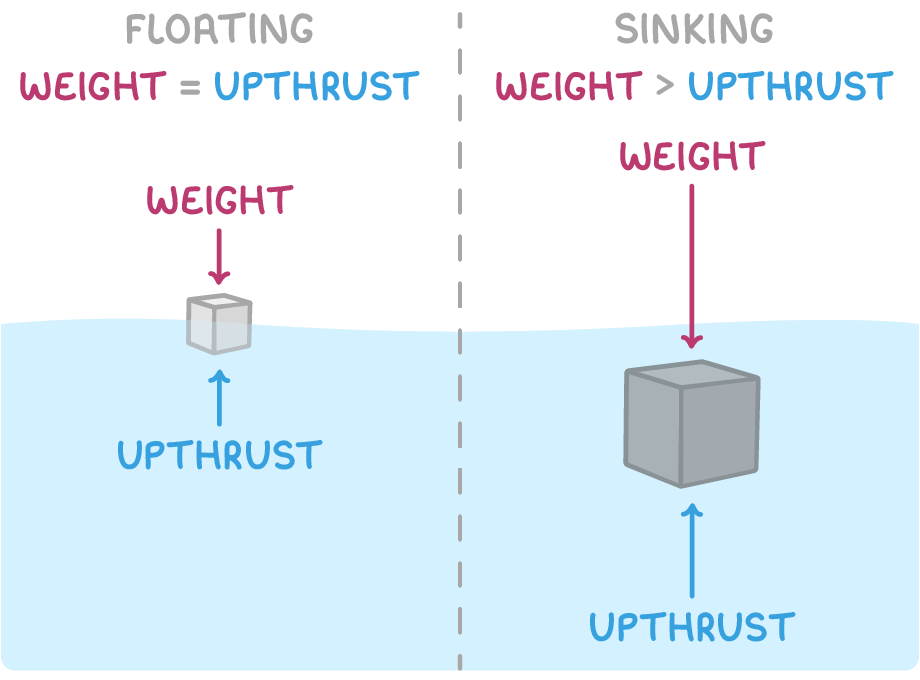
Whether an object floats or sinks depends on the balance between its weight and the upthrust on it.
Floating
- When upthrust equals the object's weight, the forces balance and the object floats.
- This happens when the object is less dense than the fluid: it displaces its own weight of fluid before it's fully submerged.
Sinking
- When the object's weight is greater than the upthrust, the object sinks.
- This happens when the object is denser than the fluid: even fully submerged, the weight of fluid it displaces is less than its own weight.
Applications
- A boat floats because the overall density of its hull and the air inside it is less than the density of water.
- A submarine controls its depth using ballast tanks:
- To dive, the tanks fill with water, increasing its weight until it exceeds upthrust.
- To surface, compressed air forces the water out, reducing its weight so upthrust lifts it.
TermDefinition
UpthrustThe upward force a fluid exerts on an object that is partly or fully submerged in it.
Key points to remember
How were these notes?