5.4 - The Origin of the Universe
Models of the Solar System changed over time
Ideas about how the Solar System is arranged have changed as new evidence appeared.
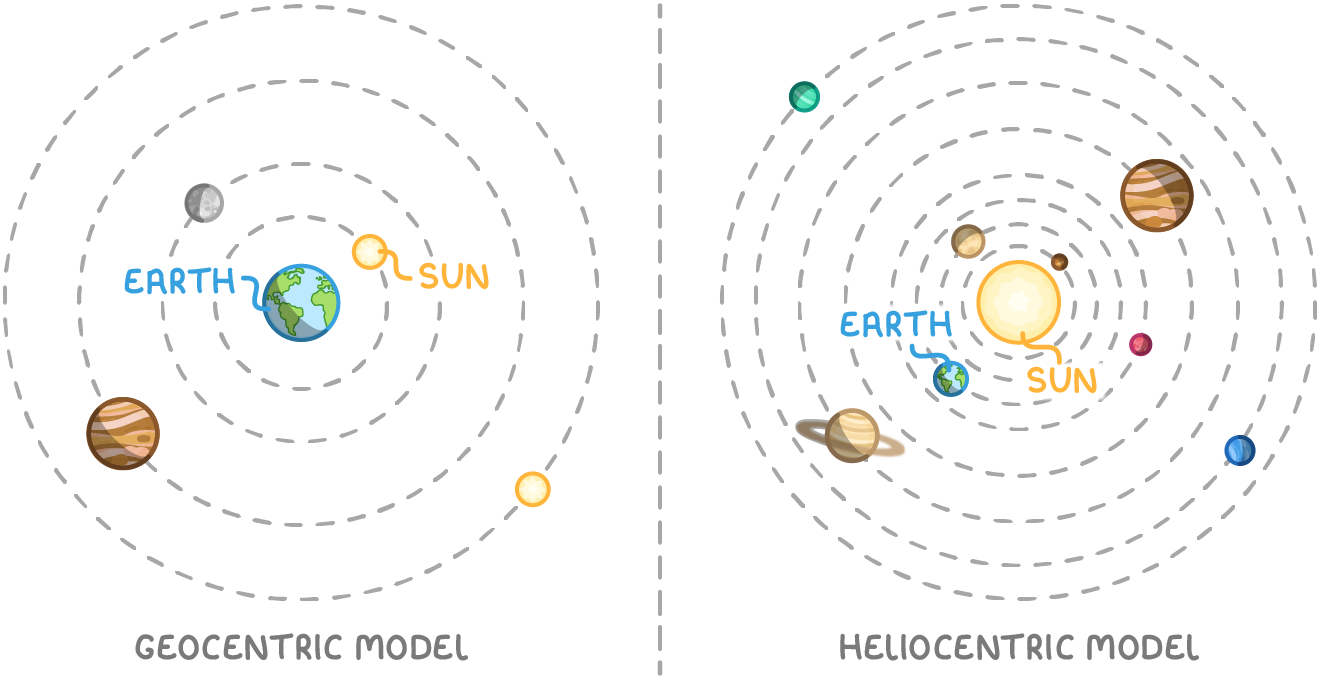
The geocentric model
- Placed the Earth at the centre, with the Sun, Moon, planets and stars all orbiting Earth in circles.
- It was accepted from the time of the ancient Greeks until the 1500s.
The heliocentric model
- Put the Sun at the centre, with the Earth and other planets orbiting it.
- Galileo found evidence using a telescope: he saw moons orbiting Jupiter, showing that not everything orbits the Earth.
The current model
- The planets orbit the Sun in slightly elliptical orbits, not perfect circles.
- The Sun is not at the centre of the whole Universe.
The expanding Universe points to a beginning
Nearly all galaxies are moving away from one another, and the more distant a galaxy is, the faster it is moving away.
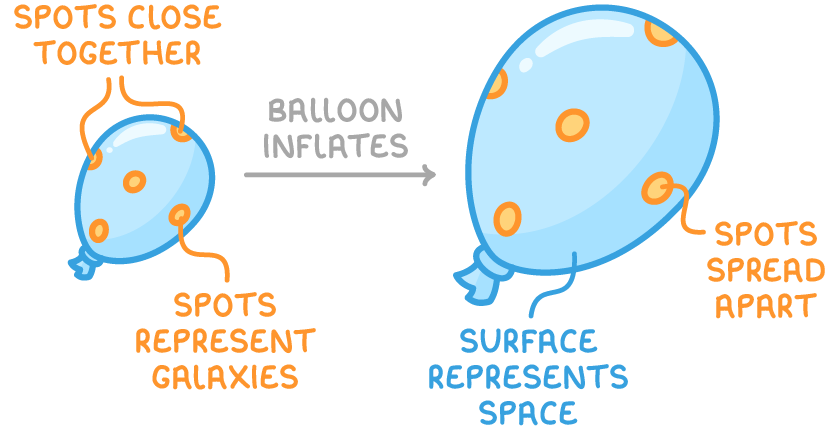
The balloon model
- Imagine a balloon with spots painted on it: as it inflates, the rubber stretches and every spot moves further from every other spot.
- The balloon's surface represents space itself and each spot represents a galaxy.
- Space is stretching and carrying the galaxies apart, so the whole Universe is expanding.
Working backwards
- Because galaxies are moving apart now, in the distant past they must have been much closer together.
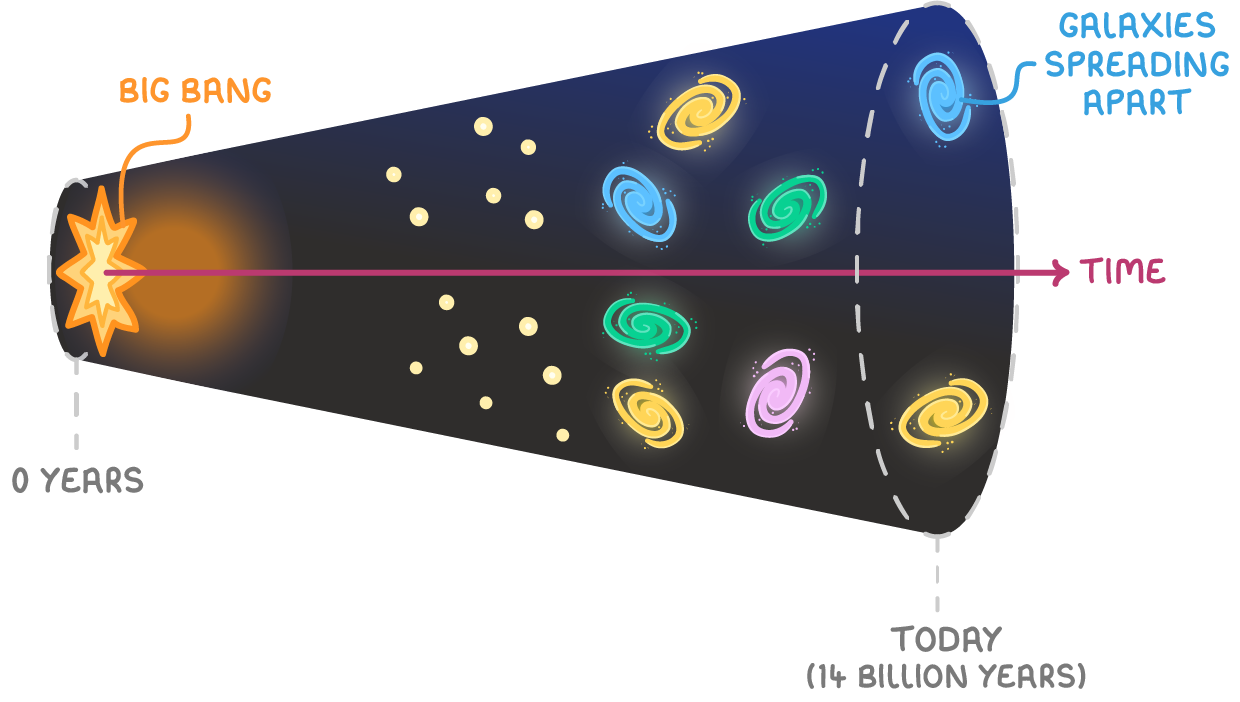
- Following this backwards leads to the conclusion that the Universe began from a single, extremely small region - the starting point for the Big Bang theory.
The Big Bang theory
- The Big Bang theory is the accepted explanation of how the Universe began.
- All the matter and energy in the Universe was once concentrated into a single, tiny region that was extremely hot and dense.
- It then began to expand rapidly - the Big Bang - and space has been expanding ever since.
The age of the Universe
- The theory gives the Universe a finite age.
- Working back from the expansion rate gives an age of roughly 14 billion years (about 13.8 billion years).
The Steady State theory
- The Steady State theory was an alternative model to the Big Bang.
- It suggests the Universe has no beginning and no end, and has always looked roughly the same as it does now.
- As space expands, new matter is constantly created in the gaps, keeping the average density of the Universe roughly constant.
Why the Big Bang won out
- Both theories account for galaxies moving apart, so red-shift alone does not decide between them.
- The Big Bang is accepted because further discoveries, especially cosmic microwave background radiation, support it rather than the Steady State theory.
Cosmic microwave background radiation as evidence
Cosmic microwave background (CMB) radiation is a faint microwave signal detected from every direction in the sky.
What the Big Bang says about it
- The Big Bang theory explains CMB as leftover radiation from the very hot early Universe.
- As space expanded, this radiation was stretched out to the longer wavelengths of the microwave spectrum.
Why it mattered
- The Big Bang theory predicted this radiation should exist, while rival theories did not.
- Discovering it was the main reason the Big Bang became the accepted model.
TermDefinition
Geocentric modelThe historical model that placed the Earth at the centre of the Universe.
Heliocentric modelThe model that puts the Sun at the centre of the Solar System.
Big Bang theoryThe theory that all the matter in the Universe was once packed into a very small, extremely hot and dense region, and that the Universe has been expanding from it ever since.
Steady State theoryAn alternative model suggesting the Universe has always existed and constantly creates new matter as it expands.
Cosmic microwave backgroundFaint electromagnetic radiation filling all of space, left over from the very early Universe.
Key points to remember
How were these notes?