6.8 - Moments - Seesaws & Gears
The principle of moments
- When an object is balanced about a pivot, it doesn't turn.
- The turning effect of a force is its moment:
where is the perpendicular distance from the pivot to the line of action of the force.
The principle of moments: for a balanced object, the total clockwise moment equals the total anticlockwise moment.
Worked example - Balancing a seesaw
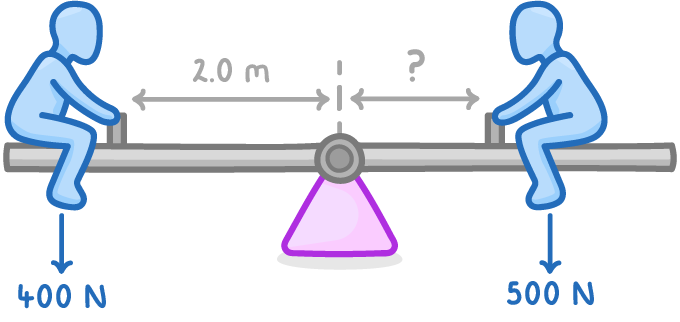
A child of weight 400 N sits 2.0 m from the pivot of a seesaw. A second child of weight 500 N sits on the other side. How far from the pivot must the second child sit for the seesaw to balance?
Step 1 - Write down the balance condition
For the seesaw to balance, the total clockwise moment equals the total anticlockwise moment:
Step 2 - Substitution
The first child gives the anticlockwise moment, the second child the clockwise moment:
Step 3 - Solve for the unknown distance
The heavier child must sit 1.6 m from the pivot - closer than the lighter child, because a larger force needs a shorter distance to give the same moment.
How gears work
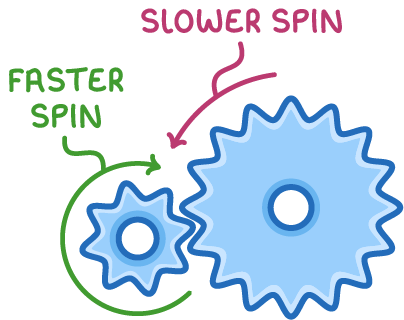
- Gears are toothed wheels that transmit the rotational effect (moment) of a force.
- Interlocking gears turn in opposite directions.
- A force applied to a larger gear acts further from its pivot, producing a larger moment ().
- A larger gear turns slower than a smaller gear it interlocks with.
Gear ratio
- The force passed between interlocking gear teeth is the same.
- By , the ratio of the moments equals the ratio of their radii, which equals the ratio of their number of teeth.
Example - A 16-tooth and an 8-tooth gear
- Gear ratio is 16 : 8 = 2 : 1.
- The 8-tooth gear turns twice for every turn of the 16-tooth gear.
- The 16-tooth gear produces double the moment of the 8-tooth gear.
TermDefinition
MomentThe turning effect of a force, equal to the force multiplied by the perpendicular distance from the pivot to the line of the force.
Principle of momentsWhen an object is balanced, the total clockwise moment about a pivot equals the total anticlockwise moment.
GearA toothed wheel that transmits (passes on) the turning effect of a force.
Key points to remember
How were these notes?