8.3 - Electric Fields
Electric fields and field lines
- An electric field is created around any electrically charged object.
- It's the region around the object where another charge feels a force.
- The closer to the object, the stronger the field.
Field lines
Electric fields are represented using field lines. Field lines:
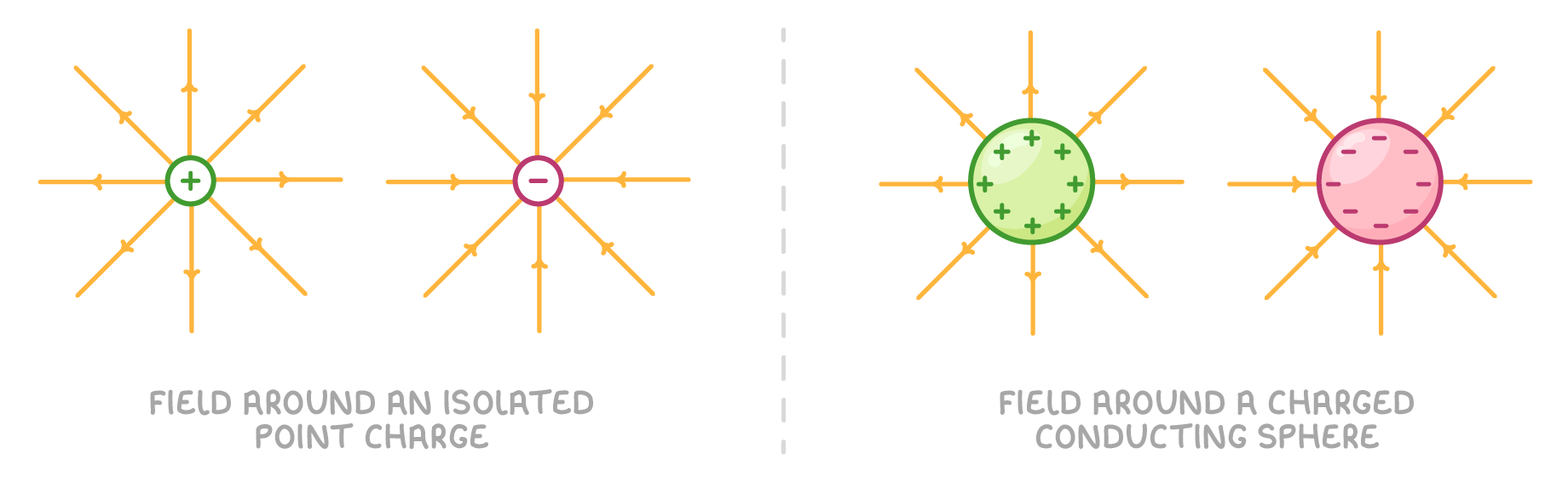
- Point from positive to negative (the direction of the force on a positive charge)
- Meet the surface of the charged object at a right angle
- Have arrows showing the field direction
- Show field strength by their spacing - the closer the lines, the stronger the field
Field patterns to recognise
- An isolated point charge
- A charged conducting sphere (which has the same field pattern as a point charge)
Force on a charge from interacting fields
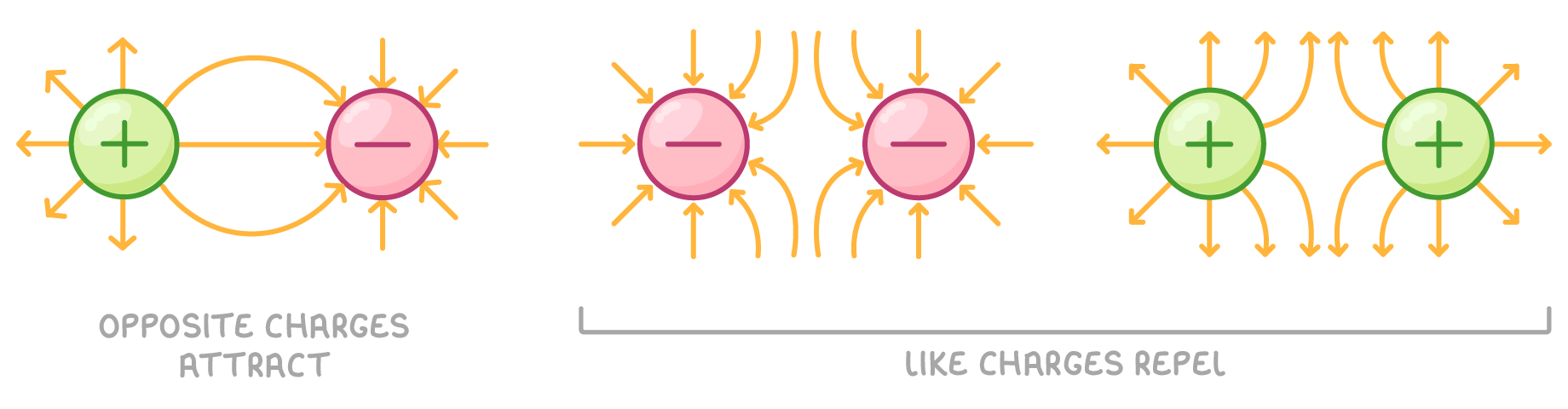
- When a charged object is placed in the electric field of another charged object, it feels a force.
- The electric fields of the two objects interact, producing an electrostatic force on each object.
Attraction and repulsion
- Opposite charges attract - The field lines between them point in the same direction and join up, pulling the objects together.
- Like charges repel - The field lines point in opposite directions and push against each other, forcing the objects apart.
Size of the force
- The size of the force depends on the strength of the field at that point.
- Increasing the distance between the charged objects weakens the field, making the force smaller.
The uniform field between parallel plates
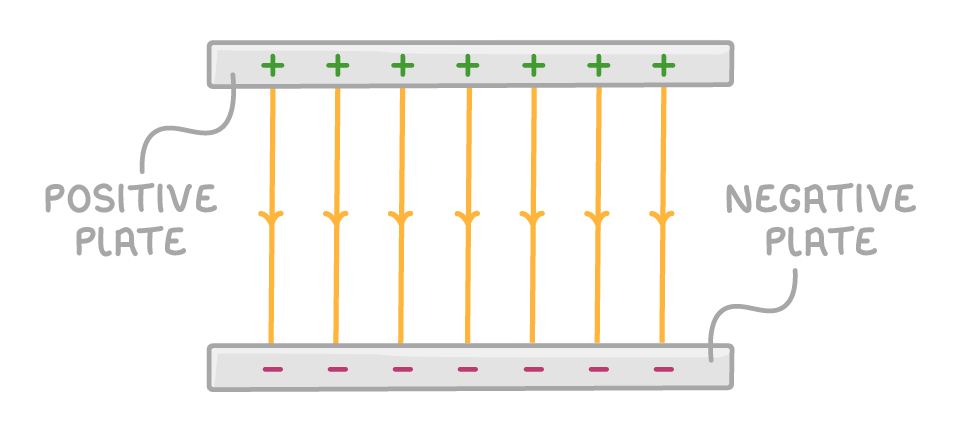
- The electric field between two oppositely charged parallel plates is uniform: its strength and direction are the same everywhere between the plates.
- A uniform field is drawn as parallel, evenly spaced field lines running from the positive plate to the negative plate.
- A charged particle placed in a uniform field feels a constant force everywhere between the plates.
Sparking explained by electric fields
- A large potential difference between a charged object and an earthed object creates a strong electric field between them.
- The strong field pulls electrons off air molecules, ionising the air.
- Air is normally an insulator, but ionised air conducts charge, allowing a current to flow.
- This sudden flow of charge through the air is a spark.
TermDefinition
Electric fieldThe region around a charged object where another charge feels a force.
Uniform fieldA field that has the same strength and direction everywhere, shown by parallel field lines that are equally spaced.
Key points to remember
How were these notes?