3.10 - Total Internal Reflection
Total internal reflection depends on the critical angle
- Under the right conditions, light meeting a boundary is reflected entirely back into the material it came from. This is total internal reflection.
- Total internal reflection can only happen when:
- Light travels from a denser material (such as glass or water) towards a less dense material (such as air).
- The angle of incidence is greater than the critical angle.
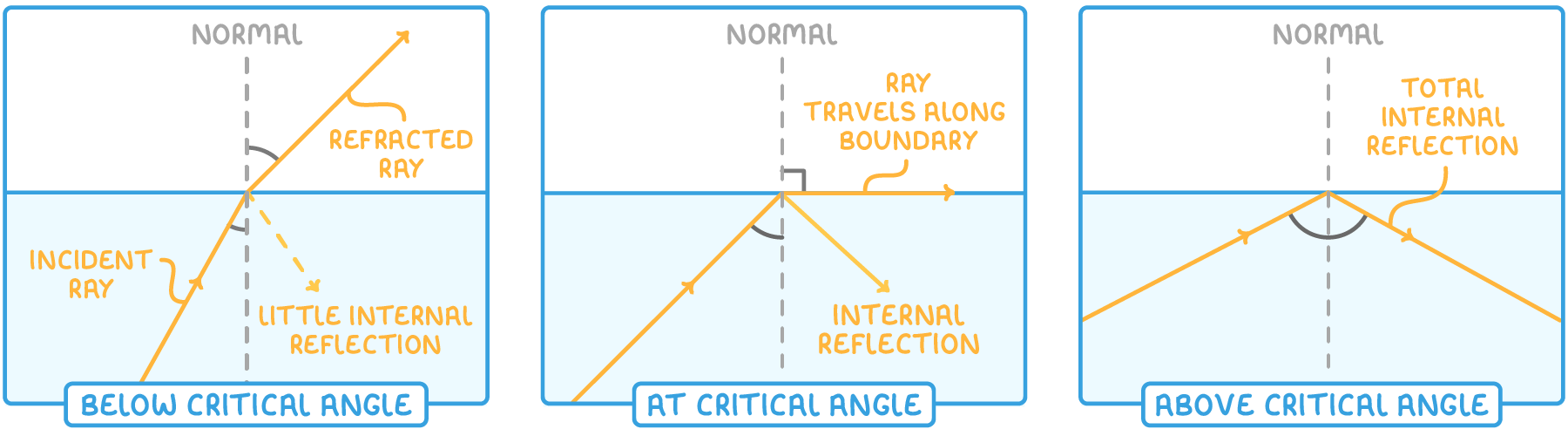
- The critical angle () is the angle of incidence in the denser material that produces an angle of refraction of 90 degrees in the less dense material. For glass to air, this is about 42 degrees.
What happens at each angle of incidence
- Below the critical angle - Most light refracts out into the less dense material, and a small amount is internally reflected.
- At the critical angle - The refracted ray travels along the boundary, and there's strong internal reflection.
- Above the critical angle - No light escapes; it's all reflected back into the material. This is total internal reflection.
TermDefinition
Total internal reflectionThe complete reflection of light back into a material when it meets a boundary with a material in which light travels faster (for example from glass into air), at an angle of incidence greater than the critical angle.
Critical angleThe angle of incidence in a denser material that produces an angle of refraction of exactly 90 degrees.
Key points to remember
How were these notes?