9.6 - Factors Affecting Gas Pressure
Gas pressure comes from particle collisions
- The particles in a gas move constantly in random directions at a range of speeds.
- As they move, they collide with each other and with the walls of their container.
- A gas's particles take up very little space - most of a gas is empty space - so particles travel far between collisions.
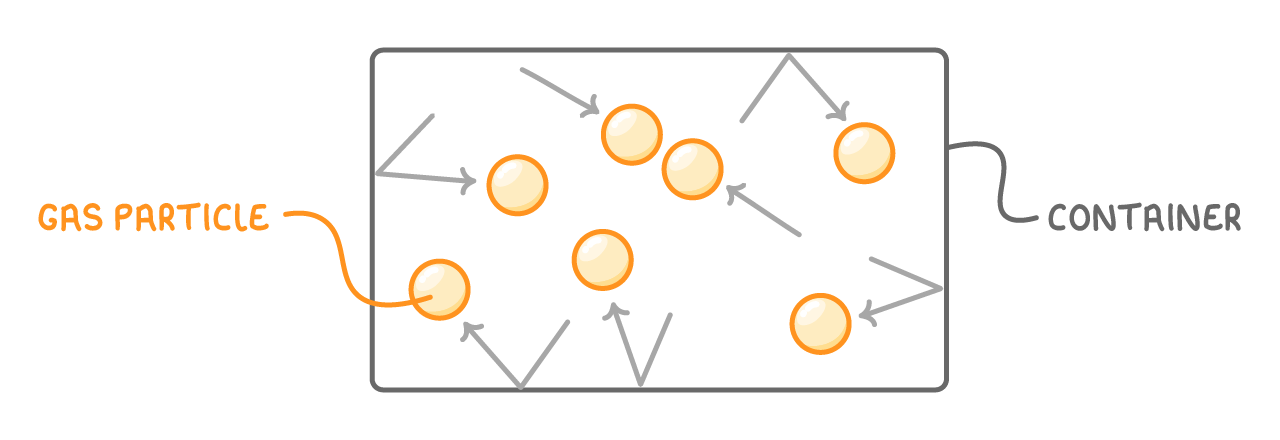
How collisions create pressure
- When a particle collides with a surface it changes direction, so it changes momentum.
- A change in momentum means a force is exerted on the surface.
- Each collision is in a random direction, but together the collisions give a net force at right angles to the wall.
- Pressure is the force acting per unit area of a surface. Gas pressure is the total force of all colliding particles on each unit area of the walls.
- The more often particles hit the walls, and the harder they hit, the greater the pressure.
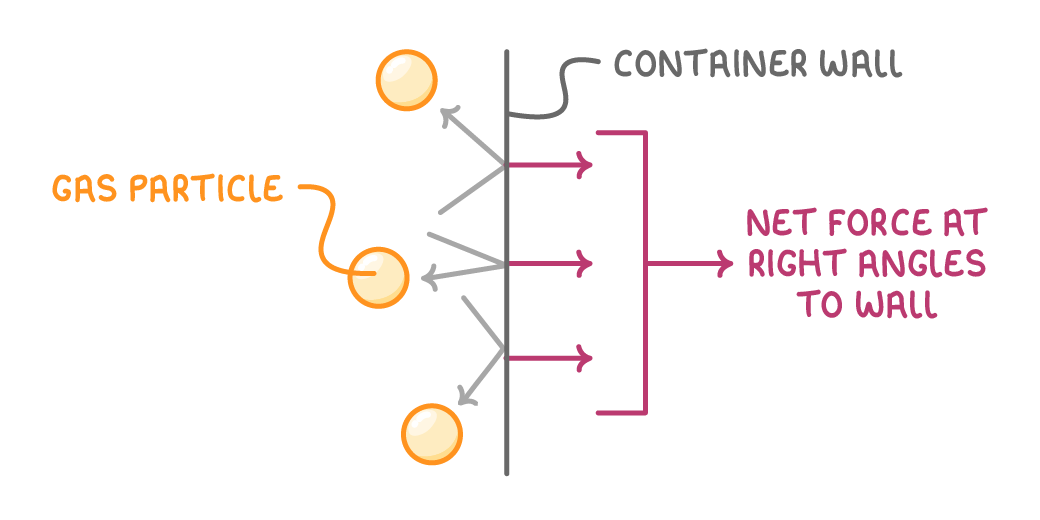
Absolute zero and the Kelvin temperature scale
Absolute zero
- The coldest temperature possible is -273 degrees C, called absolute zero.
- At absolute zero the particles have as little energy in their kinetic stores as possible - they are very nearly still.
- A gas cooled towards absolute zero exerts less and less pressure, because its particles strike the walls less often and less hard; at absolute zero an ideal gas would exert no pressure at all.
The Kelvin scale
- Absolute zero is the starting point of the Kelvin scale, where it is 0 kelvin (0 K).
- A change of 1 degree C is the same size as a change of 1 K - the scales differ only in where their zero sits.
To convert between them:
- From degrees Celsius to kelvin, add 273.
- From kelvin to degrees Celsius, subtract 273.
| Absolute zero | Freezing point of water | Boiling point of water | |
|---|---|---|---|
| Celsius scale | -273 degrees C | 0 degrees C | 100 degrees C |
| Kelvin scale | 0 K | 273 K | 373 K |
Temperature and average kinetic energy of gas particles
- The temperature of a gas measures the average energy in the kinetic energy stores of its particles.
- The hotter the gas, the more energy its particles have on average, so the faster they move on average.
- The Kelvin temperature of a gas is directly proportional to the average kinetic energy of its particles - double the temperature in kelvins and you double the average kinetic energy.
Heating and cooling a gas
- Heating transfers energy into the kinetic energy stores of the particles, increasing their average speed.
- Cooling transfers energy out of their kinetic stores, so they move more slowly on average.
- Particles always have a range of speeds, so this is an average across all particles, not a single speed shared by every particle.
How temperature and volume change gas pressure
- Two things change the pressure of a fixed mass of gas: its temperature and its volume.
- Both act by changing how often particles hit the walls and how hard they hit.
Changing the temperature (at constant volume)
- Heating makes particles move faster on average - they hit the walls more often and with greater force each time, so the pressure increases.
- Cooling makes particles move slower - they hit the walls less often and with less force, so the pressure decreases.
Changing the volume (at constant temperature)
- Squeezing the gas into a smaller volume packs the same particles into less space - they hit the walls more often, so the pressure increases.
- Letting the gas expand into a larger volume spreads the particles out - they hit the walls less often, so the pressure decreases.
Doing work on a gas can raise its temperature
Heating isn't the only way to raise a gas's internal energy - doing mechanical work on a gas also increases it, and this can raise its temperature.
Compressing a gas with a pump
- In a bike pump, the gas inside pushes outwards on the plunger, exerting a force on it.
- To push the plunger down, work must be done against this force.
- The energy transferred goes into the kinetic energy stores of the gas particles, raising the internal energy and so the temperature.
- If the pump is connected to a tyre, some energy is then transferred to the surroundings - which is why the pump and tyre feel warmer after pumping.
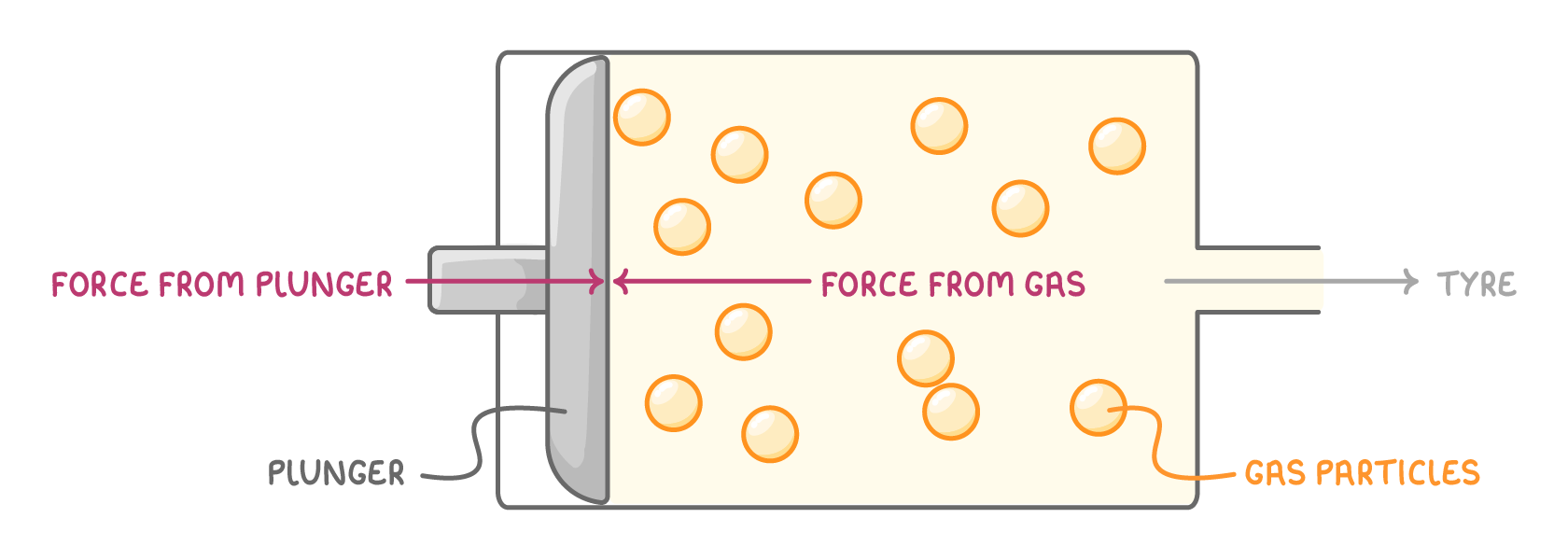
A pressure change can change a flexible container's volume
- A gas pushes outwards on its container because of particle collisions.
- Unless it's in a vacuum, there's also a pressure pushing inwards from the surroundings, such as the atmosphere.
- For a container that can change size, like a balloon, the volume settles where the inward and outward pressures balance.
Heating or cooling the gas inside
- Heating the gas raises its pressure, so the outward push exceeds the inward push and the balloon expands. As it expands, particles spread out and hit the walls less often, so the inside pressure falls until it again matches the outside pressure.
- Cooling does the opposite: the outward pressure drops below the inward pressure, and the balloon is compressed smaller.
Changing the outside pressure
- Pushing down on the plunger of a sealed syringe increases the inward pressure, so the gas is compressed until its pressure matches the push.
- Atmospheric pressure falls with altitude, so a sealed container of gas expands as it rises, because the inward pressure from the surrounding air decreases.
TermDefinition
PressureThe force acting at right angles to a surface per unit area of that surface.
Absolute zeroThe lowest possible temperature (-273 °C), where particles have the minimum possible kinetic energy.
Kelvin scaleA temperature scale that starts at absolute zero, where a change of 1 K is equal to a change of 1 °C.
TemperatureA measure of the average kinetic energy of the particles in a substance.
Key points to remember
How were these notes?