5.5 - Life Cycle of Stars
How a star is born
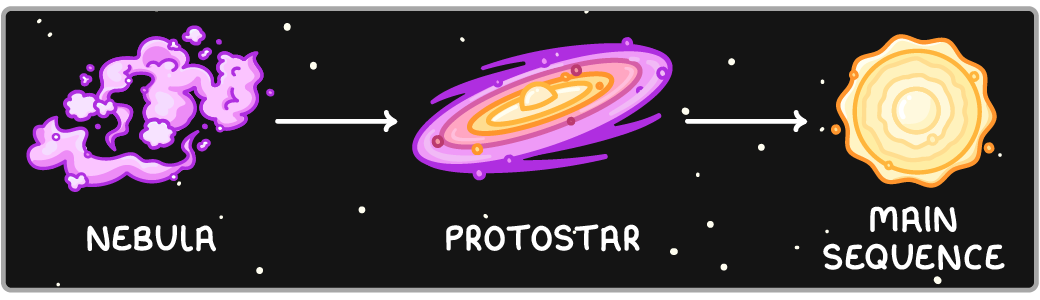
- Stars begin as a vast cloud of dust and gas called a nebula, made mostly of hydrogen.
- Gravity pulls the particles together, so the cloud collapses inwards and becomes denser.
- As particles are squeezed closer and collide more often, the core temperature rises to millions of degrees.
- This hot, dense core is called a protostar.
Nuclear fusion
- When the core gets hot enough, hydrogen nuclei join together in nuclear fusion, forming helium nuclei.
- Fusion releases enormous amounts of energy, which keeps the core hot and makes the star shine. A star in this stable, hydrogen-fusing stage is called a main sequence star.
The main sequence - A long stable life
- Once fusion begins, a star settles into a long, stable period called the main sequence.
- The energy released by fusion pushes outwards (the outward force of thermal expansion), while gravity pulls everything inwards.
- During the main sequence these two forces are balanced, so the star stays the same size.
- This stable period typically lasts several billion years. The Sun is about halfway through its main sequence.
- The more massive a star, the faster it burns through its hydrogen, so the shorter its time on the main sequence.
Red giants and red supergiants
- A star stays on the main sequence until the hydrogen in its core begins to run out.
- With less fusion to hold it up, the core contracts, heating the surrounding layers and making the outer layers swell outwards.
- As the surface expands it cools, so the star glows red.
Size depends on the star's mass
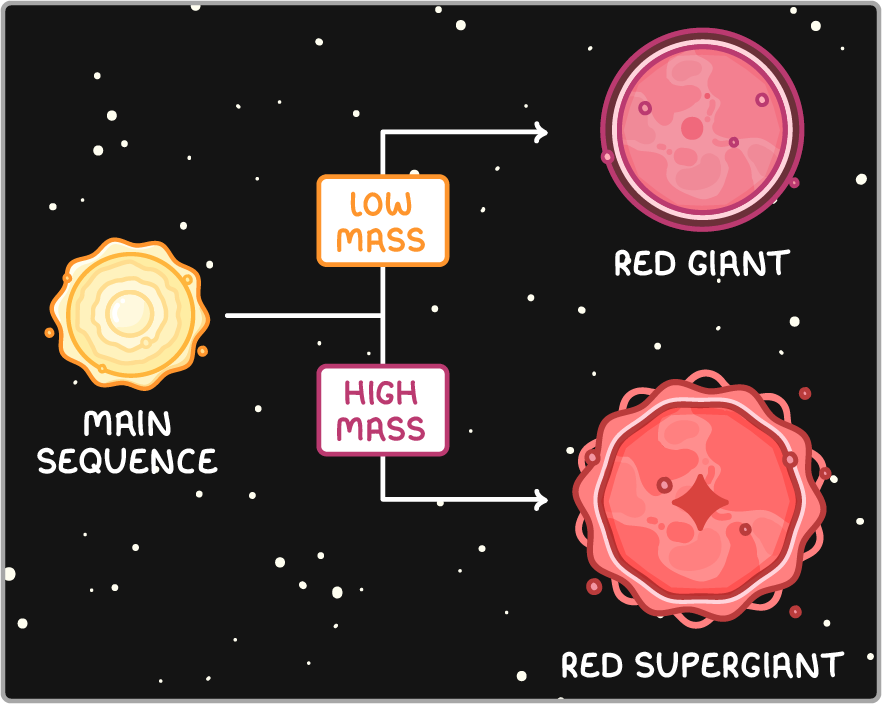
- A star about the size of the Sun swells into a red giant.
- A much more massive star swells into a much larger red supergiant.
- Helium and other light nuclei now fuse, building up heavier elements such as carbon and oxygen in the core.
The death of a small-to-medium star
- A star about the size of the Sun finishes its life as a red giant.
- It becomes unstable and ejects its outer layers of dust and gas into space - this glowing shell is called a planetary nebula.
- Left behind is a small, hot, dense core called a white dwarf.
- A white dwarf no longer fuses anything, and slowly cools over a very long time.
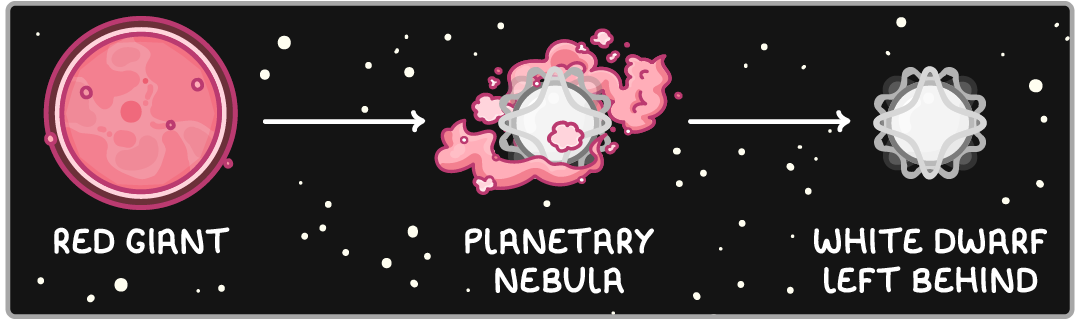
The outer layers drift off as a planetary nebula and the hot core is left behind as a white dwarf.
The death of a massive star
- As a red supergiant, a massive star keeps fusing heavier and heavier elements in shells around its core.
- Fusion can build elements only up to iron - fusing iron does not release energy.
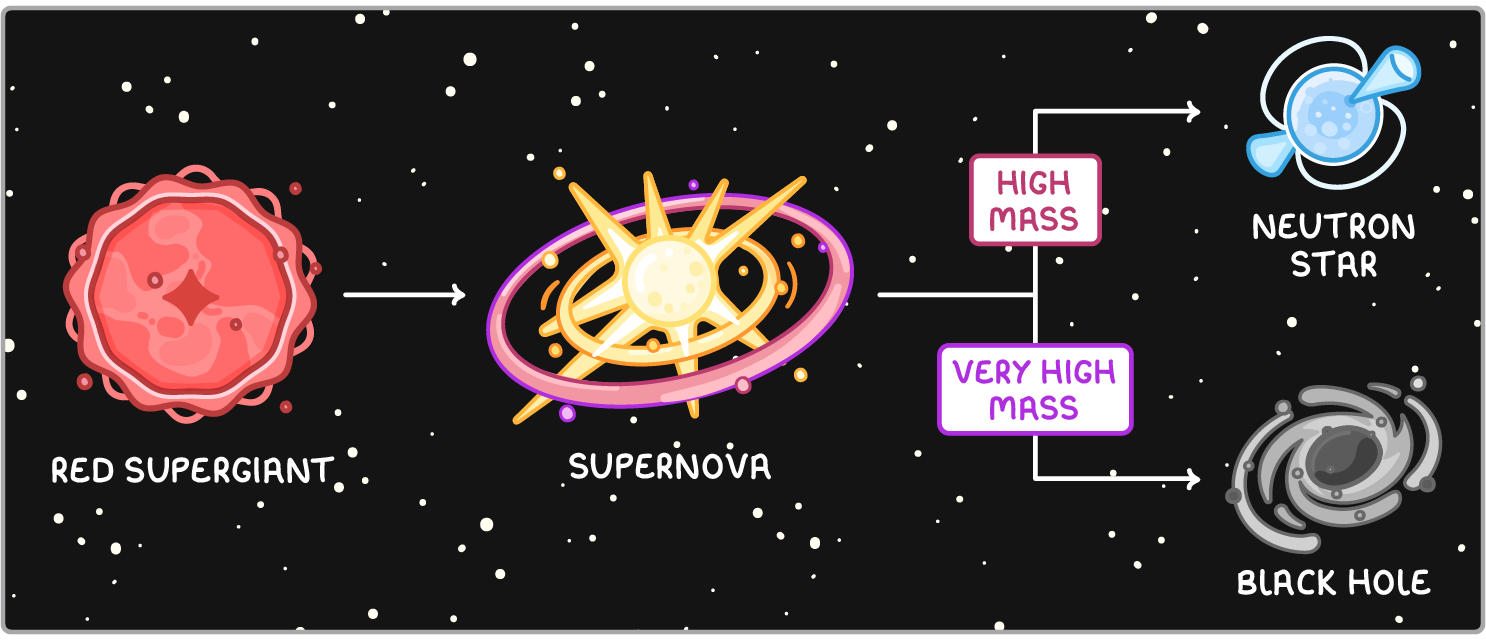
- When the core can fuse no further it collapses suddenly, and the star explodes as a supernova.
Creating heavy elements
- A supernova is energetic enough to forge elements heavier than iron and fling them out into space.
- This ejected material can later become part of new stars and planets.
The explosion leaves behind an extremely dense core
- For most massive stars, this is a neutron star.
- For the most massive stars, the core collapses further into a black hole - an object with gravity so strong that not even light can escape it.
TermDefinition
NebulaA vast cloud of dust and gas in space.
ProtostarA cloud of gas and dust that is collapsing under gravity and heating up, before nuclear fusion has started.
Main sequenceThe long, stable stage of a star's life, when the inward pull of gravity is balanced by the outward push from nuclear fusion in its core.
Red giantA star that has swollen and cooled after running out of hydrogen in its core.
Red supergiantA very large, cool star that a massive star swells into when the hydrogen in its core runs out.
Planetary nebulaThe glowing shell of dust and gas thrown off by a red giant at the end of its life.
White dwarfThe small, hot, dense core left behind after a small-to-medium star has shed its outer layers.
SupernovaThe huge explosion of a star at the end of its life, such as a red supergiant whose core collapses.
Neutron starThe very small, extremely dense core left behind after a massive star explodes as a supernova.
Black holeAn extremely dense object with gravity so strong that not even light can escape it.
Key points to remember
How were these notes?