1.1 - Scalar & Vector Quantities
Scalar and vector quantities
- A scalar quantity has magnitude (size) only.
- A vector quantity has both magnitude and direction.
| Definition | Examples | |
|---|---|---|
| Scalar | Magnitude only | distance, speed, mass, time, temperature, energy |
| Vector | Magnitude and direction | displacement, velocity, acceleration, force, momentum |
Speed vs velocity, distance vs displacement
- Speed tells you only how fast something is moving, so it's a scalar.
- Velocity tells you how fast and in which direction, so it's a vector.
- Distance is a scalar, but displacement (the straight-line distance and direction from start to finish) is a vector.
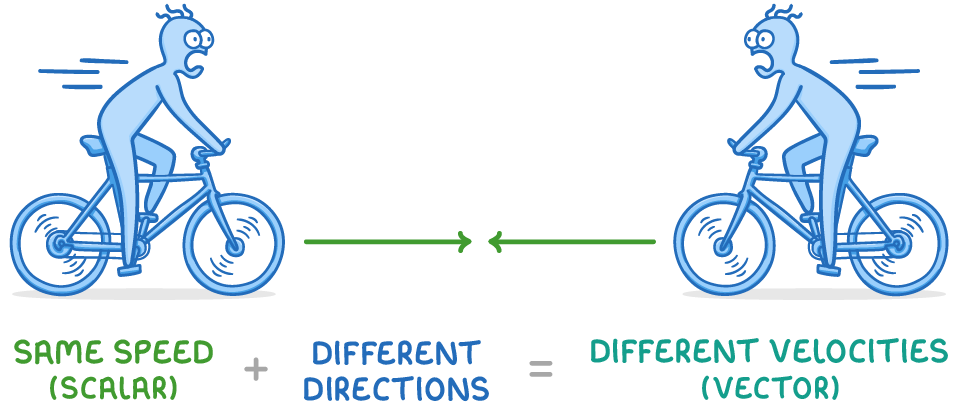
Representing vectors with arrows
- A vector is drawn as an arrow.
- The length of the arrow shows the magnitude of the quantity.
- The direction of the arrow shows the quantity's direction.
- Two objects travelling at the same speed in opposite directions have arrows of the same length pointing opposite ways: the same speed, but different velocities.
Positive and negative directions
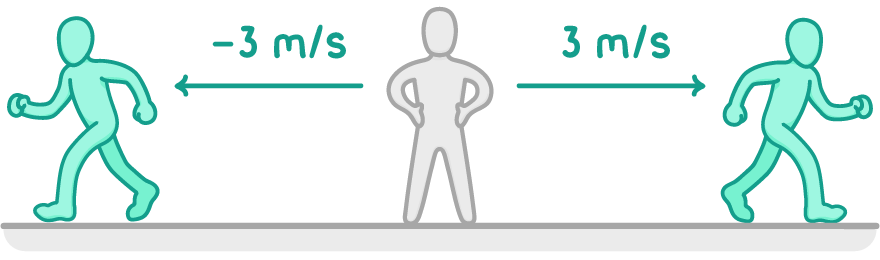
- When a vector acts along a line, one direction is chosen as positive and the opposite direction as negative.
- A velocity of 3 m/s in one direction is -3 m/s in the opposite direction (the speed is 3 m/s in both cases).
- A 10 N force in one direction is -10 N in the opposite direction.
TermDefinition
Scalar quantityA quantity that has magnitude (size) only, with no direction.
Vector quantityA quantity that has both magnitude (size) and direction.
DisplacementThe straight-line distance from a starting point to a finishing point, together with its direction.
Key points to remember
How were these notes?