4.10 - Fossil Fuels & Nuclear Energy
Fossil fuels and nuclear fuel are non-renewable
- Non-renewable energy resources are used up far faster than nature can replace them, so they'll eventually run out.
- There are two kinds: fossil fuels and nuclear fuel.
Fossil fuels
- The three main fossil fuels are coal, oil, and (natural) gas.
- They formed underground over millions of years from the buried remains of living things.
- They're burnt to release the energy they hold.
Nuclear fuels
- The nuclear fuels are uranium and plutonium.
- Their energy is released by a nuclear reaction rather than by burning.
Shared features
- They're reliable sources of energy.
- They'll all run out one day.
- They damage the environment when used.
How power stations generate electricity
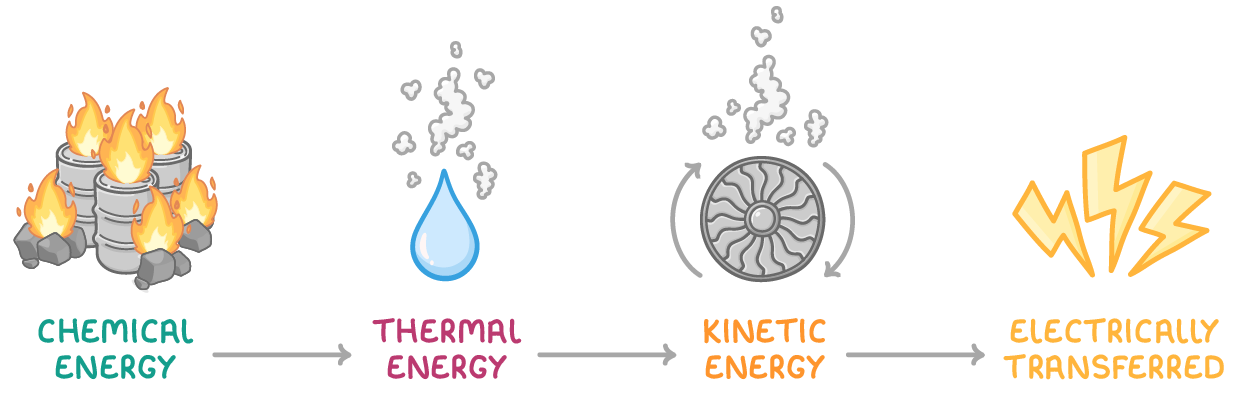
Most electricity is generated in power stations where a fuel heats water into steam, the steam turns a turbine, and the turbine drives a generator.
A fossil fuel power station
- The fuel is burnt. Energy is transferred from the chemical store of the fuel by heating.
- This heats water in a boiler until it boils into steam (gaining energy in its thermal store).
- The steam turns a turbine, transferring energy to the turbine's kinetic store.
- The spinning turbine turns a generator, which transfers energy away electrically through the national grid.
A nuclear power station
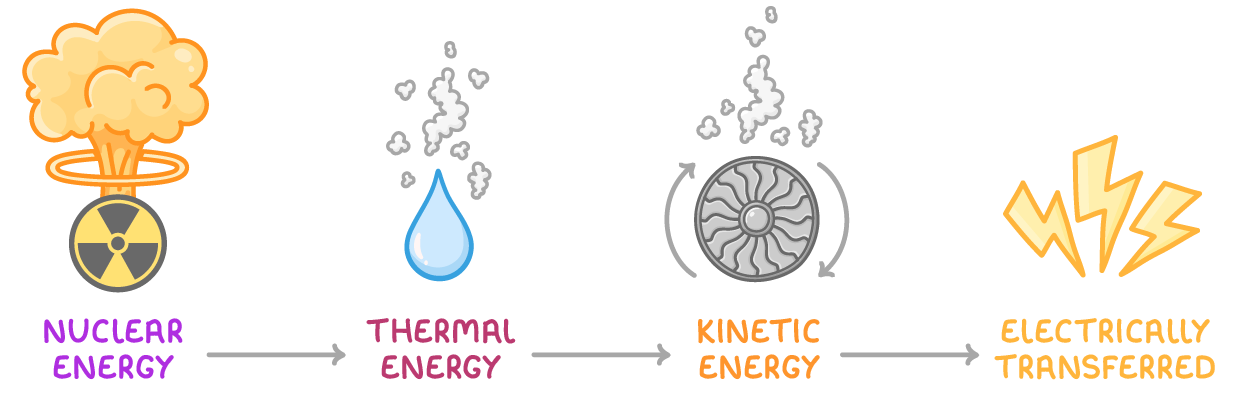
- Works the same way as a fossil fuel station, but the heat to make steam comes from a nuclear reaction rather than burning.
- In the reactor, nuclear fuel such as uranium splits in a process called nuclear fission, releasing a large amount of energy.
- The energy starts in the nuclear store of the fuel rather than a chemical store.
Weighing up nuclear power
In its favour
- Very reliable, and reduces reliance on fossil fuels.
- Does not release CO2 or sulfur dioxide while generating electricity.
- Releases a huge amount of energy from a small amount of fuel.
- There are still large reserves of uranium available.
Against it
- Radioactive waste - Stays dangerously radioactive for thousands of years and must be stored securely to prevent leaks into the environment.
- Risk of major accidents - Accidents (such as Chernobyl and Fukushima) can release radioactive material over large areas, making them uninhabitable for decades.
- High cost - Building and decommissioning nuclear power stations is extremely expensive and takes many years.
- Public perception - Concerns over safety and waste storage mean public opposition to new stations is often strong.
Nuclear fusion as a possible energy source
- Nuclear fusion occurs when two light nuclei collide at high speed and join to form a single heavier nucleus (e.g. hydrogen nuclei fusing into helium).
- The heavier nucleus has slightly less mass than the starting nuclei. The lost mass is converted into energy, which is released.
- Fusion is the process that powers stars, including the Sun.
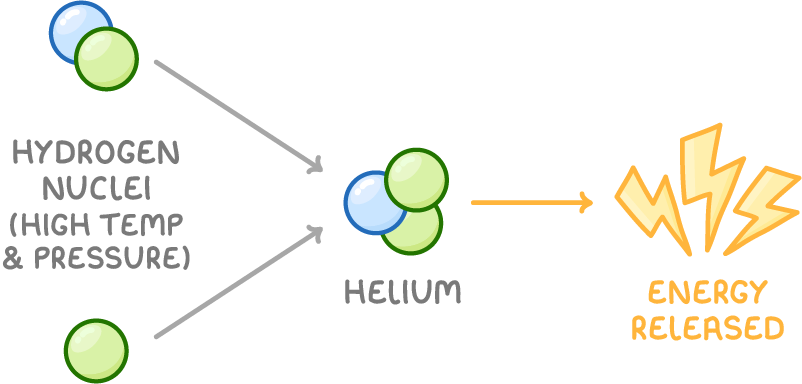
Compared with fission, fusion:
- Releases more energy per kilogram of fuel
- Produces very little radioactive waste
- Uses fuels that are abundant and easy to obtain (such as isotopes of hydrogen)
The challenges
- Fusion requires extremely high temperatures and pressures (around 10,000,000 °C).
- Positively charged nuclei repel each other (electrostatic repulsion). High temperatures give the nuclei enough kinetic energy to overcome this repulsion and fuse, and high pressures pack the nuclei closely together so that they collide often.
- No material can withstand these temperatures without vaporising, making reactors difficult and expensive to design.
- Experimental reactors currently use more energy to maintain the required conditions than the fusion reactions produce.
TermDefinition
Non-renewable energy resourceAn energy resource that is used up faster than it can be replaced, so it will eventually run out.
Fossil fuelA store of carbon formed over millions of years from dead organisms buried without oxygen. Coal, oil and natural gas are fossil fuels.
Nuclear fissionThe splitting of a large, unstable nucleus into two smaller nuclei, releasing energy.
Nuclear fusionThe joining of two light nuclei to form a heavier nucleus, releasing energy.
Key points to remember
How were these notes?