3.6 - Ultrasound
What ultrasound is
- Ultrasound is sound with a frequency higher than 20,000 Hz (20 kHz).
- This is above the upper limit of human hearing, so people can't hear ultrasound.
- Ultrasound can be produced electronically: an electrical oscillator generates oscillations at the required frequency, which are converted into mechanical vibrations to create the sound wave.
Partial reflection and ultrasound echoes
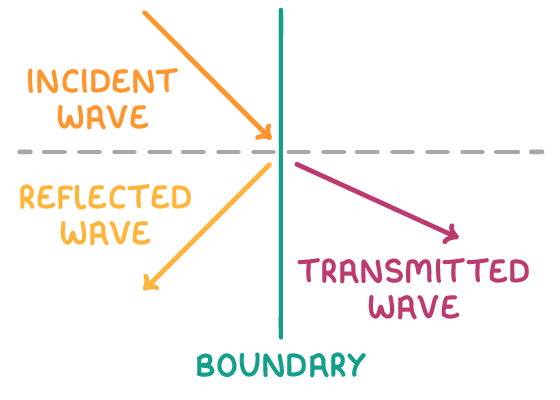
When a wave reaches a boundary between two different media, part of it is transmitted and part of it is reflected back. This is called partial reflection.
Using echoes to find a boundary
- A short pulse of ultrasound is sent into a material where the wave's speed is known.
- Measuring the time it takes for the reflection to return allows the distance to the boundary to be calculated using:
Distance = speed × time
Uses of ultrasound
Medical imaging
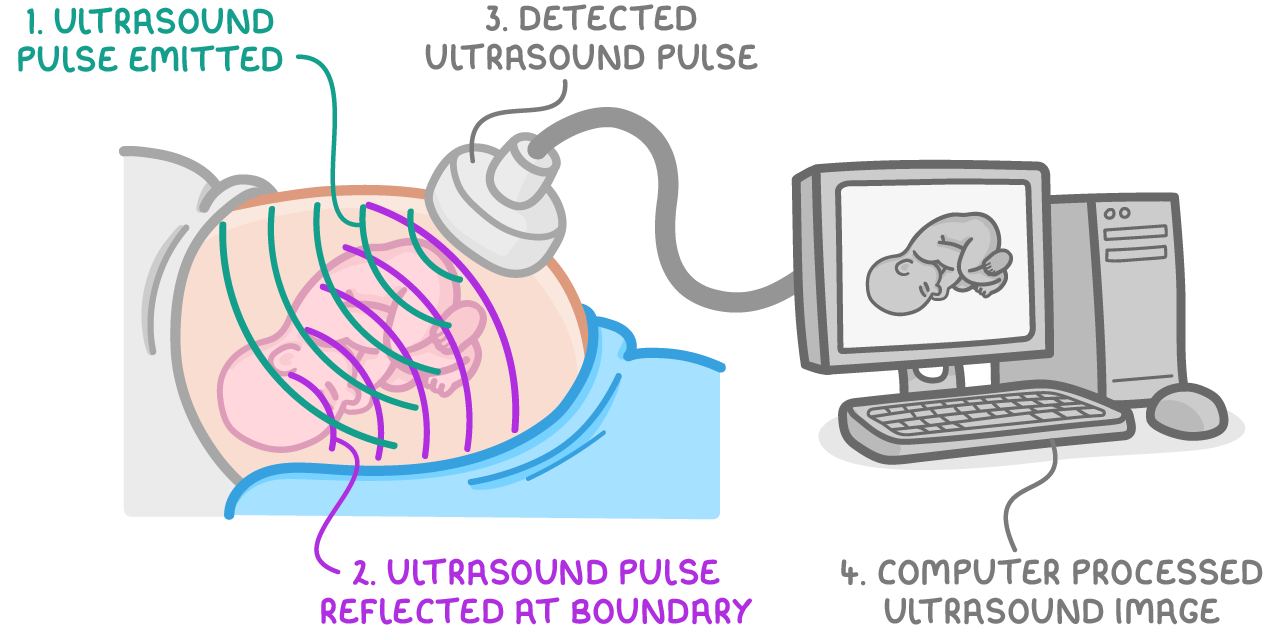
- Ultrasound passes through the body, but at every boundary between two different tissues (e.g. between fluid in the womb and the skin of a foetus), some of the wave is reflected back and detected.
- A computer processes the timing and distribution of these echoes to produce an image of internal structures or a developing foetus.
- Also used to examine soft tissues and organs (kidneys, liver, bladder).
- Safer than X-rays because it doesn't use ionising radiation.
Industrial flaw detection
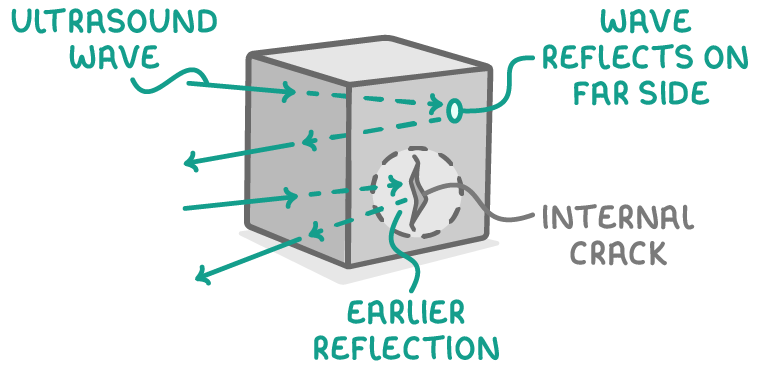
- Ultrasound entering a material is usually reflected by the far side. A flaw such as an internal crack reflects the wave sooner.
- Used to detect flaws in pipes, railway tracks, and metal castings without cutting them open.
Echo sounding and sonar
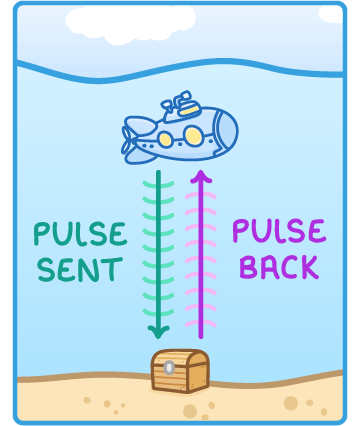
- Used by boats and submarines to find water depth or locate objects in deep water.
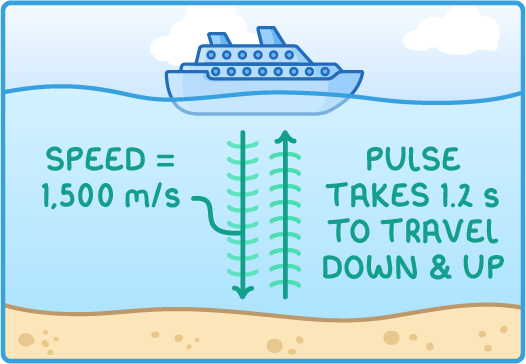
- A pulse of ultrasound sent into the water reflects off the seabed or an object, and the time taken for the reflection to return gives the distance.
Worked example - Depth from an ultrasound echo
A pulse of ultrasound takes 1.2 s to travel from a ship on the surface down to the seabed and back up to a detector on the ship. The speed of sound in seawater is 1,500 m/s. How deep is the seabed below the ship?
Step 1 - Find the total distance the pulse travels
The pulse travels at a known speed for the measured time, so use distance = speed × time.
Distance = 1,500 × 1.2 = 1,800 m
Step 2 - Halve the total distance
The 1.2 s is the time for the pulse to travel down to the seabed and back, so the pulse covers the depth twice. The depth is half the total distance.
Depth = 1,800 ÷ 2 = 900 m
The seabed is 900 m below the ship.
TermDefinition
UltrasoundSound with a frequency higher than 20,000 Hz, which is above the limit of human hearing.
Partial reflectionThe process where part of a wave is transmitted and part is reflected when it reaches a boundary between two media.
Key points to remember
How were these notes?