5.3 - Red Shift
Red-shift in light from distant galaxies
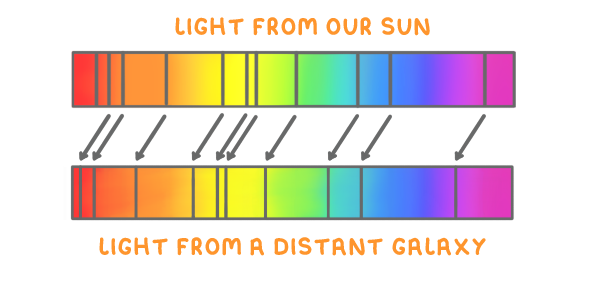
- Every element absorbs its own set of wavelengths of light, producing a fixed pattern of dark lines across a spectrum.
- In light from distant galaxies, these familiar line patterns are shifted towards the red end of the spectrum (longer wavelengths) compared to laboratory measurements.
- This increase in the observed wavelength of light from a galaxy is called red-shift.
What red-shift tells us
- A longer observed wavelength means the source of the light is moving away from us.
- Red-shift is seen in light from galaxies in every direction, showing that distant galaxies are receding from us.
- Red-shift from more distant galaxies is greater than from nearer ones, meaning the more distant a galaxy, the faster it's moving away.
Red-shift is evidence the universe is expanding
- Distant galaxies are receding in every direction, and the further away a galaxy is, the faster it's moving away.
- This is evidence that the whole universe is expanding.
Space itself is stretching
- The expansion happens because space itself is stretching, rather than galaxies flying through fixed space.
- As light travels across expanding space, it's stretched to a longer wavelength.
- Light that has travelled further has crossed more expanding space, which is why more distant galaxies show a greater red-shift.
The balloon model
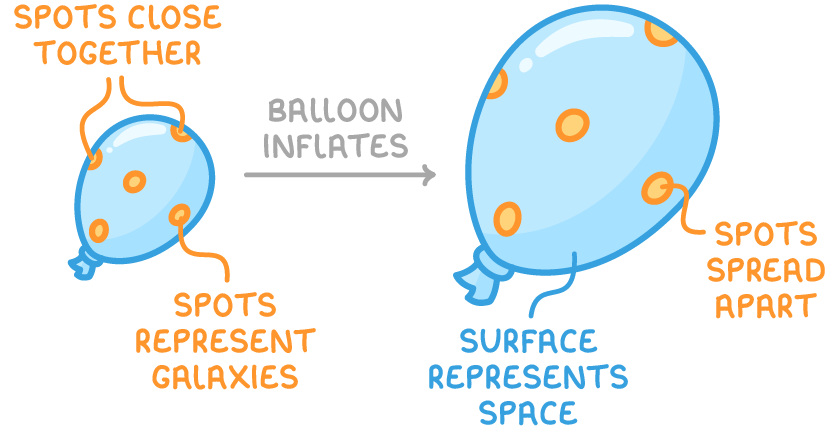
- As a balloon with spots drawn on it is inflated, every spot moves away from every other spot, and spots that start further apart separate the fastest.
- The surface represents space and each spot represents a galaxy.
- This expansion supports the idea that the universe began from a single hot, dense point.
The Doppler effect
- When a wave source moves relative to an observer, the observed wavelength and frequency change.
- This is called the Doppler effect, and it happens for all waves, including light and sound.
Why the wavelength changes
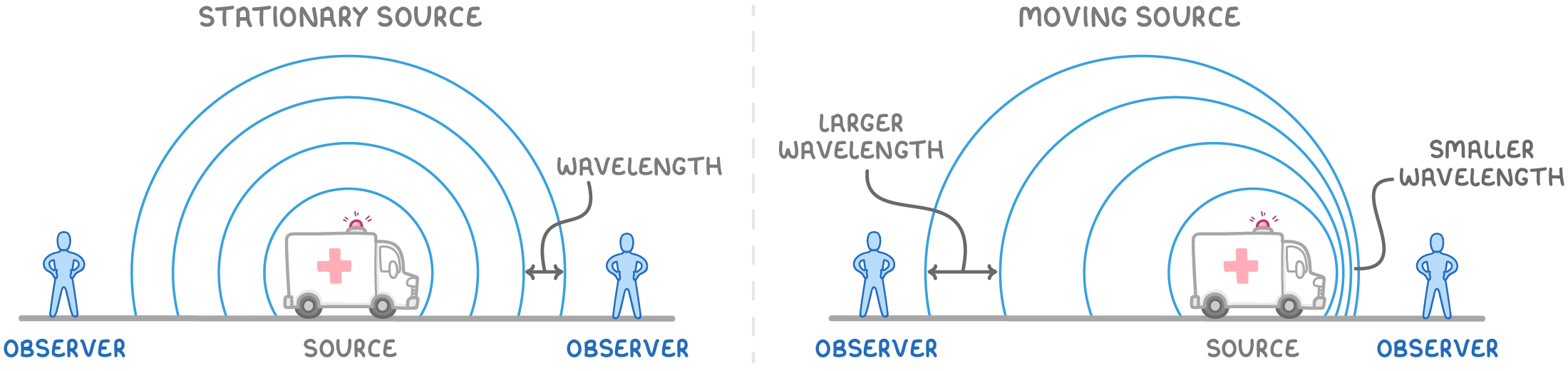
- The wave speed stays constant, so motion of the source changes the spacing of the wavefronts:
- Ahead of the source - Wavefronts are bunched together, giving a shorter wavelength and higher frequency.
- Behind the source - Wavefronts are spread out, giving a longer wavelength and lower frequency.
- For example, a passing siren sounds higher-pitched as it approaches and lower-pitched as it moves away.
The Doppler effect for light
- An object moving away from an observer has its light shifted to a longer wavelength and lower frequency - towards the red end of the spectrum (red-shift).
- An object moving towards an observer has its light shifted to a shorter wavelength and higher frequency - towards the blue end of the spectrum (blue-shift).
TermDefinition
Red-shiftThe increase in the observed wavelength of light from a distant galaxy or a source moving away.
Doppler effectThe change in the observed wavelength and frequency of a wave when its source moves relative to an observer.
Blue-shiftThe shift of light to a shorter wavelength and higher frequency when a source moves towards an observer.
Key points to remember
How were these notes?