3.18 - Microwaves & Infrared
Satellite communication with microwaves and radio waves
- Communication to and from satellites - including satellite TV and satellite phones - uses waves that pass easily through the Earth's watery atmosphere.
- These are usually microwaves, though sometimes relatively high-frequency radio waves are used.
- Some lower-frequency radio waves would be reflected back by the upper atmosphere.
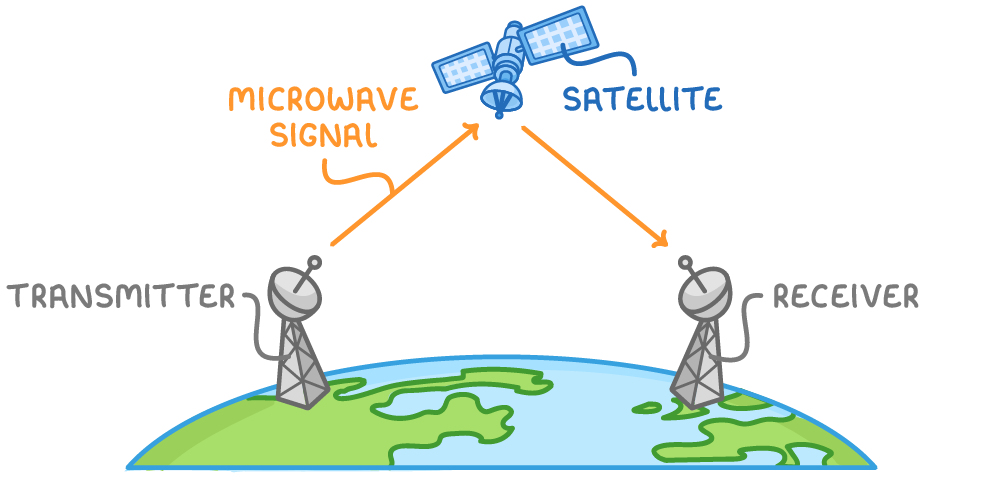
The path of a satellite TV signal
- A transmitter on the ground sends the signal up into space.
- A satellite orbiting thousands of kilometres above the Earth picks up the signal.
- The satellite transmits it back down to Earth, in a different direction.
- A satellite dish on the ground receives it.
Because the signal travels such a long distance up and back, there's a slight time delay between it being sent and received. Mobile phone calls and satellite navigation (GPS) signals also reach the ground as microwaves.
Microwave ovens cook food
Microwave ovens cook food using microwaves, which are absorbed by the water molecules in the food.
How the heating happens
- The microwaves penetrate up to a few centimetres into the food before being absorbed.
- The energy they carry is transferred to the water molecules, making them heat up.
- These hot water molecules transfer energy to the rest of the food by heating, which quickly cooks it.
The microwaves used in ovens have a different wavelength from those used for satellite communication.
Infrared is used to monitor and to raise temperature
Infrared (IR) radiation is given out by all objects, and the hotter an object is, the more infrared it gives out.
Monitoring temperature
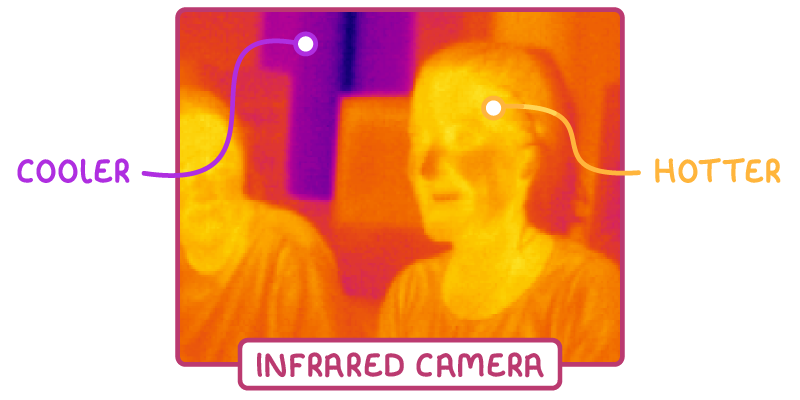
- An infrared camera detects the infrared coming from an object and turns it into an electrical signal, shown on a screen as a picture.
- The hotter a part is, the brighter it appears - different colours represent different amounts of infrared. This is called thermal imaging.
- Uses include:
- Police spotting suspects hiding in the dark
- Showing where a building is losing heat
- Infrared security sensors that set off an alarm or switch on a light when they detect a change in infrared
Raising temperature
- When an object absorbs infrared, it gets hotter.
- Cooking food - Its temperature rises as it absorbs infrared, e.g. from the heating element of a toaster or grill.
- Electric heaters - A long wire heats up as current flows through it and emits infrared (plus a little visible light, so it glows), which transfers energy to the surroundings.
Infrared and light transfer information
Both infrared and visible light are used to carry information, over short distances and over very long ones.
Short-range links
- Information is encoded as pulses of infrared sent between an emitter and a receiver.
- The devices must be fairly close and the receiver must be in the emitter's line of sight.
- Examples: a TV remote control (a small bulb emits infrared the TV detects) and sending files wirelessly between phones or laptops.
Optical fibres
-
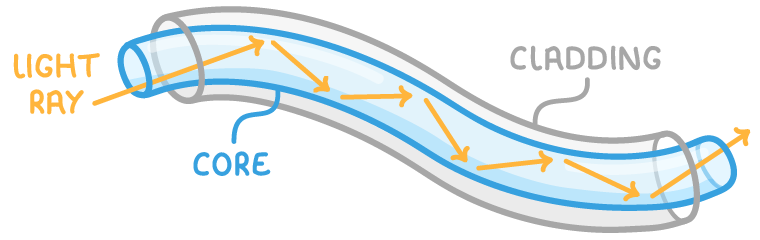
For long distances, data is sent as pulses of infrared or light through optical fibres - thin strands of glass or plastic.
-
A pulse enters at a shallow angle and is reflected again and again off the boundary between the narrow core and the cladding around it, until it emerges at the far end. This is called total internal reflection. It happens because the angle of incidence at the boundary is greater than the critical angle.
-
A single wavelength is usually used so the pulses stay sharp and information isn't lost.
-
Optical fibres carry telephone and broadband internet signals.
-
In medicine, they're used in endoscopes to see inside the body through a small hole, avoiding major surgery.
- An endoscope uses non-ionising visible light, whereas a CT scan builds a 3D image using ionising X-rays - so an endoscopic examination exposes the patient to less harmful radiation than a CT scan.