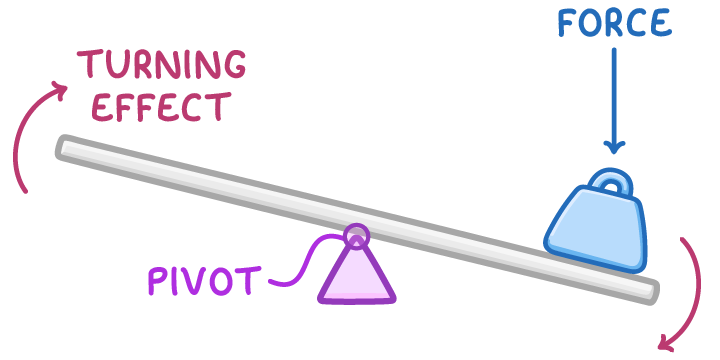
6.7 - Moments - The Turning Effect
A moment is the turning effect of a force
- When a force acts on an object that can turn about a fixed point (the pivot), it produces a turning effect called the moment of the force.
- Everyday examples include pushing a door open, loosening a nut with a spanner, and using a wheelbarrow.
Formula for the moment of a force
Where:
- = Moment of the force, in newton metres (Nm)
- = Force, in newtons (N)
- = Perpendicular distance from the pivot to the line of action of the force, in metres (m)
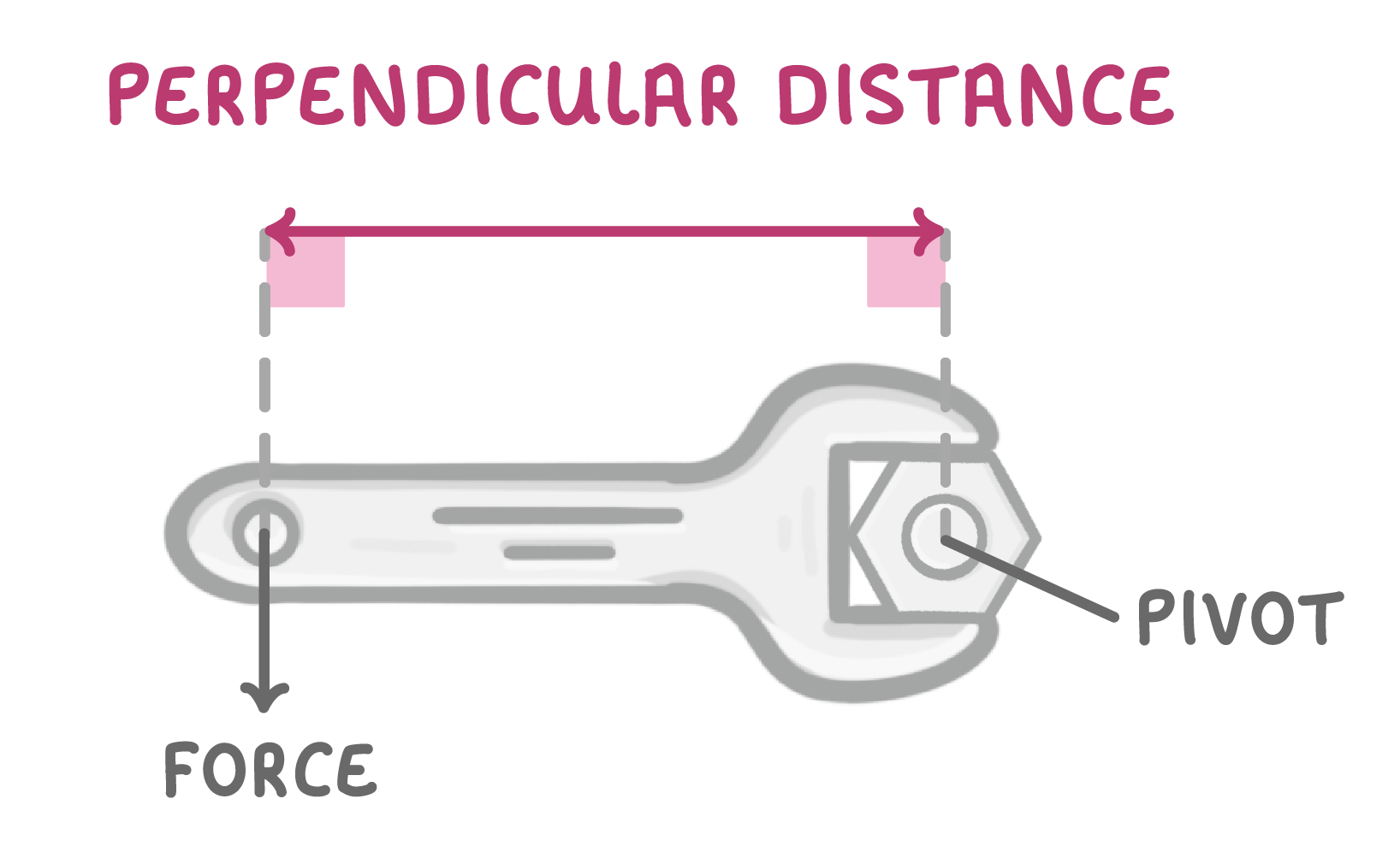
What changes the size of a moment
- Larger force - Increases the moment.
- Greater distance from the pivot - Increases the moment.
- Angle of the force - Applying the force at right angles (90°) gives the largest moment. Any other angle reduces the perpendicular distance to the pivot.
Moments have a direction
A moment turns an object either clockwise or anticlockwise, depending on the direction of the force and which side of the pivot it acts on.
Worked example - Moment of a force on a nut
A spanner is used to undo a tight nut. A force of 50 N is applied to the spanner at a perpendicular distance of 0.3 m from the nut, which acts as the pivot. What is the moment of the force on the nut?
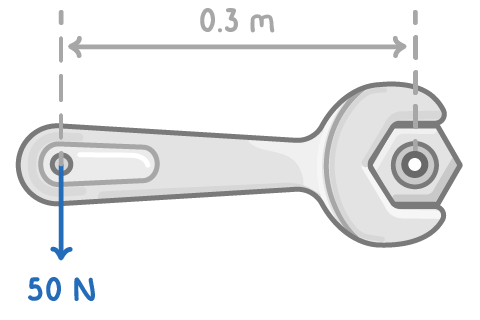
Step 1 - Write down the values
- Force, N
- Perpendicular distance, m
Step 2 - Formula
Step 3 - Substitution and calculation
The moment of the force on the nut is 15 Nm.
The principle of moments
- An object that can turn about a pivot is balanced (in rotational equilibrium) when the turning effects on each side cancel out.
- Principle of moments - When an object is balanced:
Total clockwise moment = total anticlockwise moment
If the clockwise and anticlockwise moments are not equal, there's a resultant moment and the object turns.
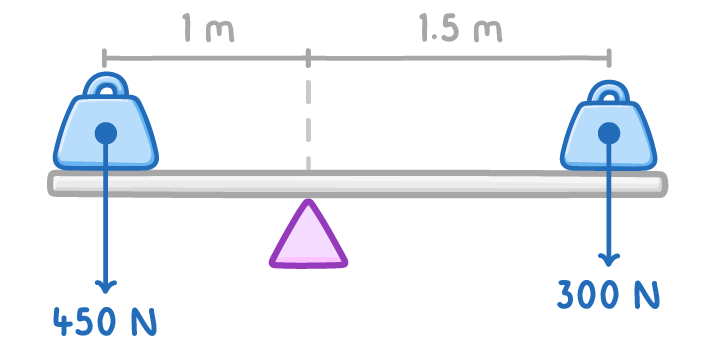
Worked example - Tension in a supporting rope
A uniform wooden beam 10 m long and weighing 1,600 N rests horizontally on a support 2 m from one end. A rope is attached vertically to the other end and holds the beam so that it balances. What is the tension in the rope?
The support acts as the pivot. The weight acts downwards at the centre of mass (the middle of the beam); the rope tension acts upwards at the far end.
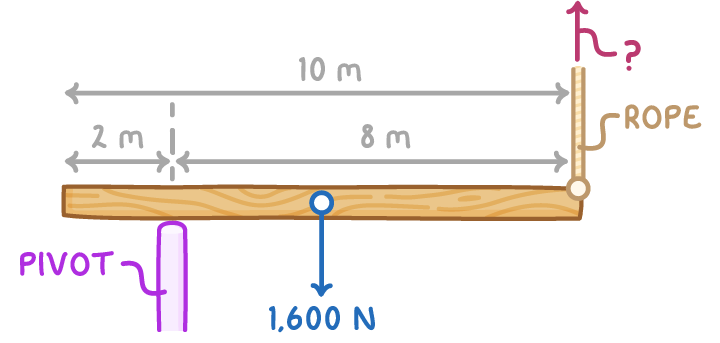
Step 1 - Find the perpendicular distances from the pivot
- Centre of mass is at the middle of the 10 m beam - 5 m from each end. The pivot is 2 m from one end, so the weight acts 5 - 2 = 3 m from the pivot.
- The rope is at the far end, 10 - 2 = 8 m from the pivot.
Step 2 - Apply the principle of moments
Step 3 - Rearrange and solve for T
The tension in the rope is 600 N.
Levers make it easier to do work
- A lever is a rigid bar that turns about a pivot.
- Levers act as force multipliers: since , increasing the distance from the pivot means a smaller force can produce the same turning effect.
- This is why a long spanner loosens a stiff nut more easily than a short one, and why a long crowbar can lift heavy loads.