1.7 - Mass & Weight
Weight and mass are not the same
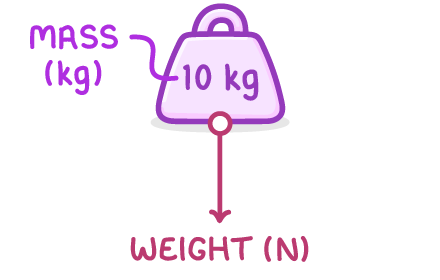
- Mass - The amount of matter in an object. Measured in kilograms (kg). Mass doesn't depend on location, so an object has the same mass anywhere in the universe. It's a scalar quantity.
- Weight - The force acting on an object due to gravity. Weight is a force, so it's measured in newtons (N) using a calibrated spring balance (a newtonmeter).
- Weight acts as though it's concentrated at a single point on the object, called the centre of mass.
Why weight changes with location
- Weight depends on the gravitational field strength where the object is.
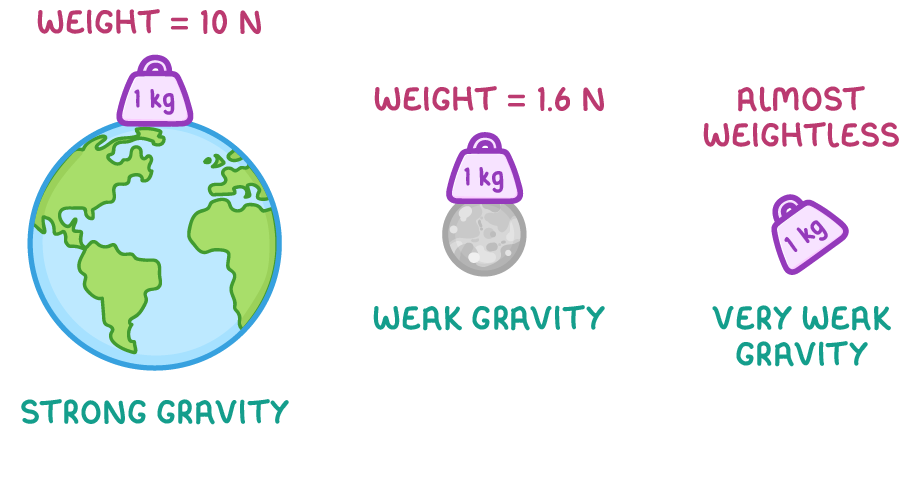
- An object has different weights in different places, even though its mass never changes.
- A 1 kg mass weighs about 10 N on Earth but only about 1.6 N on the Moon, because the Moon's gravitational field strength is smaller.
Formula for weight
Where:
- = Weight, in newtons (N)
- = Mass, in kilograms (kg)
- = Gravitational field strength, in newtons per kilogram (N/kg)
Values of g
- On Earth, is about 10 N/kg - always use the value given in the question.
- On the Moon, is about 1.6 N/kg, and it's different again on other planets.
- Weight and mass are directly proportional () for a given gravitational field strength.
Worked example - Weight of a suitcase
A 6.0 kg suitcase is on Earth, where the gravitational field strength is 10 N/kg. Calculate its weight.
Step 1 - Formula
Step 2 - Substitution and calculation
Step 3 - Interpretation
Taken to the Moon ( = 1.6 N/kg), the same suitcase would weigh 6.0 × 1.6 = 9.6 N. Its mass stays 6.0 kg in both places; only the weight changes, because is different.
TermDefinition
MassThe amount of matter in an object, measured in kilograms.
WeightThe force acting on an object due to gravity, measured in newtons.
Centre of massThe point through which the whole weight of an object can be thought of as acting. It is also called the centre of gravity.
Key points to remember
How were these notes?