8.13 - Transformer Calculation
The transformer turns-ratio equation
- A transformer changes the size of an alternating potential difference.
- The ratio of the potential differences across the two coils equals the ratio of the numbers of turns of wire on them.
Formula for the transformer turns ratio
Where:
- = Potential difference across the primary coil, in volts (V)
- = Potential difference across the secondary coil, in volts (V)
- = Number of turns on the primary coil
- = Number of turns on the secondary coil
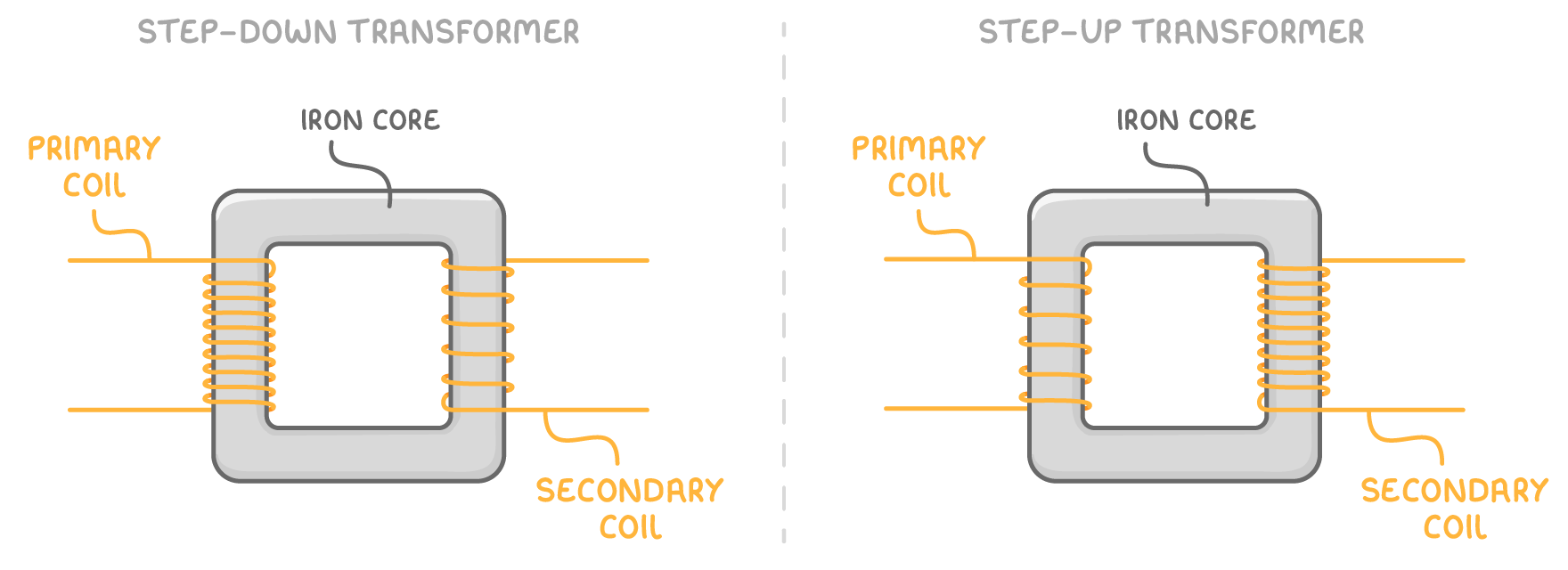
The primary coil is the input coil; the secondary coil is the output coil.
Step-up and step-down transformers
- Step-up transformer - More turns on the secondary coil than the primary (), so potential difference is increased ().
- Step-down transformer - Fewer turns on the secondary coil than the primary (), so potential difference is decreased ().
Worked example - Output voltage of a step-down transformer
A step-down transformer has 1,200 turns on its primary coil and 300 turns on its secondary coil. The input potential difference across the primary coil is 240 V. Calculate the output potential difference across the secondary coil.
Step 1 - Write the equation with the unknown on top
Step 2 - Rearrange to make Vs the subject
Step 3 - Substitute and calculate
The output potential difference is 60 V.
The transformer power equation
If a transformer is assumed to be 100% efficient, the input power equals the output power:
Input power = output power
Because power is , this gives the transformer power equation.
Formula for transformer power
Where:
- = Potential difference across the primary coil, in volts (V)
- = Current through the primary coil, in amperes (A)
- = Potential difference across the secondary coil, in volts (V)
- = Current through the secondary coil, in amperes (A)
What this means for current
Because total power stays the same:
- A step-up transformer increases potential difference and decreases current.
- A step-down transformer decreases potential difference and increases current.
Worked example - Primary potential difference from power
A transformer has a potential difference of 12 V and a current of 8 A in its secondary coil. The current in the primary coil is 2 A. Assuming the transformer is 100% efficient, calculate the potential difference across the primary coil.
Step 1 - Write the power equation
Step 2 - Rearrange to make Vp the subject
Step 3 - Substitute and calculate
The potential difference across the primary coil is 48 V.
Using the transformer equations for the National Grid
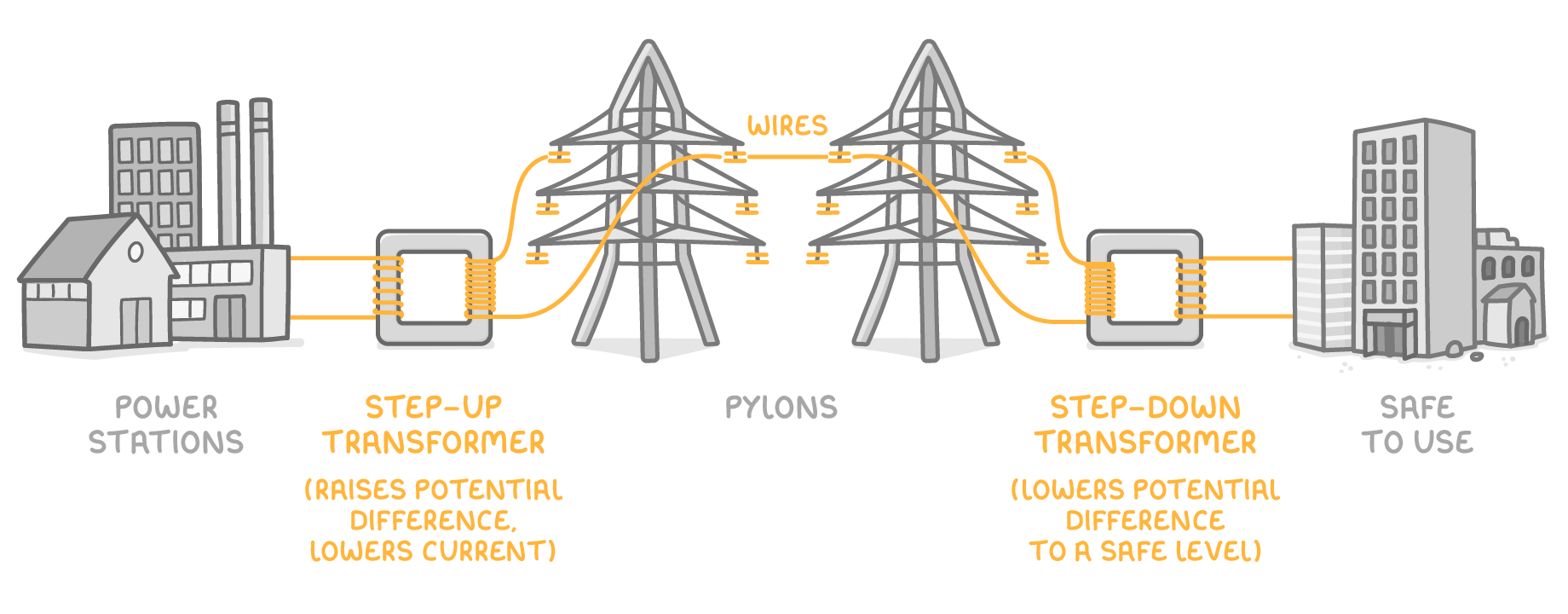
The National Grid transmits electrical power at a very high potential difference and low current to minimise energy loss.
How transformers are used
- Step-up transformers at power stations increase the potential difference, which decreases the current ().
- Lower current means less energy is wasted as heat in the transmission cables, because power wasted depends on current squared ().
- Step-down transformers near consumers decrease the potential difference to safe, usable levels.