8.2 - Static Electricity - Uses & Dangers
Useful applications of static electricity
Electrostatic sprayers
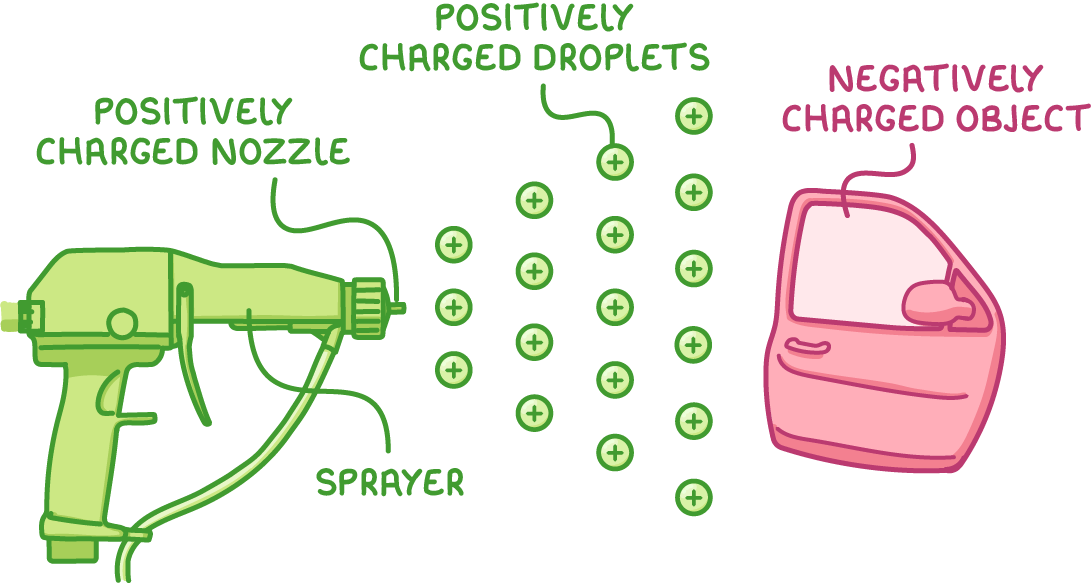
- Used to give a fine, even coat of paint or insecticide.
- The spray gun is charged, so all the droplets leaving it carry the same type of charge.
- Like charges repel, so the droplets push apart and spread into a fine, even mist.
How each type works:
- Painting - The object is given the opposite charge to the gun, so the charged droplets are attracted to it. This gives an even coat with little paint wasted, and coats hard-to-reach areas pointing away from the gun.
- Insecticide - Crops become charged by induction as the charged droplets approach, so they attract the spray.
Other uses
- Precipitators - Static electricity removes dust and smoke particles from industrial chimneys, cleaning the gases before they leave.
- Photocopiers - Static electricity copies an image onto a charged plate before transferring it onto paper.
Dangers of static electricity
A build-up of static charge can be dangerous when the charge suddenly discharges as a spark.
Where the dangers occur
- Refuelling - As fuel flows through a pipe into a car, tanker, or aircraft, friction makes static charge build up. A spark can ignite the fuel vapour and cause an explosion.
- Static on aircraft - Friction with the air charges the aircraft as it flies, which can interfere with communication equipment.
- Lightning - Inside a storm cloud, raindrops and ice bump together, leaving the top of the cloud positively charged and the bottom negatively charged. This builds up a huge potential difference, released as a giant spark.
- Shocks - Charge can build up on a person and jump as a spark to a nearby earthed conductor, giving a static shock.
Reducing the danger
These dangers are reduced by earthing the charged object, so the charge flows safely away instead of building up.
Earthing to prevent charge build-up
Dangerous sparks are prevented by earthing a charged object: connecting it to the ground through a conductor, such as a copper wire or metal strap.
How the electrons move
Because charge is carried by electrons:
- If the object is negatively charged, electrons flow down the conductor from the object to the ground.
- If the object is positively charged, electrons flow up the conductor from the ground to the object.
In both cases, the object becomes neutral. For example, fuel tankers are earthed during filling and unloading so static charge flows safely away before a spark can form.
TermDefinition
EarthingConnecting an object, such as a charged object or the metal case of an appliance, to the ground through a conductor so that charge can flow safely away.
Key points to remember
How were these notes?