25.2 - Taking Readings from Apparatus
What a reading question looks like
- Paper 5 - You read the real instrument on the bench.
- Paper 6 - You read a picture of it printed on the page, at full size or at a stated scale.
The two kinds of mark
- The value itself (1 mark) - Correct number, correct unit, and written to a sensible number of decimal places for the instrument.
- A precaution (1 or 2 marks) - A specific action taken while measuring that makes the reading closer to the true value.
A typical question
The student measures the time taken for 20 oscillations of the mass. The reading on the stop-watch is shown in Fig. 1.2. Record in Table 1.1. [1]
Reading a scale
Digital instruments
- Write down every digit shown, including trailing zeros.
- A stop-watch showing 17.76 s is recorded as 17.76 s (not 17.8 s).
- If a balance reads 250.0 g, keep the final zero to show the precision of the instrument.
Analogue instruments
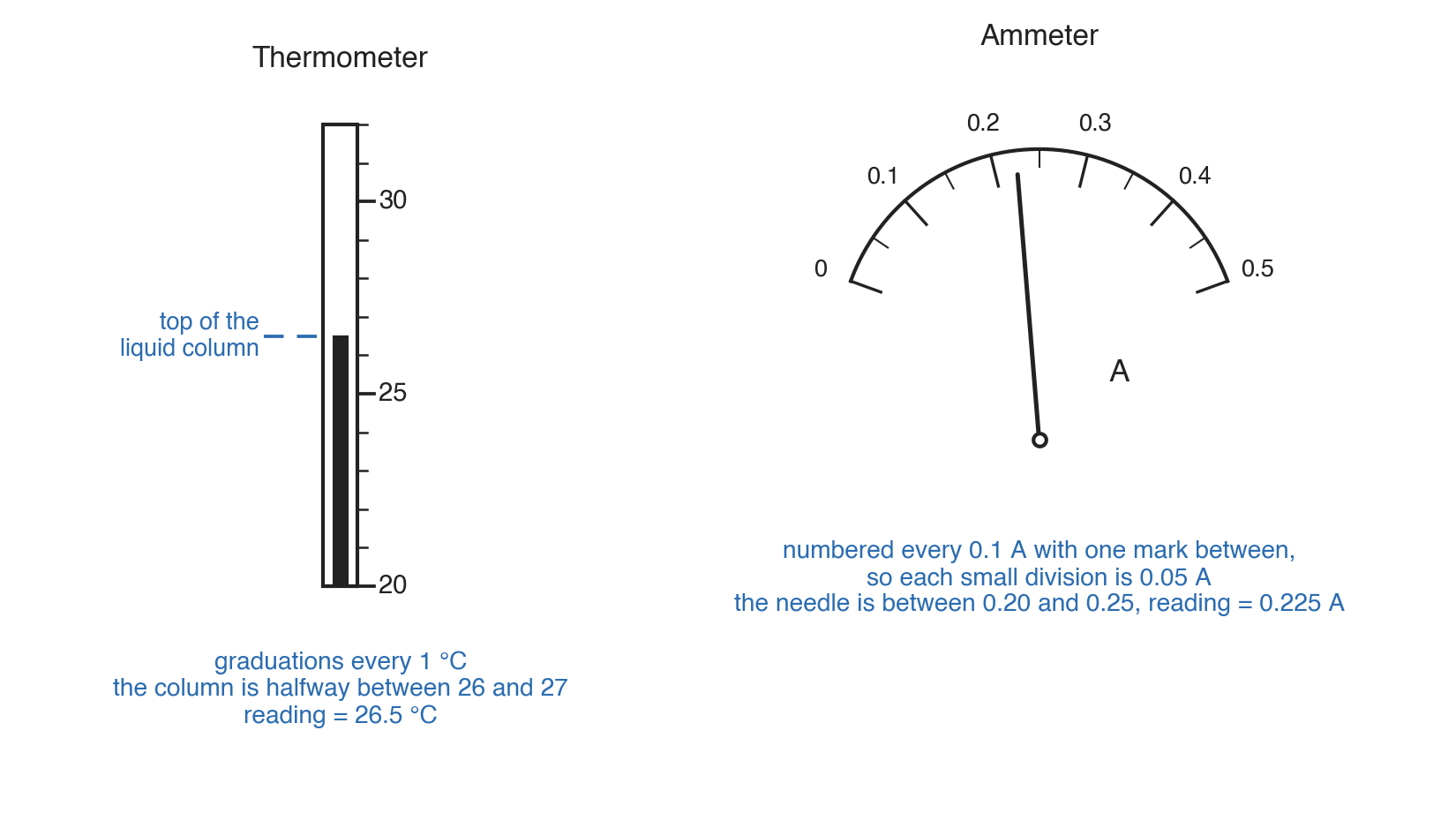
- Work out what one small division is worth - Count the small divisions between two labelled numbers and divide.
- Ruler in millimetres: ten small divisions per centimetre, so one division is 0.1 cm.
- Thermometer marked every 1 °C: one small division is 1 °C.
- Ammeter labelled every 0.2 A with four divisions between labels: one small division is 0.05 A.
- Read to the nearest half of a small division - Estimate the position of the needle or meniscus between two marks (e.g. 23.5 °C on a thermometer marked in whole degrees).
How many decimal places to write
- Match the instrument's precision, and keep it consistent down the whole column of a table.
- A metre rule in millimetres gives lengths to 0.1 cm, so seven centimetres is written 7.0 cm, not 7 cm.
Zero errors
- A zero error occurs when an instrument gives a reading when it should read zero (e.g. a force meter reading 0.2 N with no load attached).
- Two ways to deal with it:
- Adjust the instrument to zero before starting.
- Subtract the zero error from every reading.
Reading from a printed diagram
If a diagram has a scale stated (e.g. "drawn to a scale of one-quarter full size"), measure the picture with your ruler and multiply by the scale factor (e.g. multiply by 4).
Precautions that make a reading accurate
Precaution questions require a specific action taken while measuring, not a general statement about being careful.
| Instrument | Precautions that score |
|---|---|
| Thermometer | Stir the liquid before reading so it's all at the same temperature. Wait until the reading stops changing before reading. Keep the bulb clear of the sides and base of the container. View the scale at eye level. |
| Measuring cylinder | Place on a flat, horizontal surface. Read at the bottom of the meniscus. View the scale at eye level. |
| Ruler in a stand | Use a set square to line the rule up with the object. Keep the rule vertical or clamp it. View the scale at right angles. |
| Ammeter or voltmeter (needle) | View the needle at right angles to the scale. Check for a zero error before switching on. |
| Stop-watch | Time multiple oscillations or repeats and divide by the number. Start and stop at the same point in the cycle each time. |
| Optics pins and ray-tracing | Use a sharp pencil and draw thin lines. Keep pins upright. Place pins as far apart as possible. View the base of the pins. |
| Any scale | View at eye level, at right angles (perpendicular) to the scale. |
Viewing at right angles
- Looking at a scale from an angle causes parallax error, making the pointer or liquid surface appear against the wrong mark.
- Always view perpendicular (at right angles) to the scale to prevent this.
Common exam questions
Question 1
A stop-watch displays 17.76 s. How should this be recorded?
As 17.76 s, exactly as shown. Every digit the instrument gives should be written down, including the final one.
Question 2
A thermometer is graduated every 1 °C and the liquid sits exactly halfway between the 42 and 43 marks. What should be recorded?
42.5 °C. You read to the nearest half of a small division, and half of a 1 °C division is 0.5 °C.
Question 3
A length measured with a metre rule graduated in millimetres comes out at exactly nine centimetres. Why is 9 cm the wrong way to write it down?
Because the rule can be read to the nearest millimetre, so the answer should be 9.0 cm. Writing 9 cm claims the measurement was only made to the nearest centimetre and throws away the precision the instrument gave you.
Question 4
State two precautions to take when reading the volume of water in a measuring cylinder.
Read at the bottom of the meniscus, and view the scale at eye level with the water surface. Standing the cylinder on a flat horizontal surface is also accepted.
Question 5
Why should you view a scale at right angles to it?
Because looking from an angle makes the pointer or the liquid surface appear to line up with a different mark than it really does, so the reading is wrong by an amount that depends on where your head is.
Question 6
Give one precaution that makes a temperature reading more accurate.
Stir the liquid before reading, so it is all at the same temperature. Waiting until the reading stops changing, and keeping the bulb clear of the sides and base of the container, are also accepted.
Question 7
A student answers "be careful when reading the scale" for a precaution question. Why does this score nothing?
Because it does not describe anything the student would actually do. A precaution has to be a specific action tied to that instrument, such as reading at the bottom of the meniscus.
Question 8
A force meter reads 0.2 N when nothing is hanging from it. What is this called, and what are the two ways to deal with it?
A zero error. Either adjust the meter to read zero before starting, or take every reading as normal and subtract 0.2 N from each one at the end.
Question 9
A figure on the paper is captioned "drawn to a scale of one-quarter full size" and you measure a spring on it as 5.6 cm. What is the real length?
22.4 cm, because the picture is a quarter of the real size, so the measured length is multiplied by four.