5.8 - Moments - Seesaws
The principle of moments
- When an object is balanced about a pivot, it doesn't turn.
- The turning effect of a force is its moment:
where is the perpendicular distance from the pivot to the line of action of the force.
The principle of moments: for a balanced object, the total clockwise moment equals the total anticlockwise moment.
Balancing with multiple forces
- If more than one force acts on the same side of a pivot, calculate the moment of each force separately and add them together to get the total moment for that side.
- For the system to balance:
Total clockwise moment = total anticlockwise moment
Worked example - Balancing a seesaw
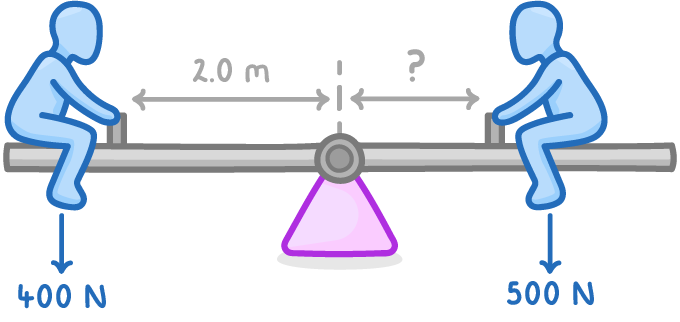
A child of weight 400 N sits 2.0 m from the pivot of a seesaw. A second child of weight 500 N sits on the other side. How far from the pivot must the second child sit for the seesaw to balance?
Step 1 - Write down the balance condition
For the seesaw to balance, the total clockwise moment equals the total anticlockwise moment:
Step 2 - Substitution
The first child gives the anticlockwise moment, the second child the clockwise moment:
Step 3 - Solve for the unknown distance
The heavier child must sit 1.6 m from the pivot - closer than the lighter child, because a larger force needs a shorter distance to give the same moment.
Parallel forces on a supported beam
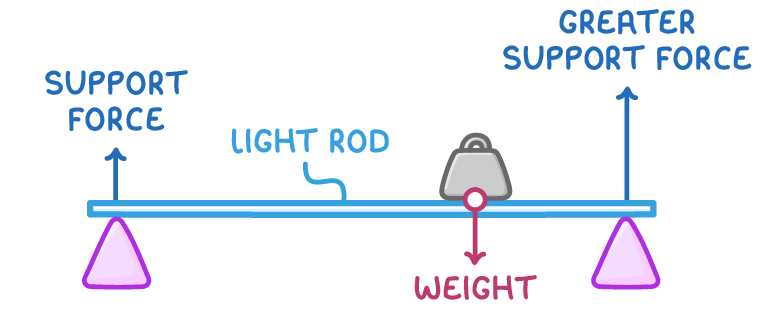
- When a beam or rod is supported at both ends, the support closer to a downward load carries the larger upward force.
- The upward forces from the supports balance the total downward force:
Total upward force = total downward force
Finding the support forces
- Take moments about one support (treating it as the pivot) to calculate the upward force at the other support.
- Subtract that force from the total downward load to find the remaining support force.
- If the beam is described as light, its own weight is ignored.
Resultant moments
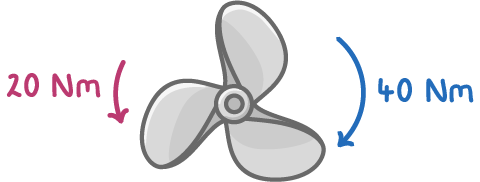
- If the clockwise and anticlockwise moments about a pivot are not equal, they don't cancel out.
- There's a resultant moment, and the object turns in the direction of the larger moment:
Resultant moment = larger moment - smaller moment