22.1 - Alpha, Beta & Gamma Radiation
Radioactive decay and the types of nuclear radiation
- Some isotopes have unstable nuclei. An unstable nucleus tends to break down, or decay, releasing radiation as it changes into a more stable arrangement.
- This process is called radioactive decay, and a substance whose nuclei decay this way is radioactive.
- A nucleus is unstable when there's an imbalance between the numbers of protons and neutrons it contains (for example, too many neutrons), or when it is too heavy.
- The radiation comes from the nucleus itself.
The three types of radiation
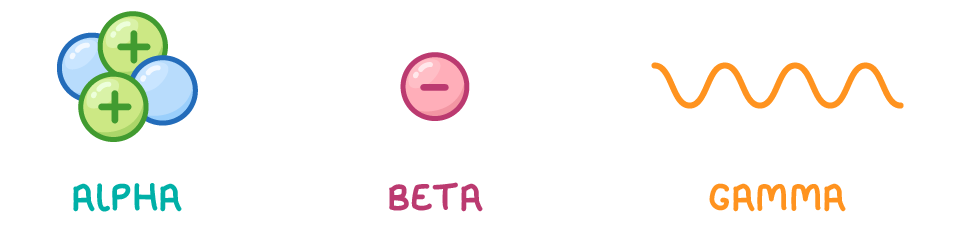
- Alpha particle (α) - Two protons and two neutrons, the same as a helium nucleus. Relative mass 4, relative charge +2. Comparatively large, heavy and slow-moving.
- Beta particle (β) - A fast-moving electron created in, and thrown out of, the nucleus when a neutron turns into a proton. Virtually no mass and a relative charge of -1. Small and travels quickly.
- Gamma ray (γ) - A high-frequency electromagnetic wave released by the nucleus. Carries away energy but has no mass and no charge.
Effect on the element
- Emitting an alpha or beta particle usually changes the nucleus into a different element.
- Gamma radiation carries only energy, so it leaves the element unchanged.
Ionising radiation and ionising power
- Ionising radiation knocks electrons off atoms it passes, turning those atoms into positively charged ions.
- Ionising power measures how readily a source does this.
What affects ionising power
How strongly a type of radiation ionises depends on its charge and its energy:
- Charge - A more highly charged particle attracts or repels an atom's electrons more strongly, so it's more likely to remove electrons.
- Energy - A particle carrying more energy can transfer more energy to an atom it collides with, making ionisation more likely.
Ionising power of each type
- Alpha - Strongly ionising. It carries much more mass and energy than beta and has the largest charge (+2), so it collides with and ionises many atoms over a short distance.
- Beta - Moderately ionising.
- Gamma - Weakly ionising. With no mass and no charge, it tends to pass straight through atoms rather than collide with them.
Penetration and range of radiation
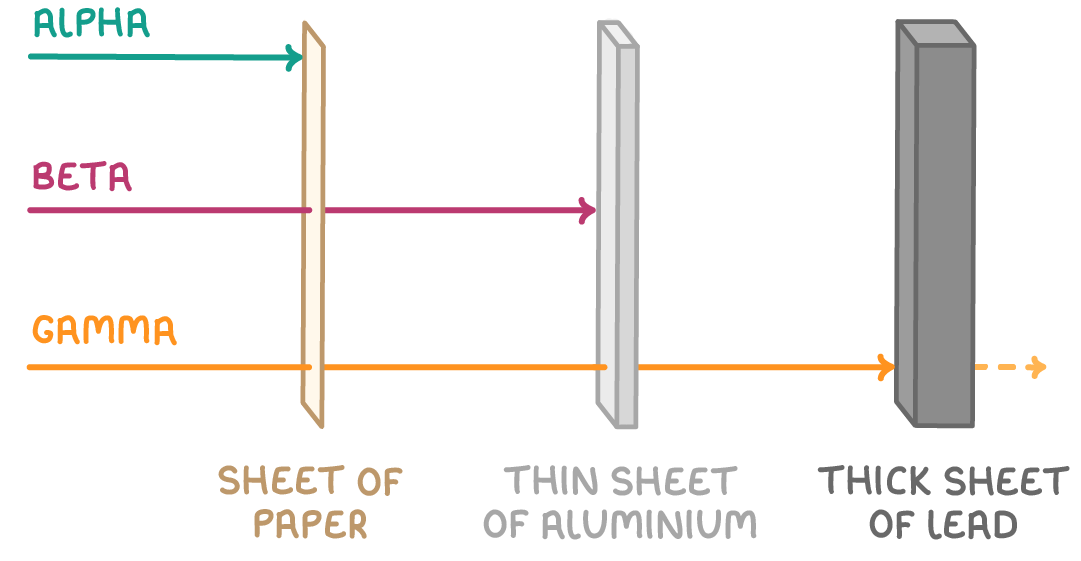
The more strongly a type of radiation ionises, the more it collides with atoms, so the shorter its range and the more easily it's absorbed.
Range and what stops each type
- Alpha - Travels only a few centimetres in air and is stopped by a sheet of paper.
- Beta - Travels up to a few metres in air and is stopped by a thin sheet of aluminium (around 5 mm thick).
- Gamma - Travels a long distance through air and is only absorbed by thick lead or metres of concrete. Gamma is never completely stopped; thick lead and concrete reduce its intensity rather than blocking it entirely.
Deflection of radiation in electric and magnetic fields
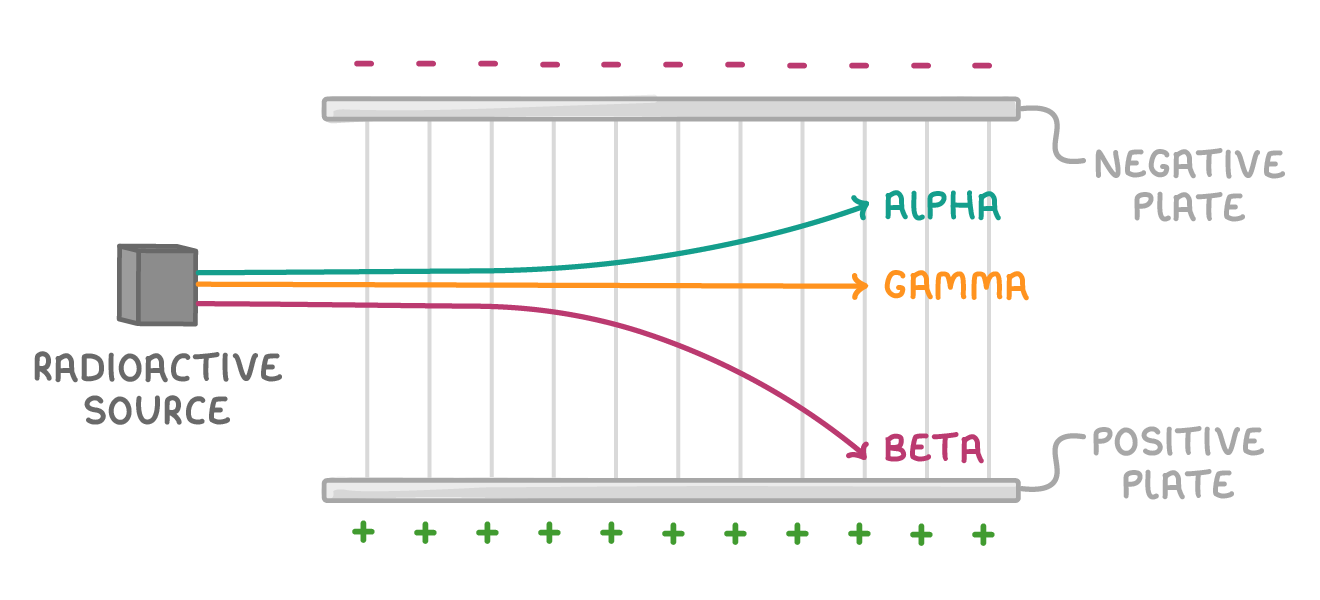
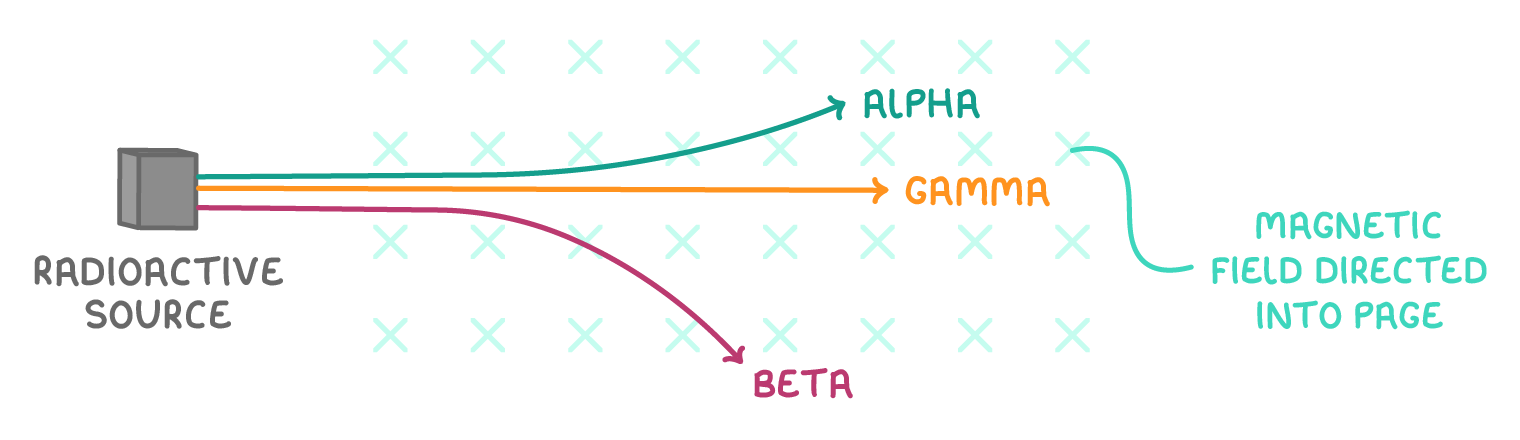
- Alpha and beta particles carry electric charge, so they feel a force in an electric or magnetic field and are deflected.
- Alpha is positive and beta is negative, so the two are deflected in opposite directions.
- Gamma rays carry no charge, so they're not deflected by either field.
In an electric field
- Between two oppositely charged plates, a beta particle is deflected towards the positive plate and an alpha particle towards the negative plate.
- Alpha is deflected less than beta because its much greater mass makes it harder to deflect.
In a magnetic field
- Alpha and beta are deflected by a magnetic field, provided they aren't travelling parallel to the field lines.
- The direction of deflection can be found using Fleming's left-hand rule, where the motion of a positive alpha particle represents the direction of conventional current.
Alpha and beta decay change the element
- Emitting an alpha or beta particle changes the number of protons in the nucleus, turning it into the nucleus of a different element.
- Gamma emission doesn't change the number of protons, so the element stays the same.
TermDefinition
Radioactive decayThe random process where an unstable nucleus breaks down and releases radiation to become more stable.
Ionising radiationRadiation that has enough energy to knock electrons out of atoms, turning them into ions.